


Did you know that a premium sateen weave can lose its structural integrity in half the time it takes for a standard T-200 percale to show wear? While guest comfort is paramount, many procurement managers find that high-thread-count linens often fail the "processability" test in high-heat industrial ironers. This leads to the premature thinning and graying that drains hospitality budgets. Finding the best hotel sheets for commercial laundry requires looking past the marketing jargon and focusing on tensile strength and industrial durability.
You're likely tired of high replacement costs and housekeeping delays caused by excessive wrinkling. We understand that your linens are a critical business asset, not just a guest amenity. This 2026 procurement guide shows you how to balance comfort with the rigorous demands of industrial laundering to maximize your ROI. We'll break down the performance differences between T-200 and T-250 blends, analyze how to lower your cost-per-use, and ensure your inventory meets the latest flammability standards to keep your facility running efficiently.
Key Takeaways
- Prioritize the "one-over, one-under" percale weave to ensure linens maintain structural integrity and breathability during high-heat industrial ironing.
- Implement 60/40 cotton-polyester blends to achieve a balance of premium guest comfort and significantly reduced drying times for better operational efficiency.
- Identify the best hotel sheets for commercial laundry by calculating the true cost-per-use, weighing initial purchase price against the total number of successful wash cycles.
- Maintain consistent inventory quality and guest satisfaction scores by sourcing standardized T200 and T250 constructions from a direct wholesale partner.
Percale vs. Sateen: Which Weave Survives Industrial Laundering?
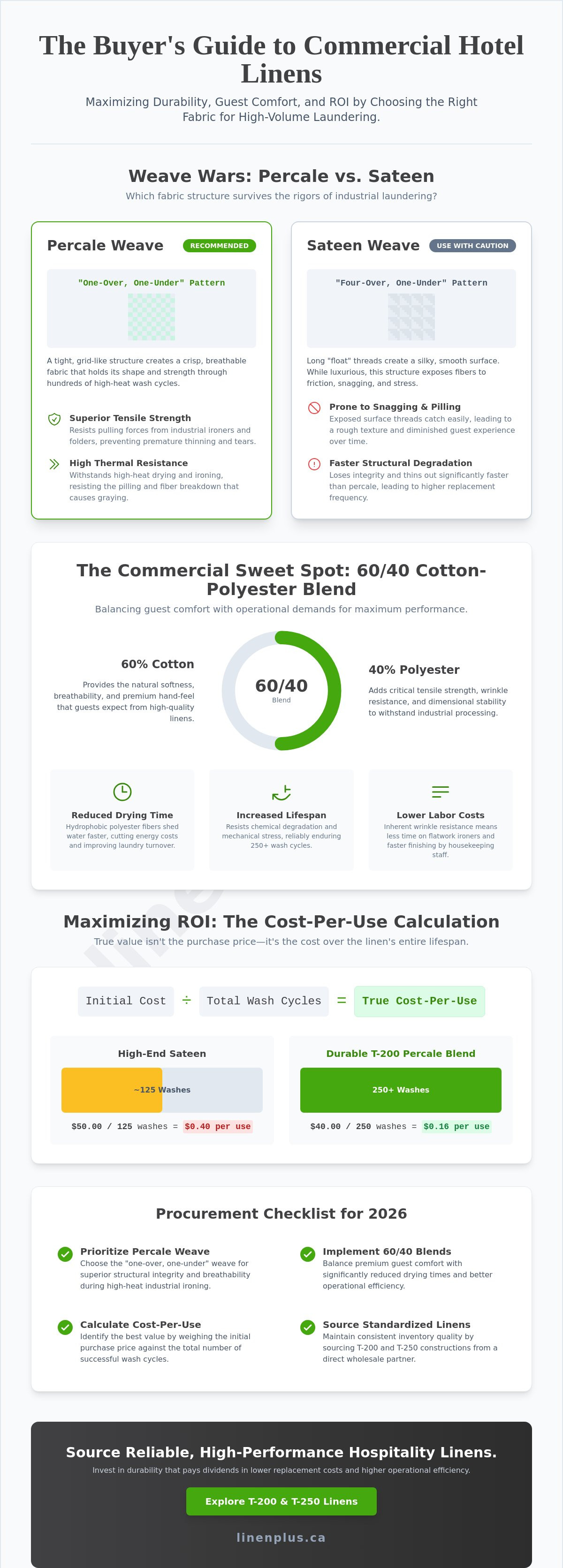
Choosing the best hotel sheets for commercial laundry requires a technical understanding of fabric construction. The two most common options, percale and sateen, react very differently to the high-pressure environment of a professional facility. A Percale weave uses a "one-over, one-under" pattern that creates a tight, grid-like structure. This result is a crisp, breathable fabric that holds its shape through hundreds of wash cycles. In contrast, a sateen weave utilizes a "four-over, one-under" pattern. This creates a silky sheen and a softer drape, but it leaves more of the thread exposed on the surface.
Tensile strength is the ability of a fabric to withstand the pulling forces of industrial ironers. In a hospitality setting, sheets are constantly subjected to mechanical stress, high-speed extraction, and automated folding. Percale's symmetrical structure provides superior resistance to these forces. Because the threads are interlocked more frequently, the fabric is less likely to distort or thin prematurely. For operations managers, this structural stability translates directly into a longer lifespan and fewer discarded units.
Thermal Stress and Shrinkage Control
Industrial dryers and flatwork ironers apply intense heat to evaporate moisture quickly. The sateen weave is particularly vulnerable here because its long "floats" are prone to snagging and friction damage. Over time, this friction leads to pilling, which ruins the guest experience. Percale's tighter, flatter surface handles thermal stress more effectively. It resists the fiber breakdown that causes graying, ensuring the sheets and pillowcases maintain a bright, professional appearance for a longer duration.
Guest Perception vs. Operational Reality
While some guests prefer the initial silkiness of sateen, it often fails the utility test required by housekeeping. T200 Percale has become the industry benchmark for mid-to-high-tier hospitality because it balances perceived luxury with extreme durability. It provides the "crisp hotel feel" that 2026 travelers associate with cleanliness. From an operational standpoint, percale is easier to process and less likely to develop the deep set-in wrinkles that increase labor costs during the finishing stage.
The Case for Cotton-Polyester Blends in Commercial Settings
While 100% cotton is often associated with high-end luxury, it frequently fails the fiscal demands of high-volume hospitality. The best hotel sheets for commercial laundry typically utilize a 60/40 or 70/30 cotton-polyester blend. This ratio ensures guests still experience the soft, breathable touch of natural fibers while the facility benefits from polyester's structural reinforcement. By integrating synthetic fibers, manufacturers create a fabric that's significantly more resilient to the mechanical agitation found in industrial washers.
Polyester fibers are naturally hydrophobic, which means they don't absorb as much water as cotton. This characteristic significantly reduces drying times during the laundry cycle, allowing for faster turnover. It also prevents the "graying" or yellowing effect that occurs when pure cotton fibers begin to break down from repeated exposure to chlorine bleach. Scientific research into the biodegradation of textile microfibers shows that synthetic blends often maintain their integrity longer under harsh chemical conditions than untreated natural fibers alone. This longevity is critical for maintaining a bright, white appearance over 250 or more wash cycles.
Need Reliable Wholesale Supplies for Your Facility?
Hotels, healthcare facilities, restaurants, and commercial operations across Canada trust Linen Plus for consistent bulk supply and commercial-grade quality.

Bulk Wholesale Pricing
Competitive pricing for large-volume procurement.

Reliable Nationwide Supply
Consistent inventory and fast shipping across Canada.

Hospitality & Healthcare Grade
Products designed for demanding commercial environments.
Reducing Housekeeping Labor Costs
Labor is the largest line item in most hotel operations. Blended fabrics offer a distinct wrinkle-resistant advantage that pure cotton cannot match. Because the polyester core holds its shape, sheets require less time on the flatwork ironer to achieve a crisp finish. Shorter dryer cycles don't just save time; they provide measurable energy savings. Reducing cycle times by even 10% can lead to substantial utility cost reductions across a large-scale property. These efficiencies allow housekeeping teams to focus on room readiness rather than battling stubborn fabric creases.
T-200 vs. T-250: Finding the Commercial "Sweet Spot"
Choosing between T-200 and T-250 involves weighing guest expectations against processability. T-200 percale remains the workhorse of the industry due to its high airflow and lighter weight. However, many mid-tier and boutique hotels are moving toward T-250 sateen blends for a smoother hand-feel. You can explore various T200 and T250 sheets and pillowcases to see which construction aligns with your brand standards. T-250 options provide a premium upgrade without sacrificing the wash-cycle integrity needed for daily laundering.
If you're looking to optimize your procurement strategy, consider how a shift to high-performance blends could stabilize your linen replacement budget. You can browse our full range of hospitality linens to find the right fit for your facility.
Maximizing ROI: Calculating the Cost-Per-Use of Your Linens
Identifying the best hotel sheets for commercial laundry requires looking beyond the initial price tag to the long-term operational impact. Procurement managers often use a specific formula to determine value: (Purchase Price + Total Laundry Costs) / Number of Successful Wash Cycles. This metric reveals the "break-even" point where a higher-quality T200 or T250 construction becomes more economical than a budget alternative. While a cheaper sheet may reduce upfront spending, its rapid degradation often leads to a higher cost-per-use over its short lifespan.
Data shows that high-quality cotton-polyester blends can endure over 250 wash cycles, whereas 100% cotton options typically last between 150 and 200 cycles. For a high-turnover hotel, this difference represents several months of additional service. Integrating these calculations into your Wholesale Linens Canada Guide strategy ensures your facility maintains high guest satisfaction without inflating the replacement budget. Investing in durability is a hedge against the rising costs of raw materials and logistics.
Chemical Resistance and Fiber Degradation
Industrial detergents and chlorine bleach are necessary for hygiene but aggressive on fibers. Over a 12-month period, these chemicals can strip the natural oils from cotton and weaken the synthetic core of blends. Using pH-neutral laundering processes is essential for extending the life of premium sateen weaves, which are more susceptible to surface damage than percale. Consistent monitoring of chemical levels prevents the accelerated fiber degradation that leads to the graying effect common in poorly managed laundry operations.
Managing Par Levels for National Facilities
A 3-par inventory system is the operational gold standard. This involves having one set of sheets and pillowcases on the bed, one set in storage, and one set in the laundry cycle. This distribution allows fibers to rest and recover their shape between uses. Dropping to a 2-par system increases the frequency of laundering for each unit, leading to rapid thinning and increased heat stress. Working with a national distributor ensures you can maintain these par levels across multiple locations without running into inventory mismatches.
Ready to optimize your facility's ROI? Explore our full range of hospitality linens to find high-durability solutions built for commercial success.
Sourcing Reliable Hospitality Linens Across Canada
Procuring textiles in the Canadian market requires a partner who understands regional logistics and the high-stakes nature of hospitality operations. With 39 new hotels scheduled to open across Canada in 2026, adding over 4,600 rooms to the national inventory, the demand for consistent quality is reaching a peak. We focus on T200 and T250 constructions because they represent the best hotel sheets for commercial laundry in terms of both durability and guest satisfaction. Maintaining a standardized inventory across multiple properties is only possible when you eliminate the quality variance often found with third-party resellers.
Protecting your textile investment goes beyond the sheets themselves. Utilizing high-quality duvet covers and mattress protectors acts as a primary defense against stains and mechanical wear, further extending the lifespan of your core linen sets. As a comprehensive business supplier, we provide a one-stop solution that spans from medical supplies to industrial safety gear, ensuring your facility management needs are met through a single, dependable channel. This integrated approach simplifies procurement for busy operations managers who can't afford to manage dozens of disparate vendors.
Direct Manufacturer Partnerships
Direct sourcing is the only way to ensure that a T200 Percale sheet purchased today matches the specifications of one ordered twelve months from now. For Airbnb hosts and boutique hotel owners, wholesale procurement through a direct partner provides access to the same industrial-grade textiles used by major national chains. This consistency prevents the "mismatched" look that can negatively impact guest reviews and professional branding. When you buy in bulk from a partner that controls the manufacturing process, you're guaranteed that the tensile strength and thread density remain uniform across every shipment.
National Distribution and Operational Support
Maintaining a 3-par or 5-par inventory level requires a logistics network that can deliver to any province without delay. Our national distribution system is designed to support the 4.58% projected growth in the Canadian textile market through 2031, providing the efficient delivery necessary for modern facility management. Whether you're stocking a new build or replacing thinned inventory, reliable shipping ensures your housekeeping team isn't waiting on a shipment to turn over a room. You're not just buying fabric; you're securing a supply chain that protects your property's operational rhythm.
Explore our full hospitality linen collection for your facility to see how we can support your operational excellence.
Future-Proofing Your Hospitality Linen Inventory
Successful procurement in 2026 requires a shift from viewing linens as a recurring expense to managing them as a strategic asset. By prioritizing the structural stability of percale weaves and selecting blends designed to endure over 250 wash cycles, you ensure your facility remains both guest-ready and fiscally sound. Maintaining a strict 3-par inventory level remains essential for fiber recovery, which directly extends the lifespan of every sheet in your rotation. Identifying the best hotel sheets for commercial laundry isn't just about thread count; it's about selecting textiles that withstand the mechanical and thermal stresses of industrial systems.
Our team supports Canadian hospitality providers with specialized T200 and T250 hospitality-grade inventory through direct manufacturer pricing and reliable national distribution. This logistical support ensures your property maintains consistent quality standards while protecting your bottom line from inflationary pressures. Operational excellence starts with selecting dependable supplies that work as hard as your housekeeping team does.
Shop Commercial-Grade Hotel Sheets at Linen Plus
Frequently Asked Questions
What is the best thread count for hotel sheets in a commercial laundry setting?
The ideal thread count for commercial hotel use is between 180 and 250. While retail consumers often equate higher thread counts with quality, counts above 300 are frequently too dense for industrial flatwork ironers. These higher counts trap moisture and require longer drying cycles, which increases energy costs and subjects the fibers to unnecessary heat stress. T-200 percale is widely considered the industry standard for balancing guest comfort with operational efficiency.
How many wash cycles should high-quality hotel sheets last?
High-quality cotton-polyester blend sheets are designed to endure over 250 wash cycles before showing significant signs of thinning or structural failure. In comparison, premium 100% cotton sheets typically last between 150 and 200 cycles in a high-turnover hospitality environment. Maintaining a 3-par inventory level is critical to achieving these numbers, as it allows the fibers sufficient time to rest and recover their shape between laundering and use.
Why do hotels prefer white sheets over colored linens for commercial use?
Hotels prioritize white linens because they convey a high standard of cleanliness and can be sanitized with chlorine bleach without the risk of color fading. Using white sheets also simplifies inventory management, as it's easier to match pieces from different batches or manufacturers. In a commercial setting, colored linens often show uneven wear and "crocking" after repeated high-heat cycles, which negatively impacts guest perception and increases replacement frequency.
Is 100% cotton or a cotton-poly blend better for high-heat drying?
Cotton-polyester blends are generally better suited for high-heat drying because the synthetic core provides thermal stability and reduces overall moisture retention. These blends typically dry faster than 100% cotton, which translates to lower utility costs and less time spent in the dryer drum. Because polyester is less prone to heat-induced shrinkage, it's often the preferred material for the best hotel sheets for commercial laundry where rapid room turnover is required.
What is the difference between T-200 and T-250 sheets in terms of durability?
The primary difference lies in the weave construction and the resulting tensile strength of the fabric. T-200 sheets usually utilize a percale weave that offers superior durability and breathability under heavy mechanical stress. T-250 sheets often feature a sateen weave, providing a silkier hand-feel that guests perceive as a luxury upgrade. While T-250 offers higher thread density, the T-200 construction often provides a better cost-per-use due to its increased resistance to pilling and snagging in industrial systems.

Article by
Sohel Shahriar
Sohel Shahriar is the Chief Growth Officer (CGO) at Linen Plus Inc., Canada, bringing a strategic blend of growth marketing, brand leadership, and content expertise. Through his writing, he explores how quality linen, smart sourcing, and long‑term partnerships can create measurable impact for healthcare and hospitality organizations.


