


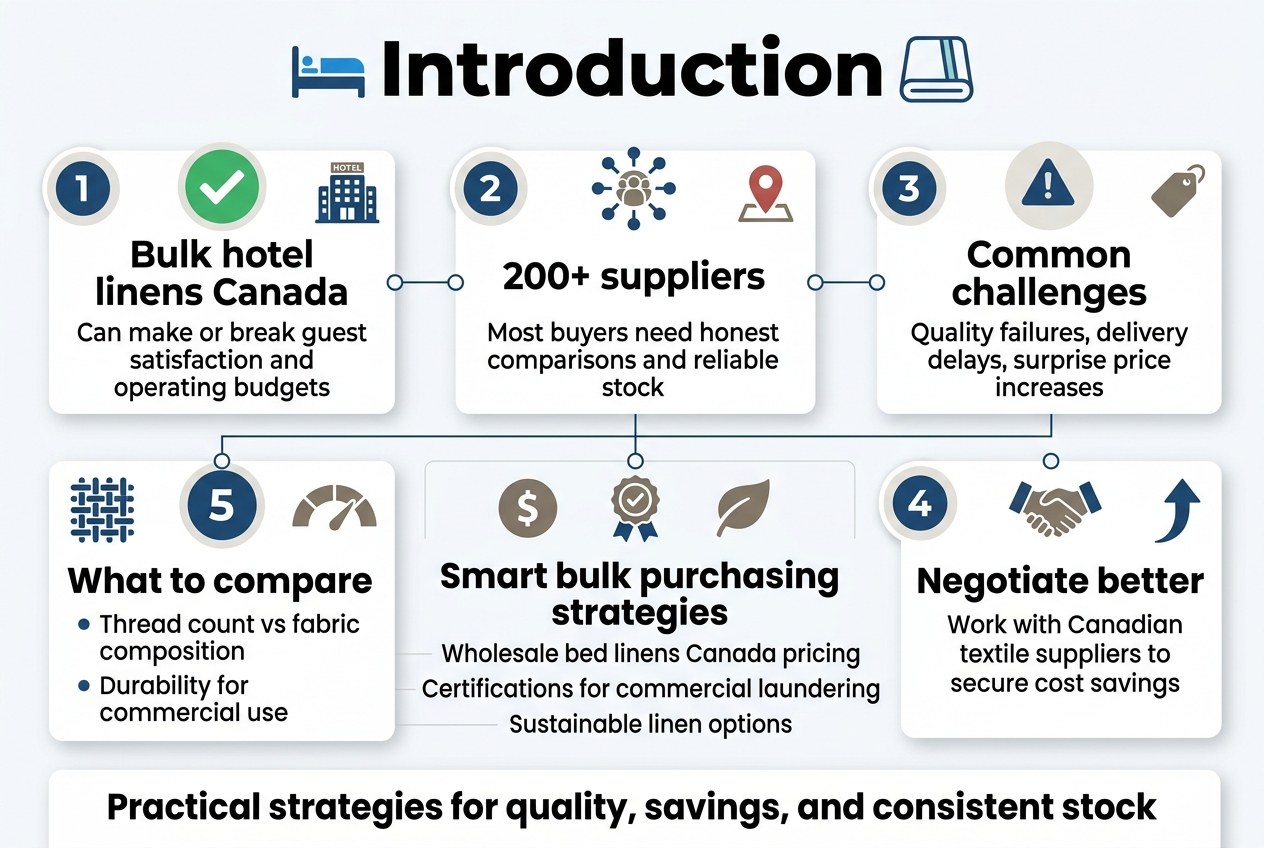
Purchasing bulk hotel linens Canada can make or break your property's guest satisfaction scores and operating budget. For hotel operators, B&B owners, and Airbnb hosts across Canada, finding reliable Canadian hotel linen suppliers who deliver quality products at fair prices while maintaining consistent stock levels is a major challenge.
The Canadian hotel linen market includes over 200 suppliers, yet most buyers struggle to find honest comparisons between vendors, understand the real difference between thread count and GSM ratings, or avoid common purchasing mistakes that double replacement costs. Many operators end up cycling through multiple suppliers after experiencing quality failures, delivery delays, or surprise price increases.
This guide reveals practical strategies for securing hotel linen cost savings through smart bulk purchasing decisions. You'll discover how to evaluate thread count versus fabric composition for maximum durability, compare wholesale bed linens Canada pricing across domestic and import options, and identify which certifications actually matter for commercial laundering. We'll also break down negotiation tactics that work with Canadian textile suppliers and highlight sustainable linen options that meet modern guest expectations without breaking your budget.
Understanding Key Factors That Impact Hotel Linen Costs
How linen quality directly affects guest satisfaction and reviews
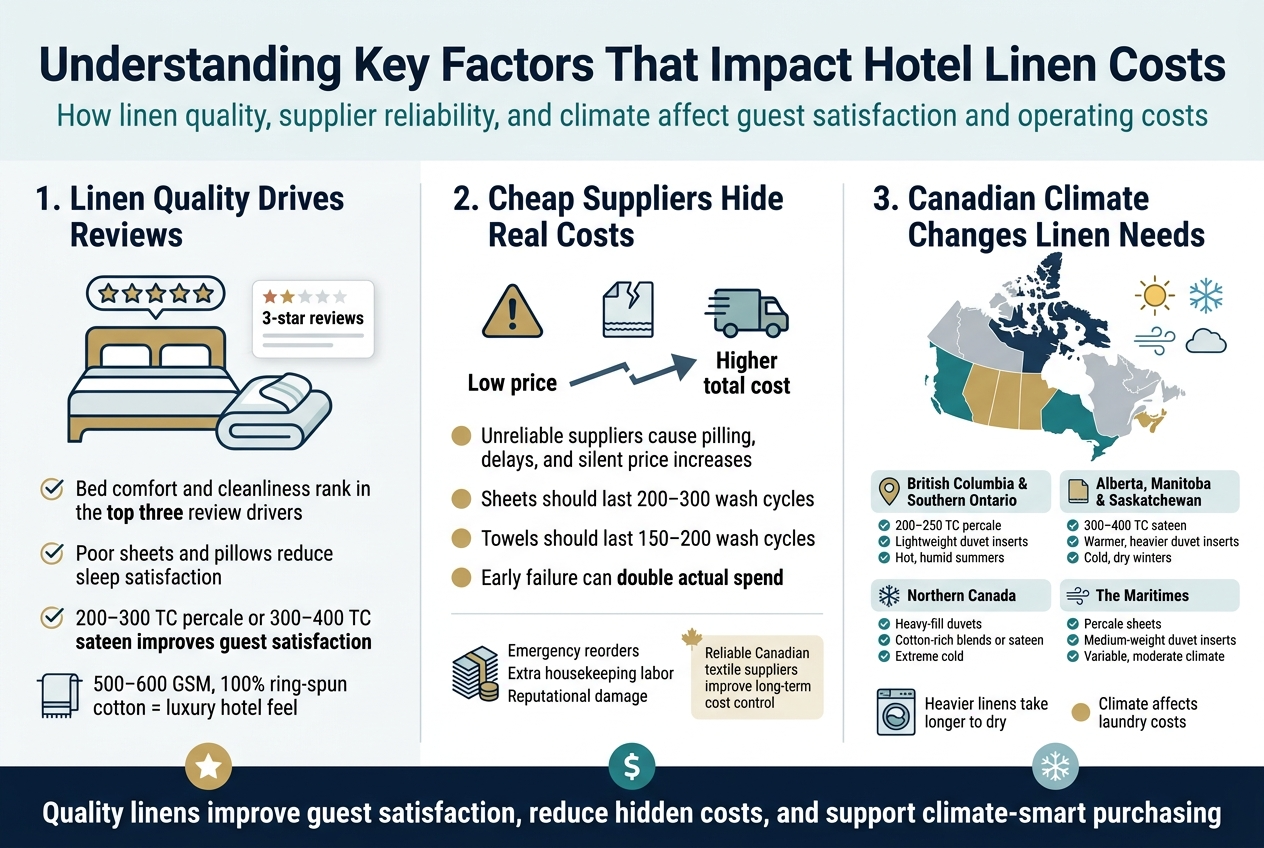
When it comes to bulk hotel linens Canada, understanding the direct correlation between linen quality and guest satisfaction is crucial for any hospitality business. Linens are one of the first things a guest touches in your hotel room, making them a critical touchpoint for the overall experience. Guest satisfaction research consistently shows that bed comfort and cleanliness rank in the top three factors that drive reviews on TripAdvisor and Booking.com.
The impact of poor-quality linens extends far beyond immediate comfort. Poor sheets that pill after a few washes can lead to 3-star reviews, significantly affecting your property's online reputation. Research has found that uncomfortable pillows and bed linens were strong predictors of poor sleep satisfaction, which directly reduces overall guest satisfaction scores.
For Canadian hotel linen suppliers, investing in quality materials makes a measurable difference. Choosing 200-300 TC percale or 300-400 TC sateen cotton sheets over cheaper polycotton blends typically results in measurably better guest satisfaction scores. Similarly, towels in the 500-600 GSM range with 100% ring-spun cotton deliver a "luxury hotel feel" that guests remember and review positively.
The J.D. Power 2025 North America Hotel Guest Satisfaction Study confirmed that guest satisfaction improved significantly in bed comfort, demonstrating that quality linens pay dividends in guest perception and ultimately impact your bottom line through better reviews and repeat business.
The hidden costs of choosing unreliable suppliers
When sourcing bulk hospitality linens, the cheapest option often becomes the most expensive in the long run. Real-world examples demonstrate how unreliable suppliers can devastate operational budgets. One hotel GM experienced issues with three suppliers in 18 months: towels pilled early, deliveries were inconsistent, and prices were quietly raised without notice.
The mathematics of commercial linen purchasing reveal why quality matters. A cheaper per-unit cost is completely negated if linens fall apart after 50 washes instead of 200. Commercial hotel sheets should survive 200-300 wash cycles minimum, while towels should endure 150-200 cycles. When linens fail prematurely, the costs extend far beyond simple replacement.
Early linen failure creates a cascade of hidden expenses including emergency reorders at premium prices, additional housekeeping labor for inspection and sorting, and potential reputational damage from guest complaints. Hotels that attempt to "save" on per-sheet costs by purchasing low-quality items from unreliable hotel supply procurement Canada sources may end up doubling their actual spend by needing to replace entire batches within eight months.
These hidden costs underscore why establishing relationships with reliable Canadian textile suppliers is essential for long-term cost control and operational efficiency.
Why Canadian climate variations should influence your purchasing decisions
Canada's extreme climate variations should be a primary factor in your wholesale bed linens Canada purchasing strategy. The diverse climate zones across the country require different linen specifications to optimize both guest comfort and operational costs.
For warm, humid summers experienced in British Columbia and Southern Ontario, lighter percale sheets (200-250 TC) and lightweight duvet inserts are recommended. These breathable options help guests stay comfortable during hot, muggy nights while reducing air conditioning costs.
Conversely, for cold, dry winters in Alberta, Manitoba, and Saskatchewan, sateen sheets (300-400 TC) and warmer, heavier duvet inserts provide the insulation guests expect. The denser weave of sateen offers better heat retention during harsh winter months.
For extreme cold conditions or shoulder seasons in Northern Canada, sateen or cotton-rich blend sheets paired with heavy-fill duvets are appropriate to ensure guest warmth and satisfaction. Meanwhile, variable, moderate climates like those found in the Maritimes benefit from percale sheets that offer year-round versatility, combined with medium-weight duvet inserts.
These climate considerations impact more than just guest comfort—they directly affect your laundry costs. Heavier linens take longer to dry and cost more per cycle, making the initial purchasing decision crucial for long-term operational efficiency when sourcing from Canadian hotel linen suppliers.
Essential Product Knowledge for Smart Bulk Purchasing
Thread Count vs GSM Metrics and What They Actually Mean
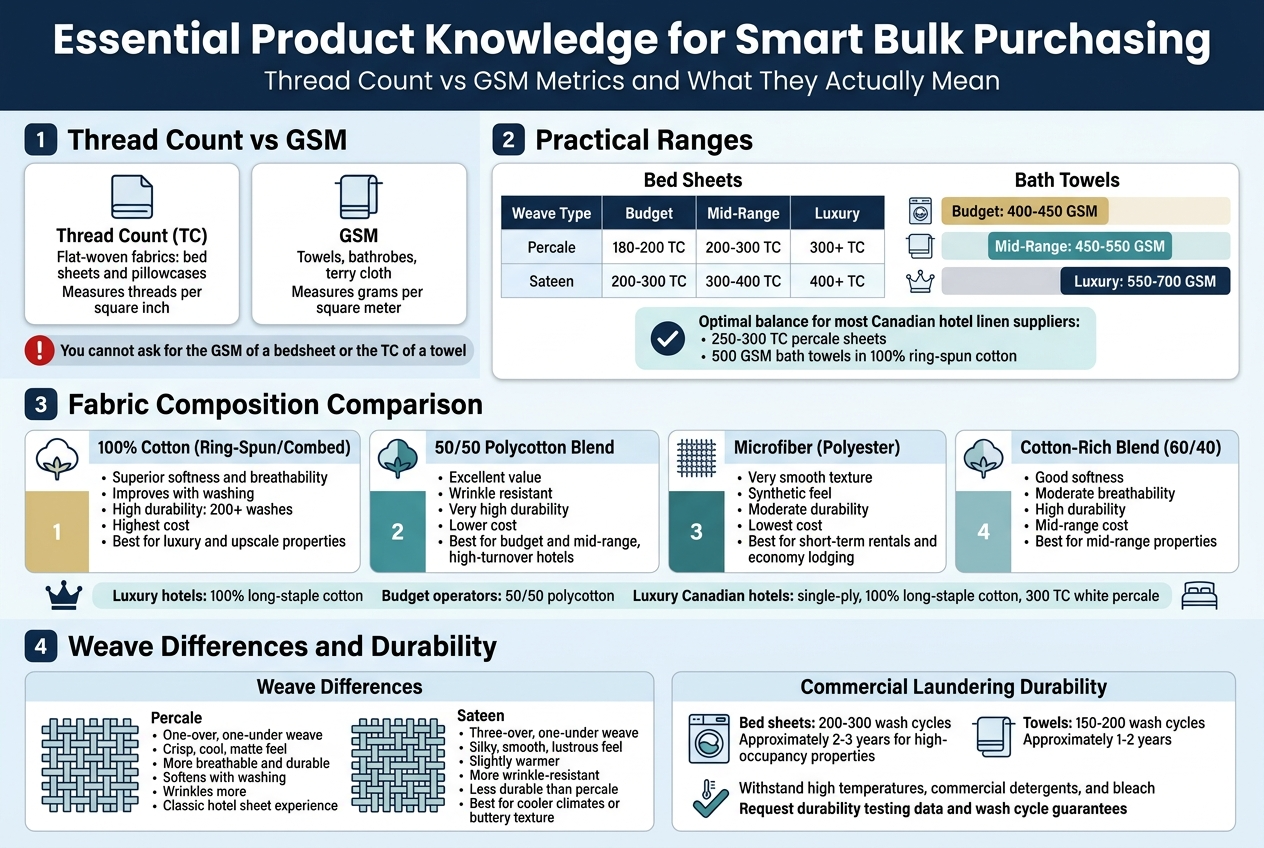
Understanding the fundamental difference between Thread Count (TC) and GSM (Grams per Square Meter) is crucial for making informed bulk hotel linens Canada purchases. These metrics measure entirely different aspects of textile quality and are not interchangeable.
Thread Count applies exclusively to flat-woven fabrics like bed sheets and pillowcases, measuring the number of threads per square inch of fabric. GSM, on the other hand, applies to towels, bathrobes, and terry cloth products, measuring fabric weight and density. You cannot ask for the GSM of a bedsheet or the TC of a towel - they measure different characteristics entirely.
For bed sheets, practical Thread Count ranges vary by weave type:
| Weave Type | Budget Range | Mid-Range | Luxury |
|---|---|---|---|
| Percale | 180-200 TC | 200-300 TC | 300+ TC |
| Sateen | 200-300 TC | 300-400 TC | 400+ TC |
For bath towels, GSM ranges include:
-
Budget: 400-450 GSM
-
Mid-Range: 450-550 GSM
-
Luxury: 550-700 GSM
For most Canadian hotel linen suppliers, the optimal balance of comfort, durability, and cost falls at 250-300 TC for percale sheets and 500 GSM for bath towels in 100% ring-spun cotton.
Fabric Composition Comparison: Cotton vs Polycotton vs Microfiber
When purchasing bulk hospitality linens, fabric composition significantly impacts both performance and cost-effectiveness.
100% Cotton (Ring-Spun/Combed) offers superior softness and breathability, actually improving with washing cycles. This premium option provides high durability with 200+ washes but comes at the highest cost, making it ideal for luxury and upscale properties.
50/50 Polycotton Blend delivers excellent value for commercial linen purchasing. While less soft than pure cotton, it offers exceptional wrinkle resistance and very high durability at a lower cost. This composition works best for budget and mid-range, high-turnover hotels where reduced ironing labor and faster drying times provide operational advantages.
Microfiber (Polyester) provides a synthetic feel with very smooth texture but moderate durability. As the lowest-cost option, it's most suitable for short-term rentals and economy lodging.
Cotton-Rich Blend (60/40) strikes a middle ground, offering good softness and moderate breathability with high durability at mid-range cost, perfect for mid-range properties seeking balance.
Most luxury hotels globally prefer 100% long-staple cotton, while budget operators favor 50/50 polycotton for operational efficiency. Luxury Canadian hotels typically specify single-ply, 100% long-staple cotton sheets, often 300 TC white percale.
Understanding weave differences is equally important. Percale sheets feature a one-over, one-under weave creating a crisp, cool, and matte feel. They're more breathable and durable, softening with washing but wrinkling more - delivering the classic "hotel sheet" experience. Sateen sheets use a three-over, one-under weave for a silky, smooth, lustrous feel. While slightly warmer and more wrinkle-resistant, they're less durable than percale, making them suitable for cooler climates or guests preferring buttery texture.
Industry-Standard Durability Requirements for Commercial Laundering
Commercial laundering places extreme demands on hotel supply procurement Canada decisions. Understanding durability requirements prevents costly premature replacements and ensures optimal return on investment.
Hotel linens must withstand rigorous commercial washing conditions, including high temperatures, commercial detergents, and bleach. Commercial hotel sheets should survive a minimum of 200-300 wash cycles, while towels should maintain quality for 150-200 cycles.
Need Reliable Wholesale Supplies for Your Facility?
Hotels, healthcare facilities, restaurants, and commercial operations across Canada trust Linen Plus for consistent bulk supply and commercial-grade quality.

Bulk Wholesale Pricing
Competitive pricing for large-volume procurement.

Reliable Nationwide Supply
Consistent inventory and fast shipping across Canada.

Hospitality & Healthcare Grade
Products designed for demanding commercial environments.
Industry guidelines provide clear replacement timelines:
-
Bed sheets: Replace after 200-300 wash cycles (approximately 2-3 years for high-occupancy properties)
-
Towels: Replace after 150-200 cycles (approximately 1-2 years)
These durability standards directly impact your wholesale bed linens Canada purchasing strategy. While higher-quality fabrics cost more initially, they often provide better long-term value through extended service life and maintained appearance throughout their lifecycle.
When evaluating Canadian textile suppliers, always request durability testing data and wash cycle guarantees. Properties with high turnover rates should prioritize fabrics meeting or exceeding these minimum standards to maximize their hotel linen cost savings and maintain consistent guest experiences.
Evaluating Canadian Hotel Linen Suppliers Effectively
Key certifications that matter: OEKO-TEX and GOTS verification
When evaluating Canadian hotel linen suppliers, certification transparency reveals a concerning industry gap. Few suppliers clearly disclose their textile certifications, creating a significant transparency problem that hotel buyers must navigate carefully.
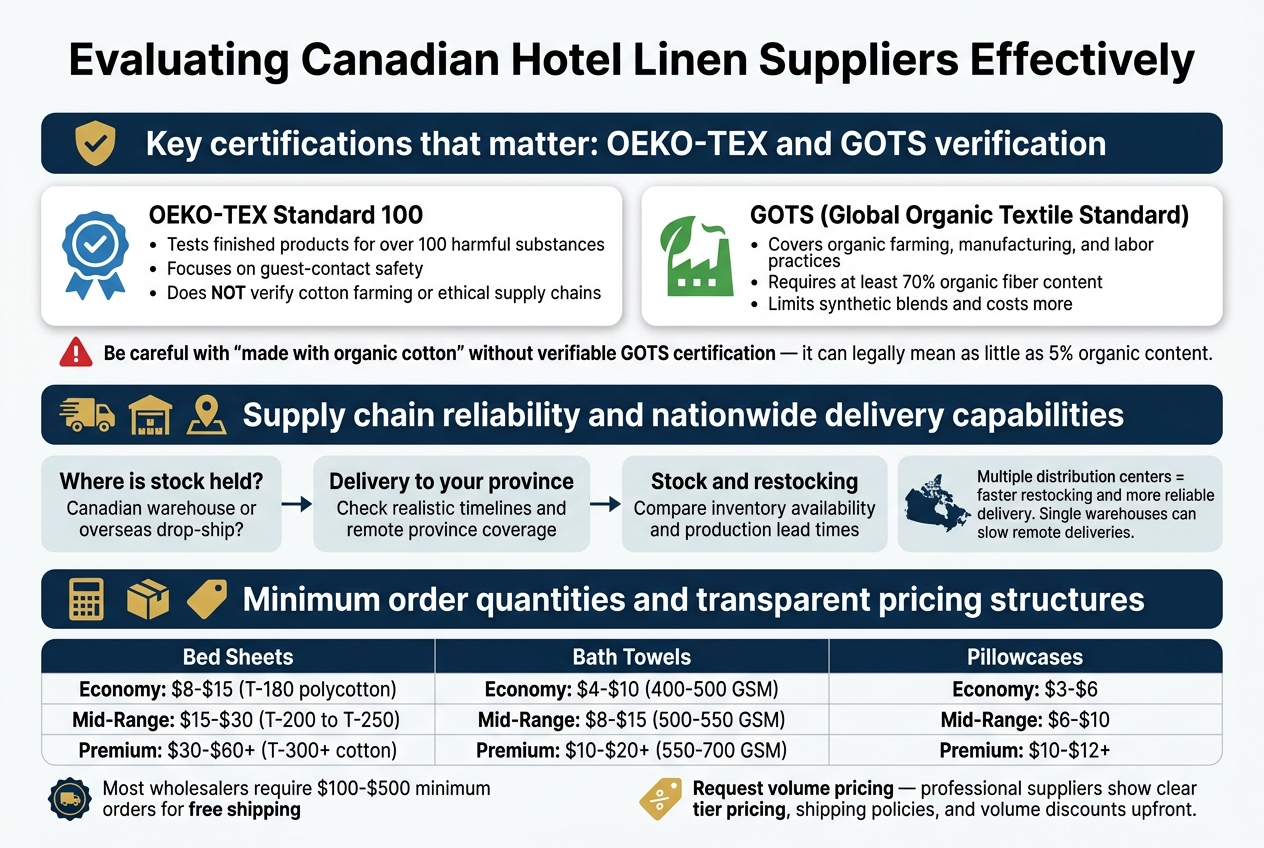
OEKO-TEX Standard 100 represents the most practical certification for bulk hotel linens Canada. This standard tests finished products for over 100 harmful substances, ensuring linens meet safety requirements for guest contact. However, it's important to understand that OEKO-TEX does not verify cotton growth practices or ethical supply chains—it focuses solely on the final product's safety.
GOTS (Global Organic Textile Standard) offers comprehensive supply chain certification, covering everything from organic farming to manufacturing and labor practices. GOTS requires a minimum of 70% organic fiber content, making it more expensive and limiting synthetic blend options that many hotels prefer for durability and cost-effectiveness.
To verify certifications when evaluating Canadian hotel linen suppliers, request specific OEKO-TEX license numbers or GOTS certification numbers and cross-reference them on official databases. Be particularly cautious of suppliers claiming "made with organic cotton" without verifiable GOTS certification—this phrase can legally represent as little as 5% organic content.
Supply chain reliability and nationwide delivery capabilities
Canada's vast geographical expanse creates unique logistics challenges for hotel linen purchasing. When assessing Canadian textile suppliers, supply chain reliability becomes crucial for consistent operations.
Essential questions to ask potential suppliers include: Do they warehouse inventory within Canada or drop-ship from overseas? What are realistic delivery timelines to your specific province? What free-shipping thresholds apply, and how does stock availability compare to production lead times?o
Distribution strategies vary significantly among wholesale bed linens Canada suppliers. Some suppliers, like Linen Plus, maintain multiple distribution centers across Canada and the US, enabling faster restocking and more reliable delivery schedules. Others operate from single warehouses, which can impact consistent inventory availability and delivery times to remote provinces.
Understanding these logistics capabilities directly affects your hotel's operational efficiency and guest satisfaction, making supply chain evaluation a critical component of supplier selection.
Minimum order quantities and transparent pricing structures
Transparent pricing structures separate professional Canadian hotel linen suppliers from less reliable options. Understanding current wholesale pricing helps identify fair deals and negotiation opportunities.
Current wholesale pricing ranges for Canadian hotel linens (2025):
| Product Category | Economy Range | Mid-Range | Premium |
|---|---|---|---|
| Bed Sheets (per sheet) | $8-$15 (T-180 polycotton) | $15-$30 (T-200 to T-250) | $30-$60+ (T-300+ cotton) |
| Bath Towels (per towel) | $4-$10 (400-500 GSM) | $8-$15 (500-550 GSM) | $10-$20+ (550-700 GSM) |
| Pillowcases (per piece) | $3-$6 | $6-$10 | $10-$12+ |
Most Canadian wholesalers require minimum orders between $100-$500 to qualify for free shipping. However, volume discounts remain almost universally available and negotiable across suppliers. Not requesting volume pricing typically results in overpaying—a critical mistake in commercial linen purchasing.
Professional suppliers provide clear tier pricing, shipping policies, and volume discount structures upfront, demonstrating transparency that supports long-term business relationships.
Top 10 Canadian Hotel Linen Suppliers Breakdown
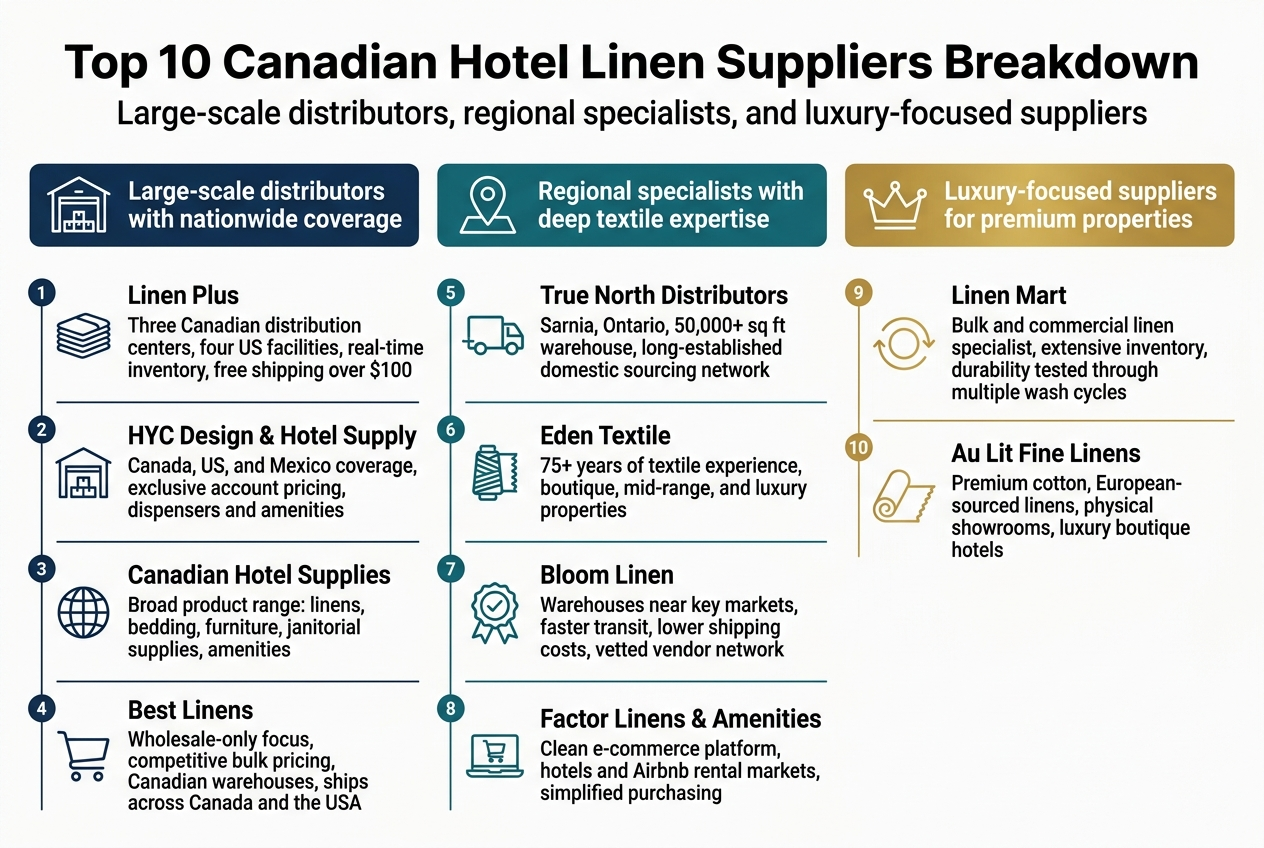
Large-scale distributors with nationwide coverage
When sourcing bulk hotel linens Canada on a national scale, several distributors offer comprehensive coverage and streamlined procurement processes. Linen Plus stands out as one of North America's largest hotel supply distributors, operating three Canadian distribution centers alongside four US facilities. Their real-time online inventory system ensures accurate stock levels, while free shipping on orders exceeding $100 makes them particularly attractive for Canadian hotel linen suppliers seeking cost-effective solutions. Their exclusive product lines cater specifically to mid-range and large hotel operations requiring reliable, one-stop supply chain management.
HYC Design & Hotel Supply extends its reach across Canada, the US, and Mexico, providing exclusive account pricing structures for bulk buyers. Beyond hotel bedding wholesale Canada offerings, they emphasize dispensers and amenities, making them ideal for modern, design-conscious properties and Airbnb operators seeking cohesive aesthetic solutions.
Canadian Hotel Supplies delivers one of the market's broadest product ranges, encompassing linens, bedding, furniture, janitorial supplies, and amenities. Their diverse clientele includes hotels, Airbnbs, retirement homes, healthcare facilities, spas, and restaurants, demonstrating versatility in commercial linen purchasing across multiple sectors.
Best Linens focuses exclusively on wholesale operations with competitive bulk pricing structures. Operating from Canadian warehouses, they ship throughout Canada and the USA, positioning themselves as specialists in bulk hospitality linens for both hospitality and healthcare sectors.
Regional specialists with deep textile expertise
Canadian textile suppliers with regional focus often provide superior expertise and personalized service compared to their national counterparts. True North Distributors, based in Sarnia, Ontario, operates from a substantial 50,000+ square foot warehouse facility. Their long-established presence in the Canadian market has fostered deep relationships with independent hoteliers, making them particularly valuable for buyers prioritizing domestic sourcing and established distribution networks.
Eden Textile brings over 75 years of Canadian textile industry experience, serving boutique, mid-range, and luxury properties with exceptional textile expertise. Their extensive industry knowledge and long-standing reputation make them a trusted partner for properties requiring specialized textile guidance and quality assurance.
Bloom Linen strategically positions warehouses near key Canadian markets, significantly reducing transit times and shipping costs. Their certification-vetted vendor network ensures quality standards, while tailored hotel and motel supply kits streamline the purchasing process. This approach particularly benefits mid-range properties, motels, and Airbnb operators seeking efficient hotel linen cost savings.
Factor Linens & Amenities offers a clean, well-organized e-commerce platform designed for both traditional hotels and modern Airbnb rental markets. Their straightforward online purchasing experience appeals to small to mid-size hotel operators and Airbnb hosts requiring simplified procurement processes.
Linen Mart specializes exclusively in bulk and commercial linen supply, maintaining extensive inventory levels to prevent stockouts. Their products undergo rigorous durability testing through multiple wash cycles, ensuring longevity for facilities requiring reliable, no-frills wholesale bed linens Canada solutions.
Cost Comparison Strategies Between Domestic and Import Options
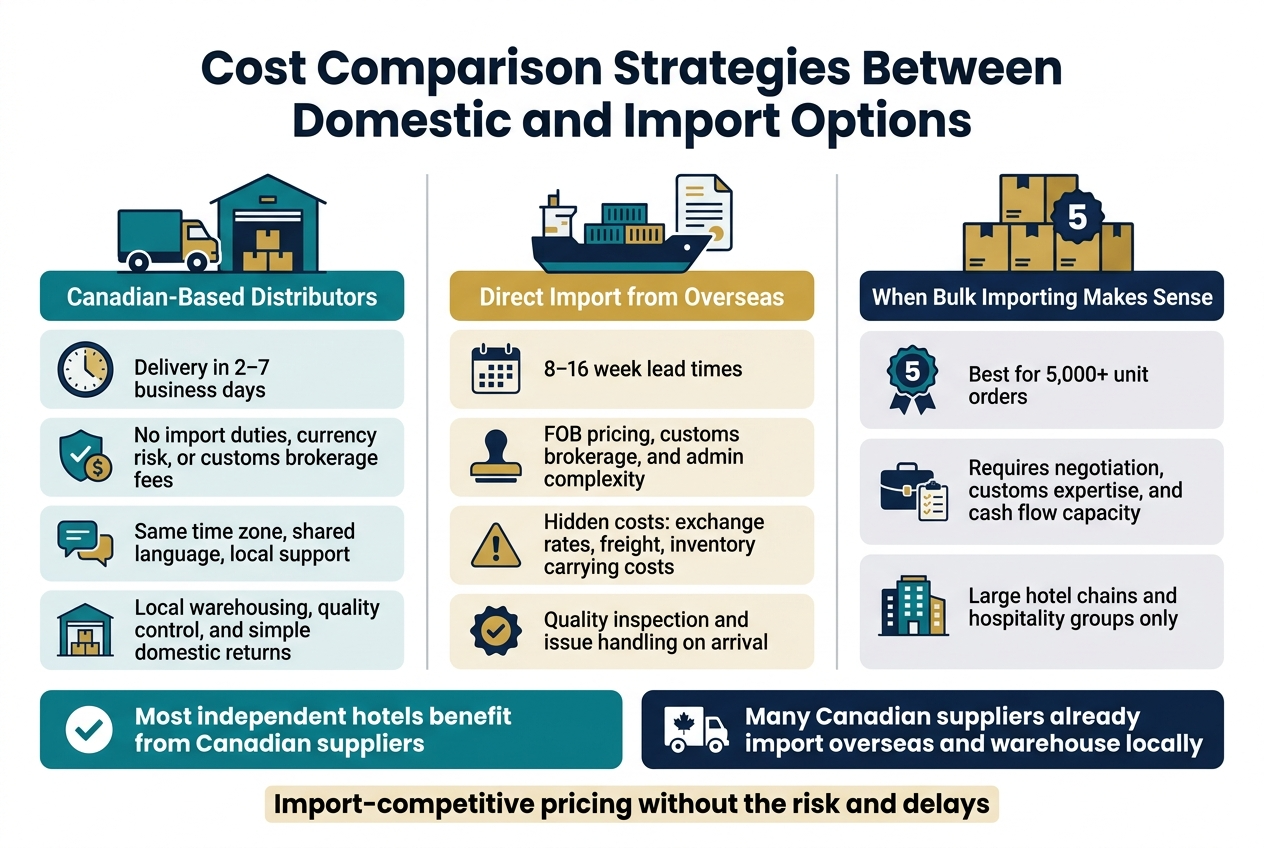
Advantages of buying from Canadian-based distributors
When evaluating bulk hotel linens Canada options, Canadian-based distributors offer compelling advantages that often outweigh the perceived savings of direct importing. The most significant benefit is delivery speed, with Canadian distributors typically providing delivery within 2-7 business days compared to the 8-16 week lead times associated with overseas imports. This rapid turnaround is crucial for hotel operations that need to maintain consistent inventory levels.
Canadian hotel linen suppliers eliminate the complexities of international trade by handling all import duties, currency fluctuation risks, and customs brokerage fees on your behalf. This streamlined approach removes significant administrative burdens and unexpected costs that can quickly erode any initial price advantages from direct importing.
The convenience of local support cannot be overstated when purchasing hotel bedding wholesale Canada. Operating in the same time zone with shared language and business culture facilitates smoother communication, faster problem resolution, and more reliable service relationships. Canadian distributors maintain local warehousing, ensuring consistent stock availability without the unpredictable delays that overseas suppliers often experience.
Perhaps most importantly, Canadian distributors add substantial value through their comprehensive services including local inventory management, quality control processes, customer service support, and simplified return procedures. When defective products arise, returns can be processed domestically without incurring expensive international shipping costs, making the overall purchasing experience more predictable and cost-effective.
Real costs of importing directly from overseas manufacturers
The true economics of direct importing reveal that this approach is typically beneficial only for very large hotel operations. Commercial linen purchasing through direct import channels becomes viable primarily for hotel chains placing orders of 5,000+ units, where the volume justifies the complexity and risks involved.
These large-scale operations must possess the infrastructure and expertise to negotiate FOB (Free On Board) pricing effectively, manage complex customs brokerage processes, and absorb the extended 8-16 week lead times that characterize overseas manufacturing. Additionally, they must handle quality inspection procedures themselves upon receipt, adding another layer of operational responsibility.
For most independent hotels, boutique properties, and short-term rental operators, the reality is that buying through Canadian textile suppliers proves more practical and ultimately more cost-effective. The hidden costs of direct importing—including customs fees, currency exchange risks, extended inventory carrying costs, and potential quality issues—often eliminate the apparent price savings that initially make overseas sourcing attractive.
When bulk importing makes financial sense for large operations
Bulk importing achieves financial viability specifically for hotel chains and large hospitality groups ordering 5,000+ units at a time. These substantial volume commitments provide the leverage necessary to negotiate favorable FOB pricing and justify the operational complexities of international procurement.
Large operations that succeed with direct importing possess several critical capabilities: the ability to negotiate effectively with overseas manufacturers, dedicated personnel to manage customs brokerage processes, financial capacity to absorb 8-16 week lead times without operational disruption, and quality assurance systems to handle incoming product inspections.
It's important to understand that most established Canadian hotel linen suppliers are already sophisticated importers who purchase from overseas manufacturers, warehouse products domestically, and offer competitive pricing that reflects import economics while providing domestic convenience. This business model effectively delivers wholesale bed linens Canada at import-competitive prices without the associated risks and complexities of direct importing, making it the optimal choice for most hotel supply procurement Canada needs.
Common Purchasing Mistakes That Waste Money
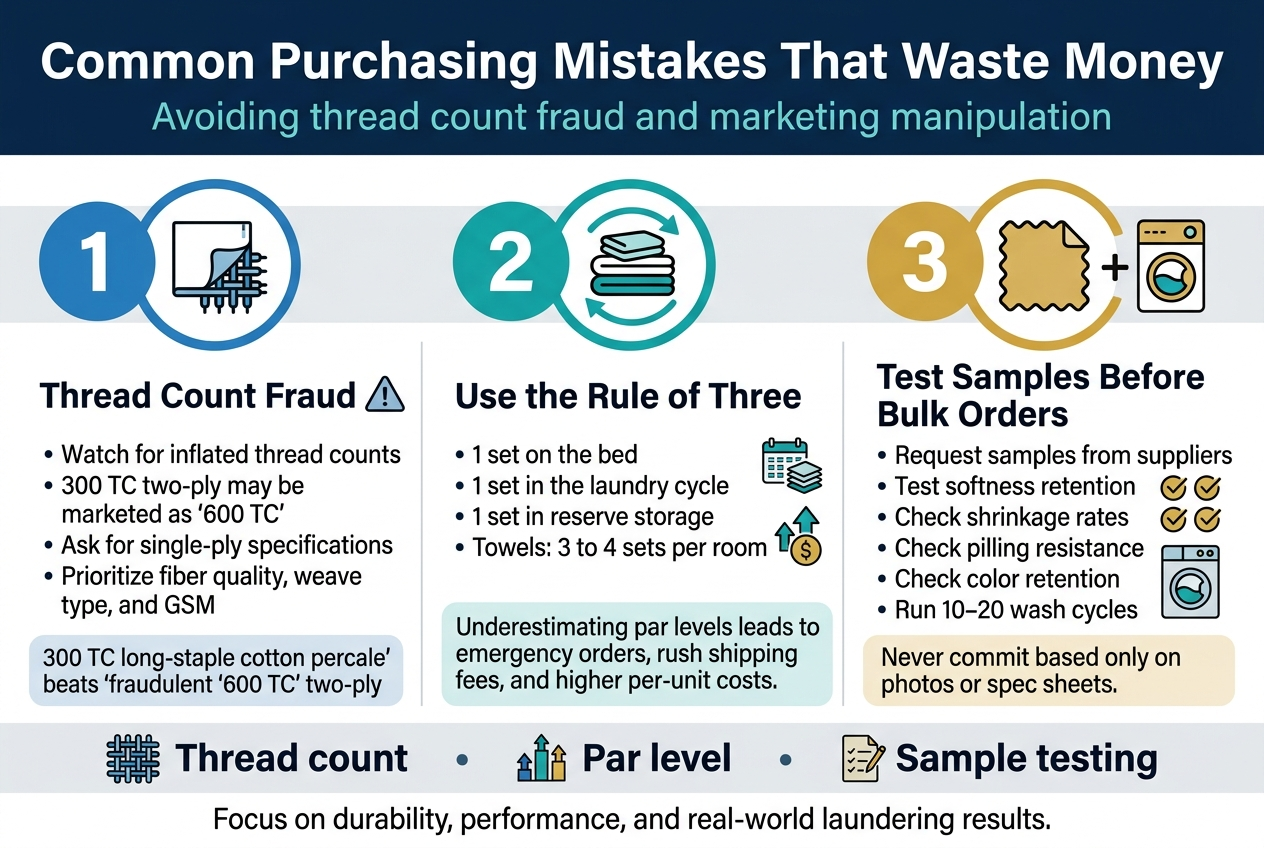
Avoiding thread count fraud and marketing manipulation
When purchasing bulk hotel linens Canada, one of the most pervasive industry scams involves thread count manipulation. Thread count fraud is alarmingly common, with manufacturers deliberately inflating numbers by counting each ply separately rather than individual threads. For instance, a 300 thread count two-ply yarn sheet may be deceptively marketed as "600 TC," creating false value perception for Canadian hotel linen suppliers and buyers alike.
Smart procurement professionals should immediately question any hotel bedding wholesale Canada marketing that advertises thread counts above 500 TC for commercial hospitality use. Always request single-ply specifications when evaluating potential purchases. The reality is that a well-constructed 300 TC long-staple cotton percale sheet will consistently outperform and outlast a fraudulent "600 TC" two-ply sheet in commercial laundering environments.
Rather than focusing solely on inflated thread count numbers, prioritize fiber quality, weave type, and GSM (grams per square meter) measurements. These factors provide more accurate indicators of durability and performance for hotel linen cost savings over time.
Proper par level calculations using the "Rule of Three"
The hospitality industry's established "Rule of Three" serves as the foundation for effective bulk hospitality linens inventory management. This proven formula requires maintaining one set of bed linens on the bed, one set in the laundry cycle, and one set in reserve storage. For towels, the recommendation increases to three to four sets per room to accommodate higher usage frequency.
Underestimating par levels represents one of the most costly mistakes in commercial linen purchasing. When hotels miscalculate their inventory needs, they inevitably face emergency orders that trigger expensive rush shipping fees and force them to settle for whatever Canadian textile suppliers have in stock rather than their preferred products. This reactive purchasing eliminates negotiating power and often results in significantly higher per-unit costs.
Importance of sample testing before bulk commitments
Reputable Canadian hotel linen suppliers will provide samples for thorough evaluation before any major purchase commitment. These samples must undergo rigorous testing under real-world commercial conditions to assess their suitability for hotel supply procurement Canada operations.
Testing protocols should evaluate multiple performance factors including softness retention, shrinkage rates, pilling resistance, and color retention after multiple wash cycles. Never commit to wholesale bed linens Canada orders based solely on product photographs or specification sheets, as these materials cannot accurately represent actual performance characteristics.
Industry best practices recommend running samples through your specific laundry process 10-20 times to properly assess commercial laundering durability. This testing period allows you to identify potential issues with fabric integrity, color fastness, and dimensional stability before making substantial bulk commitments that could impact your hotel's guest satisfaction and operational efficiency.
Sustainable and Eco-Friendly Linen Options
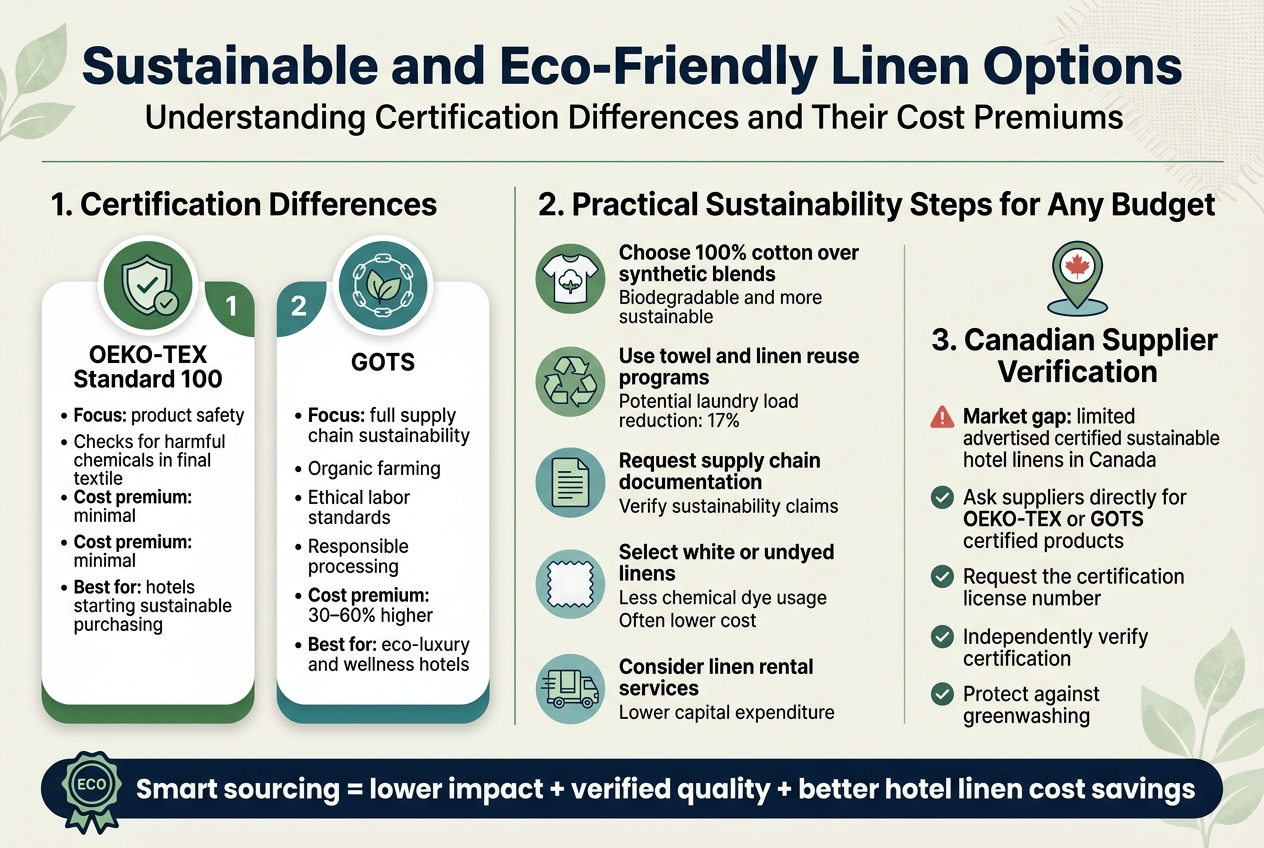
Understanding Certification Differences and Their Cost Premiums
When evaluating sustainable bulk hotel linens Canada options, understanding certification standards helps hotel operators make informed purchasing decisions that align with both budget constraints and environmental goals.
OEKO-TEX Standard 100 represents the most accessible entry point for Canadian hotel linen suppliers seeking sustainable products. This certification focuses primarily on product safety by ensuring the absence of harmful chemicals in the final textile product. The cost premium for OEKO-TEX certified linens remains minimal, making it a practical starting point for hotels of any size looking to incorporate sustainable practices without significant budget impact.
GOTS (Global Organic Textile Standard) offers the most comprehensive sustainability coverage, encompassing the entire supply chain from organic farming practices to ethical labor standards and environmentally responsible processing methods. However, this thorough certification comes with a substantial 30-60% higher price premium compared to conventional linens. This certification level proves most suitable for eco-luxury properties and wellness-focused hotels where guests specifically value and expect verified sustainable practices.
Practical Sustainability Steps for Any Hotel Budget
Previously, we've established that certification premiums can vary significantly, but sustainable practices don't always require expensive certifications. Hotels can implement several cost-effective approaches when sourcing commercial linen purchasing options.
Selecting 100% cotton over synthetic blends provides an immediate sustainability improvement, as cotton offers complete biodegradability compared to synthetic alternatives. This choice often aligns with existing quality preferences without requiring substantial budget adjustments.
Implementing towel and linen reuse programs delivers both environmental and financial benefits, with studies showing potential reductions in laundry loads by 17%. This operational change directly impacts utility costs while reducing the overall demand for wholesale bed linens Canada inventory.
When evaluating Canadian textile suppliers, requesting documentation for supply chain practices helps verify sustainability claims without relying solely on marketing materials. Opting for white or undyed linens minimizes chemical dye usage while often reducing costs compared to colored alternatives.
Hotels operating under tight budget constraints should consider linen rental services as an alternative to outright ownership, potentially reducing capital expenditure while accessing sustainably managed inventory.
Canadian Suppliers Offering Verified Sustainable Products
The Canadian market currently shows limited availability of prominently advertised certified sustainable product lines among hotel supply procurement Canada vendors, indicating a significant market gap for environmentally conscious hospitality operators.
When engaging with bulk hospitality linens suppliers, specifically inquiring about OEKO-TEX or GOTS certified products becomes essential, as many suppliers may carry these options without prominently featuring them in standard catalogs or marketing materials.
Verification remains crucial when evaluating sustainability claims. Always request the specific license number for any certification mentioned by suppliers and independently verify this information rather than accepting marketing claims at face value. This due diligence protects against greenwashing while ensuring genuine sustainable sourcing for your hotel linen cost savings strategy.
Negotiation Tactics for Maximum Savings
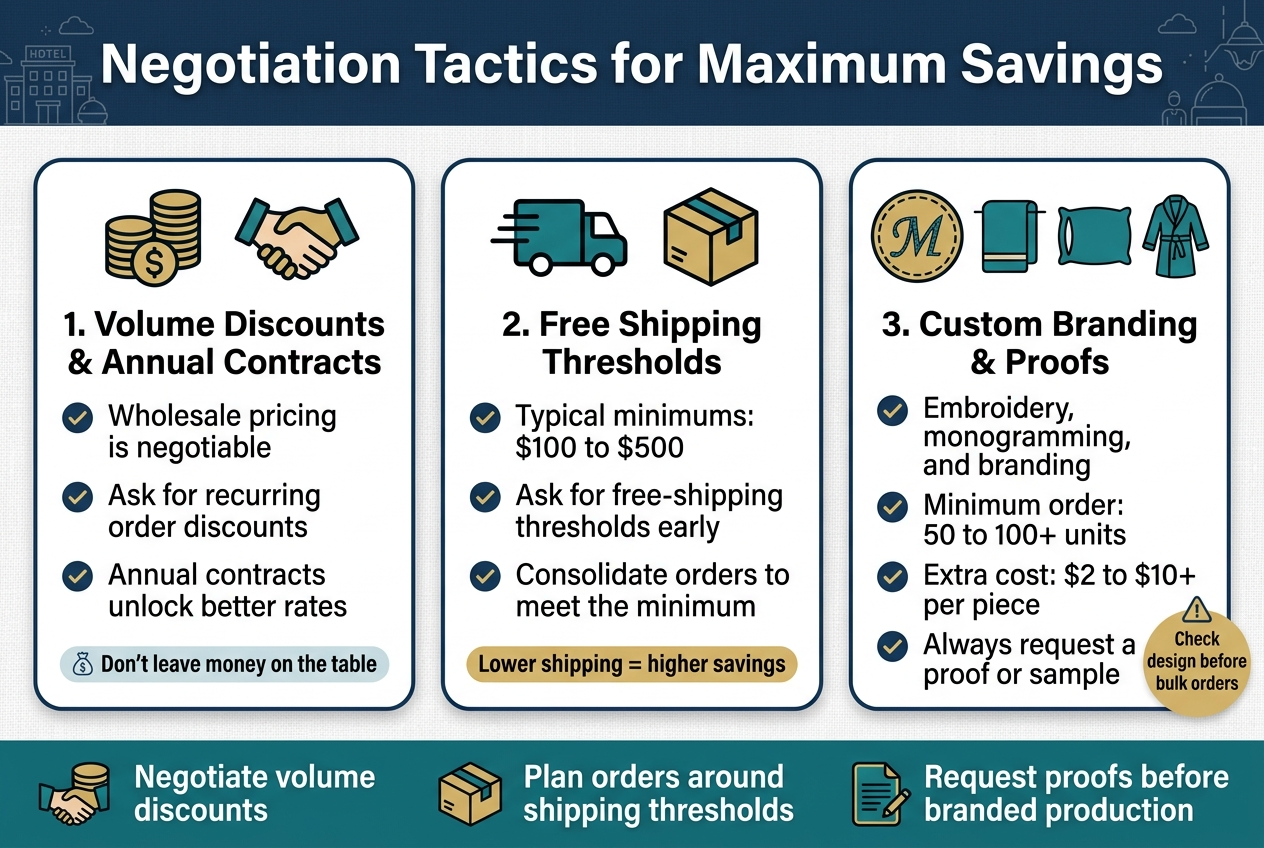
Volume Discount Structures and Annual Contract Benefits
When purchasing bulk hotel linens Canada suppliers offer, understanding volume discount structures becomes crucial for maximizing your cost savings. Wholesale pricing is almost always negotiable, particularly when you're placing recurring orders with Canadian hotel linen suppliers. The key insight here is that volume discounts are nearly always available and should be actively negotiated rather than simply accepted at face value.
Many businesses make the critical mistake of not exploring these opportunities thoroughly. Not asking for volume discounts or investigating annual contract benefits essentially means leaving money on the table. When working with hotel bedding wholesale Canada suppliers, approach negotiations with confidence, knowing that these discounts are standard industry practice rather than special favors.
Annual contracts provide additional leverage for securing better rates. Suppliers value the predictability and guaranteed business volume that annual agreements provide, making them more willing to offer substantial discounts in exchange for this commitment.
Free Shipping Thresholds and Delivery Optimization
Most Canadian hotel linen suppliers establish minimum order requirements ranging from $100 to $500 to qualify for free shipping. Understanding these thresholds is essential for optimizing your commercial linen purchasing strategy and managing overall procurement costs effectively.
When evaluating potential suppliers for your bulk hospitality linens needs, always inquire about free-shipping thresholds during your initial discussions. This information should be factored into your total cost calculations, as shipping expenses can significantly impact your bottom line, especially for smaller orders.
Strategic order planning around these thresholds can result in substantial savings. Consider consolidating multiple smaller orders into fewer, larger shipments that meet or exceed the free shipping minimums. This approach not only eliminates shipping costs but often qualifies you for better volume pricing tiers simultaneously.
Custom Branding Options and Minimum Order Requirements
Many Canadian textile suppliers offer custom branding services, including embroidery, monogramming, and specialized branding on various hotel linen items such as towels, bathrobes, pillowcases, and table linens. These customization options can enhance your property's professional appearance while maintaining cost-effectiveness when ordered in bulk.
Custom branding typically requires minimum order quantities ranging from 50 to 100+ units per item, depending on the supplier and complexity of the design. The additional cost for custom branding generally ranges from $2 to $10+ per piece, with pricing varying based on the intricacy of the design, number of colors, and type of customization requested.
Before committing to any branded bulk order through your hotel supply procurement Canada process, always request a proof or sample. This critical step ensures the final product meets your quality standards and accurately represents your brand before you invest in large quantities. This precautionary measure can prevent costly mistakes and ensure satisfaction with your custom-branded hotel linens investment.
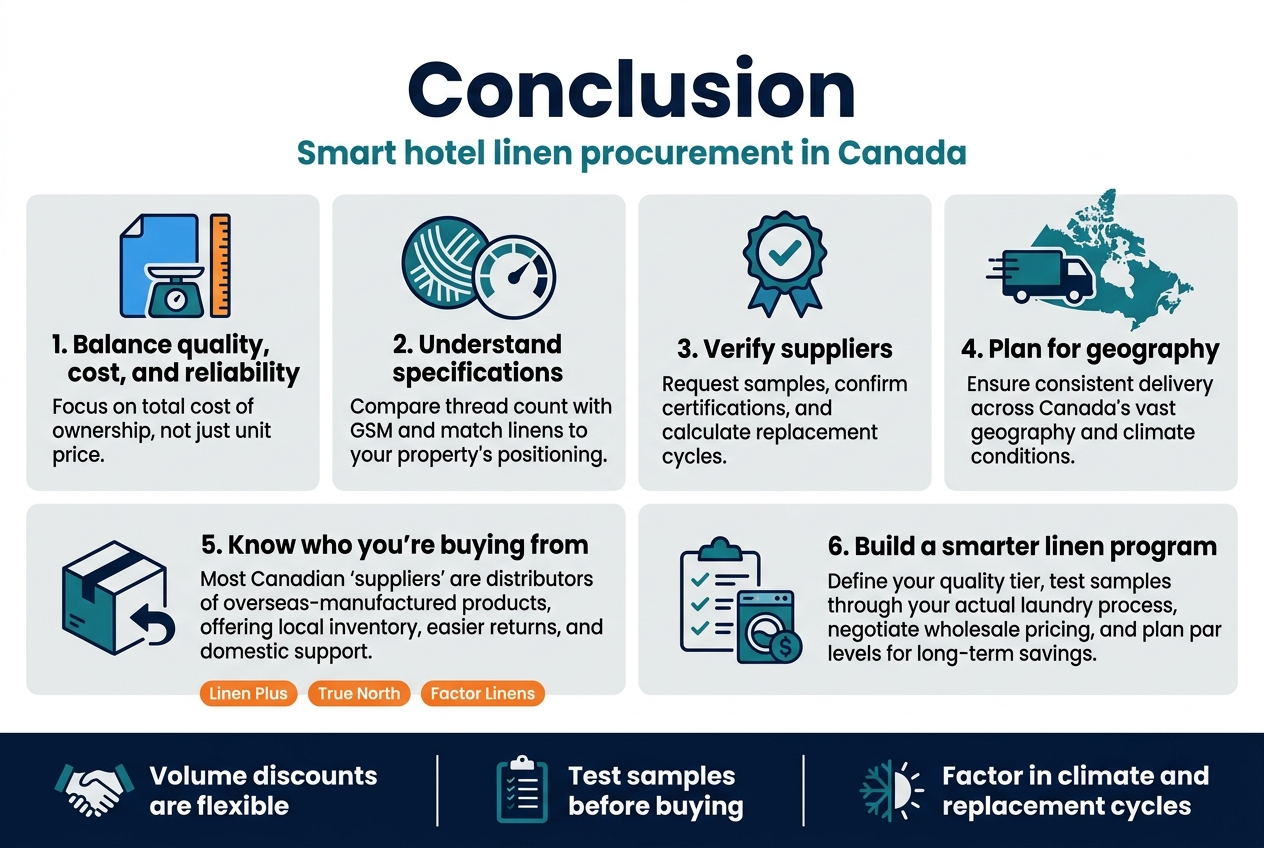
Smart procurement of hotel linens in Canada requires balancing quality, cost, and reliability across multiple factors. From understanding thread count versus GSM measurements to evaluating supplier certifications and negotiating volume discounts, successful buyers focus on total cost of ownership rather than just unit prices. The key is matching your linen specifications to your property's positioning while ensuring suppliers can deliver consistently across Canada's vast geography.
Remember that most Canadian "suppliers" are actually distributors of overseas-manufactured products, which isn't necessarily negative—it provides local inventory, easier returns, and domestic support. Whether you choose established distributors like Linen Plus and True North or specialized suppliers like Factor Linens, prioritize requesting samples, verifying certifications, and calculating replacement cycles. With proper planning around par levels and climate considerations, you can build a linen program that enhances guest satisfaction while controlling long-term costs. Start by defining your quality tier, test samples through your actual laundry process, and don't hesitate to negotiate—wholesale pricing is almost always flexible for serious buyers.


