


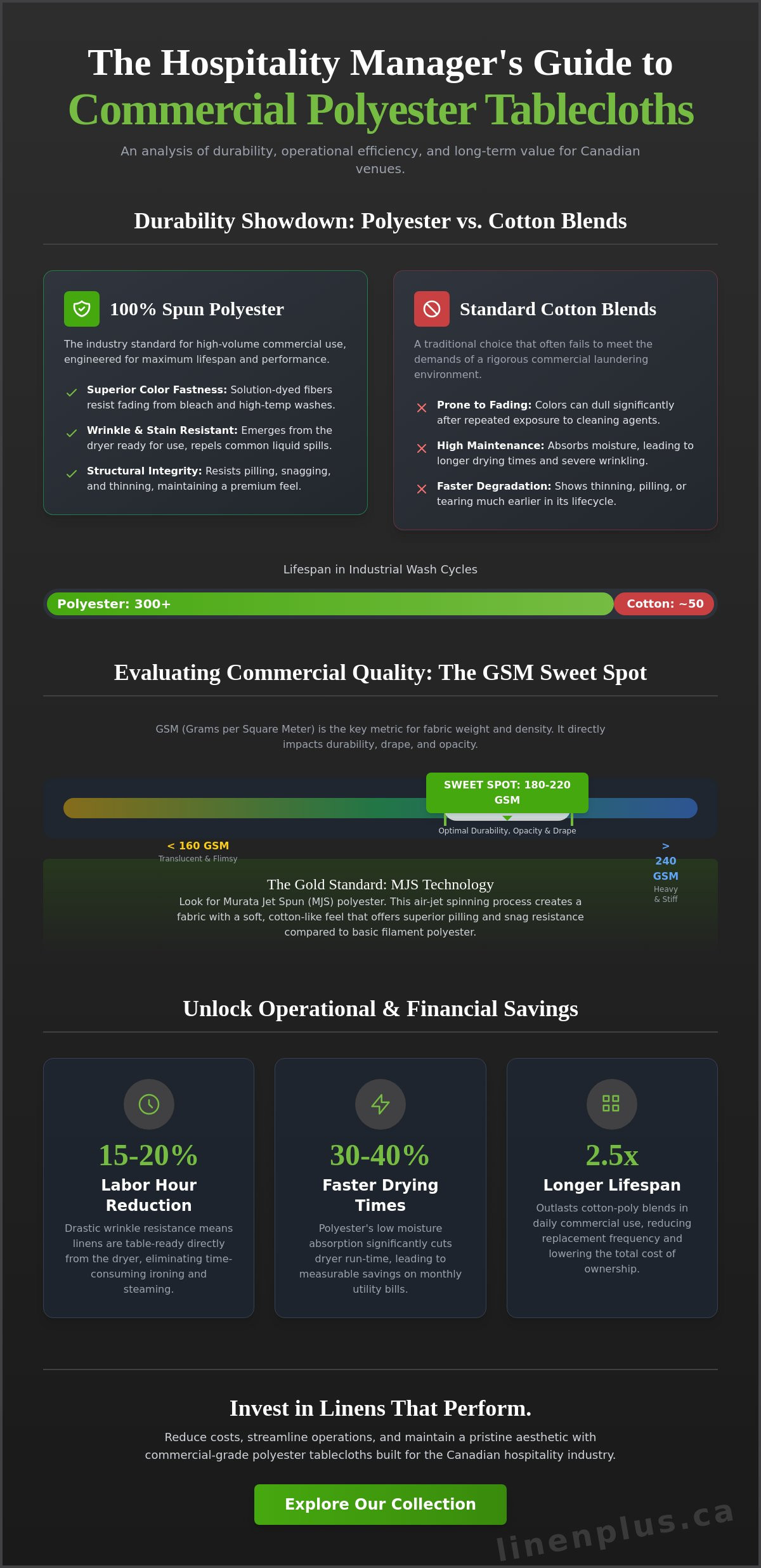
Did you know that a high-grade 100% polyester linen can withstand 300 industrial wash cycles, while standard cotton blends often fail after just 50? For Canadian hospitality managers, every premature replacement is a direct hit to the bottom line. You're likely tired of seeing operational budgets swallowed by persistent stains and the excessive labor hours required to iron out stubborn wrinkles. Maintaining a consistent, professional aesthetic across your venue shouldn't feel like a constant battle against fabric degradation.
This guide helps you master the technical specifications of Polyester Tablecloths to ensure your procurement strategy aligns with long-term fiscal goals. We'll examine the critical role of GSM and weave density in preventing liquid absorption and reducing maintenance time. You'll learn how to select durable, wrinkle-resistant linens that maintain their structural integrity in high-volume commercial environments. From sizing accuracy for standard Canadian banquet tables to advanced laundering protocols, we provide the complete solution for your facility's textile needs.
Key Takeaways
- Understand why 100% spun polyester outperforms traditional cotton in high-traffic Canadian venues by offering superior color fastness and structural integrity.
- Identify the commercial quality benchmarks for fabric weight, ensuring your Polyester Tablecloths meet the 180-220 GSM "sweet spot" for maximum durability.
- Master the technical calculations for lap-length and floor-length drapes to achieve a professional aesthetic across standard Canadian banquet table dimensions.
- Implement specific commercial laundering protocols and temperature controls designed to prevent pilling and extend the operational lifespan of your textile investment.
Understanding Polyester Tablecloths: Why Synthetic Fibers Dominate the Hospitality Industry
Commercial 100% spun polyester represents the standard for Canadian hospitality venues. Unlike basic filament polyester, spun versions utilize fibers twisted to replicate the texture of natural cotton. This process creates a textile that provides the aesthetic appeal required for upscale events while offering the mechanical strength needed for industrial laundering. It's a complete solution for venues that require both elegance and endurance without the high maintenance of organic fabrics.
While cotton remains a traditional choice, it lacks the color fastness required for high-turnover environments. Polyester Tablecloths retain their pigment even after exposure to heavy bleaching agents and high-temperature sanitization cycles. Research into textile performance shows that synthetic fibers resist fiber degradation significantly better than organic alternatives, which often show signs of thinning or "pilling" after only 30 washes. The structural integrity of the weave ensures that the fabric doesn't sag or lose its shape, even when draped over large banquet tables daily.
Wrinkle resistance serves as a primary driver for operational efficiency. In a busy banquet hall, the time spent steaming or pressing linens can increase labor hours by 15% to 20% per event. Polyester Tablecloths emerge from the dryer ready for immediate use, allowing staff to focus on guest service rather than tedious maintenance. This reliability is why they remain the preferred choice for hospitality operations looking to streamline their workflow and maintain a crisp, professional appearance at all times.
The Economic Impact of Choosing Polyester for High-Volume Venues
The financial benefits of polyester extend beyond the initial purchase price. These linens typically last 2.5 times longer than cotton-poly blends in daily commercial use. Because polyester has a low moisture absorption rate, drying times are reduced by approximately 30% to 40% compared to natural fibers. For a mid-sized facility in Ontario or British Columbia, this reduction in dryer run-time leads to measurable savings on monthly utility bills. It's a cost-effective strategy that maximizes the lifespan of every unit in the inventory while reducing the total cost of ownership.
Evaluating Commercial Quality: GSM, Weave, and Durability Benchmarks
Grams per Square Meter (GSM) serves as the primary metric for assessing the density and longevity of Polyester Tablecloths. In the Canadian hospitality sector, the 180-220 GSM range is the established sweet spot. This weight provides enough substance to mask table imperfections and ensures a professional drape that resists wind displacement during outdoor events. Choosing a fabric below 160 GSM often results in a translucent appearance that compromises the aesthetic of professional banquet settings.
Need Reliable Wholesale Supplies for Your Facility?
Hotels, healthcare facilities, restaurants, and commercial operations across Canada trust Linen Plus for consistent bulk supply and commercial-grade quality.

Bulk Wholesale Pricing
Competitive pricing for large-volume procurement.

Reliable Nationwide Supply
Consistent inventory and fast shipping across Canada.

Hospitality & Healthcare Grade
Products designed for demanding commercial environments.
The distinction between basic filament polyester and Murata Jet Spun (MJS) fabrics defines the performance gap in high-traffic venues. MJS technology utilizes air-jet spinning to create a fabric with a soft, cotton-like feel that lacks the synthetic shine of cheaper alternatives. This process binds fibers tightly; it prevents the pilling and snagging that usually occurs after 30 to 40 industrial laundry cycles. For large-format linens, seamless construction is essential. A single-piece design eliminates structural weak points, ensuring the hem remains intact through years of heavy use.
Common Weaves: Poplin, Satin, and Damask Performance
Poplin is the industry standard for daily restaurant operations because its tight, plain weave offers a smooth surface that resists liquid penetration. For gala events, Satin and Damask weaves provide visual depth through light-reflective patterns. While these decorative weaves look premium, high-quality versions maintain the same 200 GSM durability as their poplin counterparts. This ensures they don't snag on guest jewelry or service trays during high-volume service periods.
Color Retention and Bleach Resistance in Commercial Settings
Solution-dyed polyester integrates pigment into the polymer melt before the fiber is even extruded. This ensures the color is part of the fabric's DNA rather than a surface treatment. Color-fastness in 2026 hospitality standards refers to a textile's ability to retain its original lab-certified color values after 100 industrial wash cycles involving thermal disinfection and chlorine exposure. You can explore our full range of durable linens within our hospitality supply collection to find the right match for your facility's laundry protocols.
Strategic Procurement: Selecting Shapes and Sizes for Diverse Venue Requirements
Precise measurements are the foundation of a professional event setup. In the Canadian hospitality sector, standardizing your inventory of Polyester Tablecloths ensures operational efficiency across different banquet halls and meeting rooms. Understanding the geometric relationship between the table surface and the fabric overhang prevents tripping hazards and aesthetic inconsistencies. It's a critical step in maintaining a polished environment for high-stakes corporate events and weddings.
Sizing Guide for Standard Commercial Tables
Canadian venues typically utilize 6-foot (72" x 30") or 8-foot (96" x 30") rectangular banquet tables. For a 6-foot table, a 90" x 132" linen provides a full floor-length drop. On an 8-foot table, a 90" x 156" cloth is required for the same effect. If your facility prefers a lap-length finish, usually 15 inches from the edge, a 60" x 102" or 60" x 126" cloth suffices. For round tables, a 60-inch diameter surface needs a 120-inch round cloth for a floor-length drape, while a 72-inch table requires a 132-inch round linen to reach the ground.
Calculating the "Drop" is straightforward. Subtract the table dimension from the linen dimension and divide by two. A 30-inch drop touches the floor on standard 30-inch high tables. A 15-inch drop hits the lap of a seated guest. Selecting high-quality Polyester Tablecloths in bulk ensures that every table in a 500-person ballroom matches perfectly. Ordering in case packs is the most cost-effective strategy for procurement. This method reduces the per-unit C$ cost and guarantees dye-lot consistency. You can explore our hospitality linen collection to find bulk options that fit these specific venue requirements.
Specialty Linens: Overlays and Runners to Enhance Aesthetic
Polyester overlays serve a dual purpose. They protect the base linen from spills while allowing for rapid color changes to match corporate branding or seasonal themes. Square 54-inch or 72-inch overlays are common additions to round setups. For boutique hotels, coordinating these accents with wholesale bed linens creates a cohesive brand identity across guest rooms and event spaces. This unified approach simplifies inventory management and reinforces a high-end atmosphere for guests throughout the entire facility.
Commercial Laundering and Care: Protecting Your Textile Investment
Maximizing the lifespan of Polyester Tablecloths requires strict adherence to thermal and chemical limits. While polyester is renowned for its durability, pilling occurs when fibers break and tangle due to excessive mechanical action or high pH levels in the wash cycle. It's essential to use a synthetic-specific detergent and avoid overloading machines to maintain a smooth surface. High-volume kitchens must address stains immediately; protein-based spills like dairy require enzymatic pre-soaks, while tannins from wine or coffee respond best to oxygen-based bleaches. Don't use chlorine bleach, as it can yellow synthetic fibers and weaken the material over time.
Temperature control is the most critical factor in commercial care. High-heat drying is the primary cause of fiber degradation and heat-setting permanent wrinkles. Dryers shouldn't exceed 60 degrees Celsius (140 degrees Fahrenheit), followed by a mandatory 10-minute cool-down cycle. This process allows the polymers to stabilize, ensuring the fabric retains its shape and remains easy to press. For a deeper look at sourcing these high-performance materials, consult our Wholesale Linens Canada: The 2026 Commercial Procurement Guide.
Storage and Folding Techniques for Wrinkle-Free Deployment
Professional venues often choose between flat-folding and hanging based on available square footage. Flat-folding is efficient for bulk storage, but linens should be rotated using a first-in, first-out system to prevent permanent creases. In regions with high seasonal humidity, such as coastal British Columbia or Southern Ontario, climate-controlled storage is vital. Maintaining a consistent humidity level below 50% prevents mildew growth, which can ruin a textile investment in less than 72 hours of exposure.
Identifying When to Retire and Replace Commercial Linens
The light test remains the industry standard for quality control; hold the fabric against a bright light source to identify thinning patches or micro-tears that signal structural failure. If oil-based stains remain visible after three professional wash cycles, the piece isn't suitable for guest-facing use. A typical 4-star venue will replace its polyester inventory every 18 to 24 months to maintain brand standards.
Optimizing Your Textile Inventory for Long-Term Performance
Investing in high-quality textiles is a strategic decision that impacts both brand perception and your facility's bottom line. Success in the 2026 hospitality landscape requires a focus on durability benchmarks like GSM and precise weave specifications to withstand rigorous commercial laundering cycles. By prioritizing consistent dye-lot matching for large orders, you'll maintain a uniform professional appearance across every dining room or event hall. Efficient procurement of Polyester Tablecloths ensures your venue stays equipped for diverse requirements while minimizing replacement costs over time.
Linen Plus serves as a critical B2B partner, offering direct manufacturer partnerships that provide wholesale pricing directly to Canadian businesses. Our nationwide distribution network ensures fast fulfillment from local hubs, keeping your operations running without delay. We understand that consistency is non-negotiable for healthcare and hospitality professionals. It's why we focus on providing a complete solution that balances fiscal responsibility with premium quality.
Shop Bulk Polyester Tablecloths at Linen Plus and secure your facility's inventory with a dependable partner. We're ready to support your venue's growth with the reliability your industry demands.
Frequently Asked Questions
Are polyester tablecloths better than cotton for high-traffic restaurants?
Polyester tablecloths are the superior choice for high-traffic Canadian restaurants because they resist shrinking and fading far better than natural fibers. While cotton linens can shrink up to 10 percent after the first few washes, 100 percent polyester maintains its original dimensions for over 100 industrial wash cycles. This durability ensures a consistent fit on your tables and reduces the frequency of replacement orders.
What is the standard GSM for a high-quality commercial polyester tablecloth?
A standard of 180 to 220 GSM (grams per square meter) defines a high-quality commercial polyester tablecloth. Fabrics in this weight range provide the necessary opacity and drape required for professional dining environments. If you select a weight below 150 GSM, the linen often appears translucent under bright dining room lights and lacks the structural integrity needed for heavy daily use.
How do I remove grease and oil stains from 100% polyester linens?
You can remove grease and oil stains by applying a pH-neutral liquid degreaser directly to the affected area before laundering. Since polyester is naturally oleophilic, it attracts oils and requires a wash temperature of 60 degrees Celsius to effectively release the bond. For stubborn spots, a 20 minute soak in a surfactant-rich solution ensures the fabric remains pristine for your next service.
Can polyester tablecloths be dried in a commercial high-heat dryer?
You shouldn't dry polyester linens on high-heat settings because excessive temperatures cause permanent fiber damage and set wrinkles. Instead, use a medium-heat cycle and remove the linens while they're slightly damp to prevent static build-up. This method utilizes the fabric's natural wrinkle-resistant properties, allowing your staff to move items directly from the dryer to the storage rack without extra processing.
Do polyester tablecloths require professional ironing after every wash?
Polyester tablecloths don't require professional ironing if you utilize a proper cool-down cycle in your commercial dryer. By gradually reducing the temperature during the final 10 minutes of the drying process, the synthetic fibers set in a flat, smooth position. This operational efficiency saves your team hours of manual labour, making polyester a more cost-effective solution than cotton blends for high-volume banquet facilities.

Article by
Sohel Shahriar
Sohel Shahriar is the Chief Growth Officer (CGO) at Linen Plus Inc., Canada, bringing a strategic blend of growth marketing, brand leadership, and content expertise. Through his writing, he explores how quality linen, smart sourcing, and long‑term partnerships can create measurable impact for healthcare and hospitality organizations.


