


Did you know that the average Canadian hotel loses up to 20% of its total linen inventory every year to avoidable damage, staining, and theft? For a 100-room property, these recurring expenses can drain thousands of C$ from your annual operating budget. Knowing how to reduce linen replacement costs in a hotel is essential for operations managers who see premium textiles thinned by harsh chemicals or lost to inconsistent tracking. You likely agree that maintaining high guest standards shouldn't require a constant cycle of emergency orders or premature discards.
In this guide, you'll discover professional strategies to extend textile lifespan and lower your hotel's operational expenses through smarter procurement and laundry management. Our goal is to provide a complete solution for your facility, showing you how to push past the standard 200-wash cycle. We'll cover everything from optimizing chemical ratios to implementing a precise inventory system that delivers the reliability your business needs, plus the long-term savings your bottom line deserves.
Key Takeaways
- Learn why prioritizing 'cost per use' over initial purchase price is the most effective strategy for how to reduce linen replacement costs in a hotel.
- Discover how precise chemical calibration and temperature management prevent premature fibre degradation and the common "greying" effect in commercial washes.
- Implement the 4-par inventory standard and the 24-hour "fibre rest" rule to significantly extend the operational lifespan of your textile inventory.
- Identify why high-performance T200 Percale and cotton-rich blends often outperform higher thread counts in demanding Canadian hospitality environments.
- Master the balance between tensile strength and guest comfort to ensure your procurement decisions support long-term fiscal responsibility and ROI.
Understanding the Total Cost of Ownership in Hotel Linens
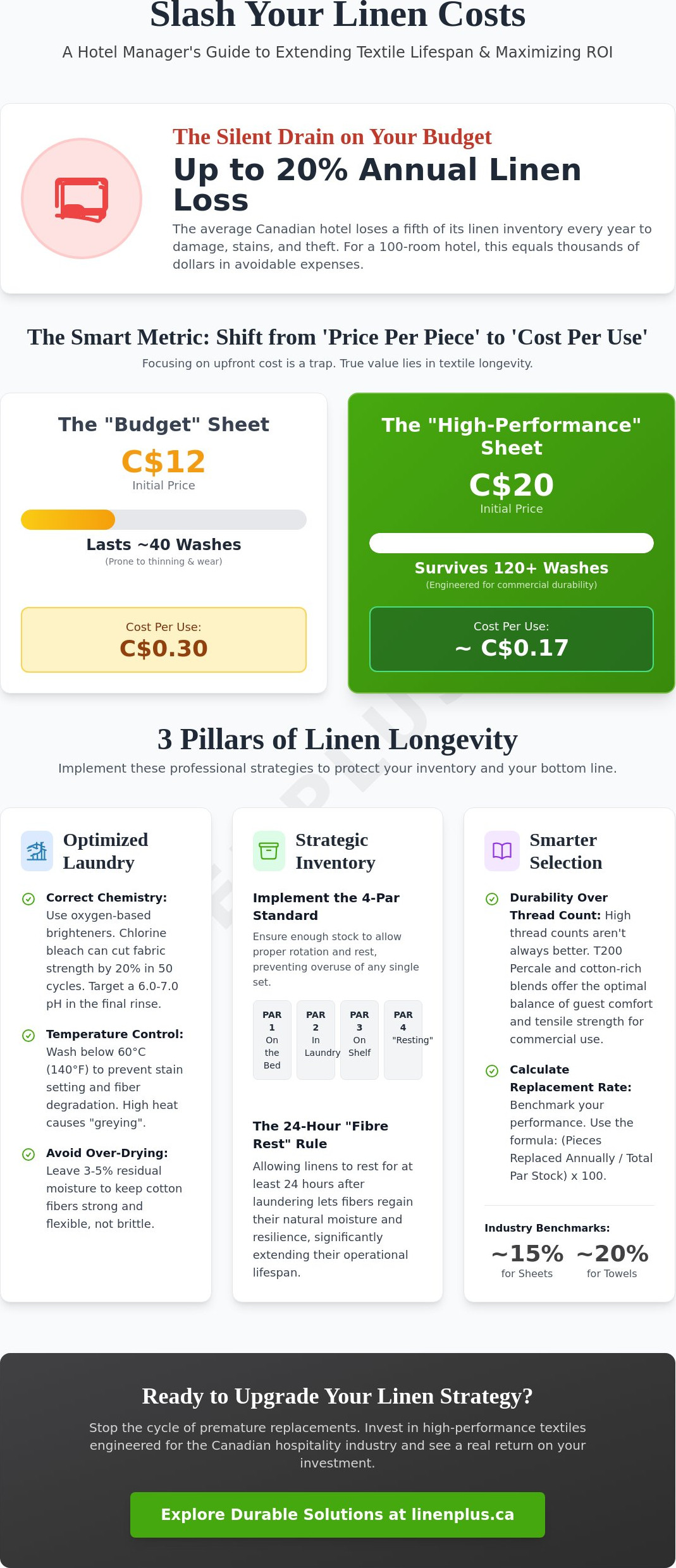
Hotel operators often focus on the upfront invoice. This is the "price per piece" trap. A budget-grade sheet might cost C$12, but if it fails after 40 industrial wash cycles, your annual spend skyrockets compared to a premium C$20 sheet that survives 120 cycles. To understand how to reduce linen replacement costs in a hotel, you've got to pivot to the "Cost per Use" metric. This calculation accounts for the initial purchase price divided by the projected lifespan of the textile. It's the most accurate way to measure ROI in 2026.
Linen loss occurs through three primary channels. Mechanical wear happens in high-speed extractors and dryers. Chemical damage results from improper pH levels or excessive bleach during the laundry process. Guest-related loss includes permanent staining from cosmetics or outright theft. These expenses directly erode your Average Daily Rate (ADR). For a typical 100-room Canadian hotel, a 5% increase in linen loss can translate to thousands of dollars in lost profit annually. Every piece of discarded fabric is a direct hit to the bottom line.
The Hidden Costs of Premature Textile Aging
Thinning sheets and frayed bath towels do more than just look bad. They trigger negative guest reviews. In competitive markets like Vancouver or Toronto, a single point drop in satisfaction scores can impact your booking volume. There's also a labor burden. Housekeeping staff spend roughly 15% more time per room when they must manually sort through damaged inventory to find usable items. This inefficiency adds up to significant payroll waste over a fiscal year.
Calculating Your Annual Replacement Rate
Setting a benchmark is the first step toward efficiency. Use this formula: (Annual Pieces Replaced / Total Par Stock) x 100. For 2026, industry standards suggest a 15% replacement rate for sheets and pillowcases and 20% for towels. If your rates exceed these numbers, your procurement strategy needs adjustment. A deep understanding textile properties helps in selecting fabrics that withstand the rigors of Canadian commercial laundries. Knowing how to reduce linen replacement costs in a hotel starts with this data-driven audit of your current inventory turnover.
Optimizing Laundry Operations for Maximum Fabric Longevity
Laundry operations represent the frontline of fabric preservation. High alkalinity is a silent killer of cotton fibres; maintaining a neutral pH between 6.0 and 7.0 during the final rinse prevents chemical burns that lead to premature thinning. When chemicals aren't calibrated, residual surfactants remain in the weave, attracting dirt and accelerating wear. Understanding these technical variables is central to learning how to reduce linen replacement costs in a hotel. Temperature control is equally vital. Washing at temperatures exceeding 60°C (140°F) often sets organic stains and degrades the elastic components in fitted sheets. High heat is also the primary culprit behind "greyed" linens, as it bakes minerals from the water supply directly into the fabric. Over-drying is perhaps the most common operational error in Canadian hospitality laundries. Cotton requires roughly 3% to 5% residual moisture to maintain its tensile strength. When linens are bone-dry, the fibres become brittle and prone to snapping. Additionally, preventive maintenance on commercial washers is non-negotiable. A single 2mm metal burr or a sharp edge inside a drum can ruin a C$60 duvet cover during a high-speed extraction cycle, leading to immediate inventory loss.Modern Laundry Chemistry for Commercial Textiles
- Oxygen-Based Brighteners: Replace harsh chlorine bleach with oxygen-based alternatives. Chlorine can reduce fabric tensile strength by up to 20% over just 50 wash cycles.
- Water Softeners: Many regions across Canada deal with high mineral content. Water softeners prevent calcium buildup, which otherwise makes wholesale bath towels feel scratchy and abrasive to guests.
Staff Training and Standard Operating Procedures (SOPs)
Implementing a "stain-first" protocol is essential. Staff must treat marks before they reach the dryer, as the intense heat of a commercial dryer permanently sets proteins and oils. Training your team to spot these issues early is a practical way to understand how to reduce linen replacement costs in a hotel without sacrificing guest satisfaction. As the impact of housekeeping trends shifts toward less frequent room entries, the quality of each manual linen inspection becomes more critical. Housekeeping staff should be trained to pull damaged items from circulation immediately, preventing them from reaching a guest room where they would trigger a complaint. For facilities looking to improve their operational efficiency, sourcing durable hospitality textiles provides a more resilient foundation for these laundry protocols.
Need Reliable Wholesale Supplies for Your Facility?
Hotels, healthcare facilities, restaurants, and commercial operations across Canada trust Linen Plus for consistent bulk supply and commercial-grade quality.

Bulk Wholesale Pricing
Competitive pricing for large-volume procurement.

Reliable Nationwide Supply
Consistent inventory and fast shipping across Canada.

Hospitality & Healthcare Grade
Products designed for demanding commercial environments.
Implementing Strategic Inventory and Par Level Management
Maintaining a 4-par inventory is the industry benchmark for operational longevity. This system allocates one set in the guest room, one in the laundry cycle, one ready in the floor closet, and one in a resting state. Many facilities struggle with how to reduce linen replacement costs in a hotel because they operate on a 2 or 2.5 par level. This creates a destructive cycle where linens are pulled from the dryer and placed immediately back on beds. Cotton fibres require 24 hours of rest to regain their natural shape and moisture balance. Without this recovery period, heat-stressed fibres become brittle and snap; this leads to premature thinning and a shorter product lifecycle.
Conducting monthly inventory audits on a set date, such as the 15th of every month, is essential to track "linen loss" accurately. These audits help managers determine if a 12% shrinkage rate is due to harsh laundry chemicals or guest theft. To mitigate loss, consider implementing RFID tracking tags or offering premium bath towels for purchase at the front desk. Providing a "buy it now" option for high-quality items turns a potential loss into a retail opportunity, as guests are often willing to pay for luxury they can take home.
Establishing a Rotation System
Implementing a first-in, first-out (FIFO) method in every linen closet ensures even wear across your entire stock. Housekeeping teams should be trained to pull from the bottom of the stack and restock at the top. To make this process measurable, mark your sheets and pillowcases with a discreet date stamp or colour-coded thread. This allows you to track exactly how many wash cycles a piece has endured. When a sheet exceeds 100 cycles, it should be moved to a secondary tier of service or retired before it fails during a guest stay.
Reducing 'Ragging' and Misuse
Misuse by housekeeping staff is a primary cause of avoidable replacement costs. You can prevent this by providing dedicated, colour-coded microfiber cleaning cloths for spills and bathroom surfaces. This stops the common practice of using guest towels for heavy cleaning tasks. Furthermore, educating guests through subtle room signage can significantly impact your bottom line. Referencing the EPA's H2Otel Challenge helps guests understand that reusing towels isn't just about environmental stewardship; it's about reducing the mechanical stress that destroys high-quality textiles. This simple shift in guest behaviour can extend the life of your inventory by as much as 20% over a fiscal year.
Selecting High-Performance Textiles for Commercial Durability
Procurement choices directly dictate your annual par loss. Understanding how to reduce linen replacement costs in a hotel begins with prioritizing tensile strength over marketing metrics like thread count. While retail consumers chase high thread counts, commercial operators know that T200 Percale often outperforms T300+ alternatives in industrial settings. Thicker yarns in a T200 weave withstand the high-pH detergents and 71-degree Celsius temperatures required for sanitization without thinning or tearing prematurely.
Fibre composition is another critical lever for fiscal efficiency. Cotton-rich blends, typically a 60/40 or 70/30 cotton-polyester split, offer substantial operational advantages. These blends dry up to 20% faster than 100% cotton, which reduces energy consumption and the mechanical friction that causes pilling. Standardizing your inventory also eliminates sorting complexity. When housekeeping teams don't have to distinguish between three different white sheet grades, they make fewer errors that lead to chemical damage or improper laundering cycles.
Look for reinforced construction details like double-needle stitching on hems. This prevents the unravelling that often forces a premature retirement of the product. High-density weaves ensure the fabric remains opaque and professional even after 100+ wash cycles, maintaining the guest experience while protecting your bottom line.
Choosing the Right Bedding for High-Turnover Environments
For hotels with high occupancy rates, T200 Percale Bed Sheets provide the necessary balance of guest comfort and institutional durability. These sheets maintain their structural integrity through repeated industrial processing. Transitioning to duvet covers instead of traditional bedspreads also extends the life of your top-of-bed items. Covers are simpler to launder and protect the expensive inner duvet from stains, significantly lowering the frequency of full-bedding replacements.
Selecting Towels That Withstand Daily Laundering
The construction of your bath linen determines how quickly it will shed or fray. Unlike carded cotton, ring-spun towels use longer fibers that are continuously twisted to create a smoother, stronger yarn. This process reduces linting in commercial dryers by approximately 25%. To optimize your budget, review the Wholesale Linens Canada guide for bulk purchasing strategies. Investing in high-density weaves ensures your towels remain in service longer, even with the aggressive agitation of daily commercial laundering.
Securing Your Hospitality Bottom Line for 2026
Transitioning from a reactive replacement model to a proactive management strategy protects your property's bottom line. Focus on the total cost of ownership and maintain a strict 3-par inventory level to extend the lifespan of every sheet and towel in your facility. Learning how to reduce linen replacement costs in a hotel requires a shift toward specialized T200 and T250 hospitality-grade textiles designed to withstand the intensity of industrial laundering cycles. These high-performance fabrics offer the durability needed to maintain guest satisfaction while lowering annual procurement expenses. Investing in quality upfront prevents the frequent churn of low-grade materials.
Operational excellence relies on consistent quality and reliable supply chains. Our direct manufacturer partnerships and national Canadian distribution network eliminate lead time uncertainty for busy operations managers. You'll receive specialized support that prioritizes your facility's long-term fiscal health over short-term fixes. Optimize your hospitality operations with high-durability linens from Linen Plus today. Building a more resilient textile inventory starts with choosing the right partner for your commercial needs. We're ready to help you streamline your procurement process across all Canadian locations.
Frequently Asked Questions
What is the average lifespan of a hotel bed sheet?
A high-quality hotel bed sheet typically lasts between 150 and 200 industrial wash cycles before the fabric integrity begins to fail. For a Canadian property maintaining 80% occupancy, this usually results in a replacement cycle of 12 to 18 months per sheet. Monitoring the thread count and tensile strength during monthly inventory audits helps managers identify when sheets are nearing the end of their functional life.
How many par levels of linen should a hotel maintain for maximum efficiency?
Hotels should maintain a minimum of 4 par levels to ensure operational stability and extend the life of their inventory. This system assigns one par in the guest room, one in the laundry process, one clean set in the linen closet, and one set resting for 24 hours. Implementing a 4-par system is a fundamental strategy for how to reduce linen replacement costs in a hotel because it prevents fiber fatigue caused by immediate reuse.
Does using fabric softener actually damage hotel towels?
Using commercial fabric softeners damages hotel towels by coating the cotton fibers in a hydrophobic waxy film that significantly reduces water absorbency. This buildup makes towels feel greasy over time and can lead to a greyish discoloration that ruins the guest experience. It's better to use a proper souring agent during the final rinse to neutralize pH levels, which keeps towels soft without compromising the GSM performance.
How can I tell if my laundry chemicals are too harsh for my linens?
You can tell if laundry chemicals are too aggressive by checking for "pinholes" in the fabric or noticing a yellow tint on white linens after fewer than 75 washes. Test the pH of your damp linens after the final rinse; a reading outside the 5.5 to 6.5 range indicates that your chemical titration is incorrect. If your linens feel brittle or "crunchy" when dry, it's a sign that high alkalinity is stripping the natural oils from the cotton fibers.
Is it more cost-effective to repair or replace stained hotel linens?
It's more cost-effective to replace linens with permanent stains larger than a C$2 coin located in the center of the fabric. While small edge tears can be repaired by a seamstress to extend the item's life, visible stains usually require the item to be downgraded to a cleaning rag to maintain brand standards. Implementing a "reclaim wash" program for localized stains can often recover 15% to 20% of rejected inventory, providing a better ROI than immediate replacement.

Article by
Sohel Shahriar
Sohel Shahriar is the Chief Growth Officer (CGO) at Linen Plus Inc., Canada, bringing a strategic blend of growth marketing, brand leadership, and content expertise. Through his writing, he explores how quality linen, smart sourcing, and long‑term partnerships can create measurable impact for healthcare and hospitality organizations.


