


Did you know that switching from 600 GSM towels to a 500 GSM alternative can reduce your property's drying time by up to 40%? For many operations managers, the pursuit of heavy luxury often results in linens that feel like sandpaper and skyrocketing energy costs from extended laundry cycles. You shouldn't have to sacrifice guest satisfaction to keep your utility bills under control.
This hotel towel GSM guide provides the technical framework you need to stop overspending on energy while maintaining the 4 to 5 star tactile experience your guests expect. By mastering the balance between density and durability, you'll ensure your linens withstand the 50 to 70 industrial wash cycles required in a high volume commercial setting. We will examine why the 500 to 550 GSM range is the industry's current sweet spot for maximizing ROI and inventory efficiency in 2026.
Key Takeaways
- Identify the operational sweet spot where fabric density meets absorbency to prevent skyrocketing utility costs from over-specified linens.
- Utilize this hotel towel GSM guide to select the appropriate weight tier for your specific facility, from high-traffic fitness centers to mid-scale guest suites.
- Understand why ring spun yarn and long-staple cotton offer better long-term softness and durability than high-GSM towels made with inferior open-end fibers.
- Apply the "Weight-to-Wash" ratio to calculate your true cost per use, moving beyond initial unit pricing to optimize your laundry and replacement budget.
Understanding GSM: The Industry Standard for Commercial Towel Weight
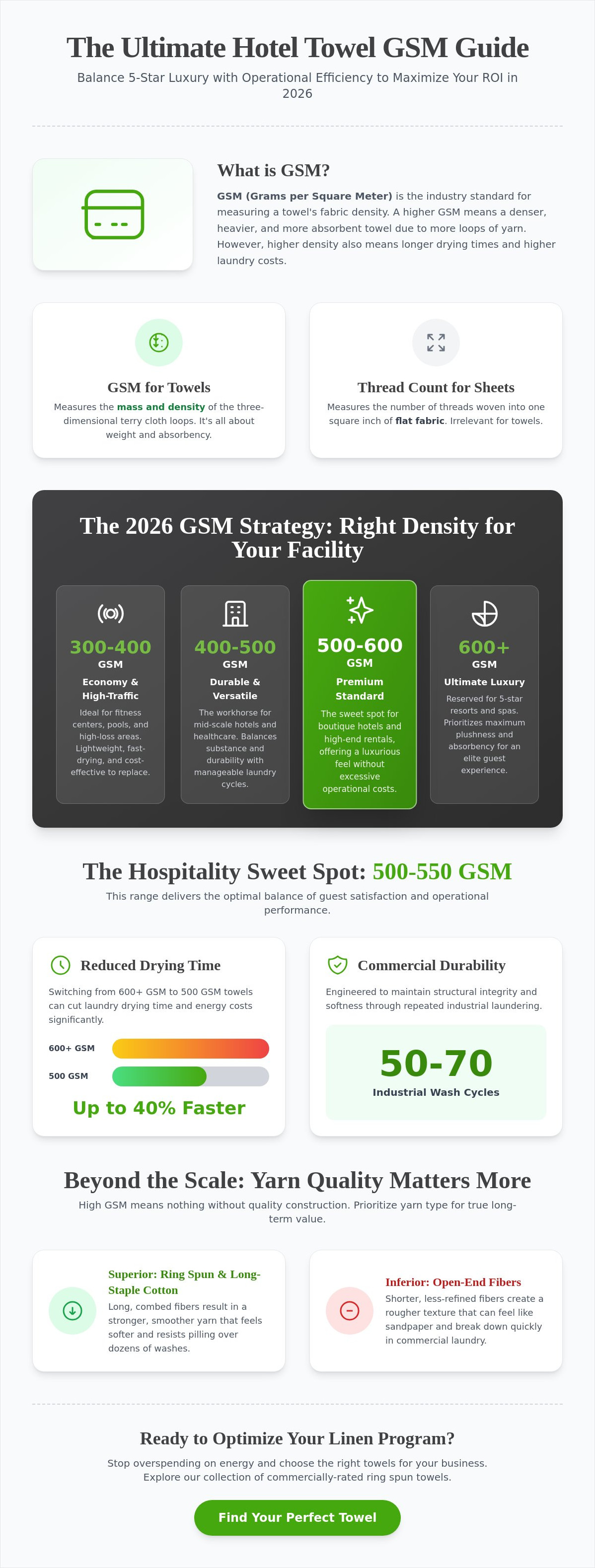
GSM (Grams per Square Meter) serves as the primary benchmark for fabric density. In this hotel towel GSM guide, we focus on how this number dictates the physical performance of your linens. Higher GSM values indicate a denser pile with more loops, which increases the surface area for water absorption. However, this density comes with an operational trade-off. As GSM rises, drying times lengthen. For high-volume properties, this correlation is critical because it determines the number of wash cycles your laundry team can complete in a single shift.
In 2026, the industry is moving toward "engineered density." This shift focuses on using superior yarn quality to achieve the plush feel of a high-weight towel without the excessive mass that traps moisture. This approach helps facilities maintain a 4 to 5 star guest experience while lowering the total cost of ownership through reduced energy consumption and faster throughput in the laundry room.
The Technical Breakdown: How GSM is Calculated
Calculation is straightforward; manufacturers weigh a single square meter of the terry cloth to determine the rating. When you buy wholesale, you are paying for this mass. It is common to see slight weight variations in bulk shipments due to humidity or minor manufacturing tolerances. Operations managers must distinguish between dry weight and wet weight during laundry planning. A high-GSM towel can hold several times its weight in water, which can strain commercial extractors and increase mechanical wear if the machines are consistently overloaded.
GSM vs. Thread Count: Clearing the Confusion
A frequent point of confusion for new procurement managers is the difference between these two metrics. While thread count is the standard measurement for sheets, it is irrelevant for towels. Thread count measures the number of threads per square inch of flat-woven fabric. GSM, conversely, measures the mass of the three-dimensional loops. To understand how various towel materials and types like cotton or bamboo blends impact this weight, you must look at the density of the weave rather than the thread count. Combining high thread count bedding with appropriately weighted towels creates a balanced textile package that feels cohesive to the guest.
The 2026 GSM Strategy: Selecting the Right Density for Your Facility
Selecting the correct weight requires matching your property's operational pace with guest expectations. Using a comprehensive hotel towel GSM guide helps you avoid the common mistake of over-specifying linens for high-traffic areas. High-loss environments like fitness centers or pool decks benefit from 300 to 400 GSM towels. These are light, fast-drying, and cost-effective to replace. Mid-scale hotels and long-term care facilities typically rely on the 400 to 500 GSM range. It's a durable workhorse tier that provides enough substance for daily use without straining laundry budgets.
Need Reliable Wholesale Supplies for Your Facility?
Hotels, healthcare facilities, restaurants, and commercial operations across Canada trust Linen Plus for consistent bulk supply and commercial-grade quality.

Bulk Wholesale Pricing
Competitive pricing for large-volume procurement.

Reliable Nationwide Supply
Consistent inventory and fast shipping across Canada.

Hospitality & Healthcare Grade
Products designed for demanding commercial environments.
For boutique hotels and high-end vacation rentals, the 500 to 600 GSM tier represents the premium standard. Once you exceed 600 GSM, you enter the luxury tier reserved for 5-star resorts and spas. These heavy bath sheets prioritize maximum absorbency and a plush hand-feel, though they require significantly more energy to process in industrial dryers.
The "Sweet Spot": Why 500-550 GSM Dominates Hospitality
This hotel towel GSM guide identifies the 500 to 550 GSM range as the most efficient choice for modern hospitality. It offers the tactile luxury guests crave but avoids the operational pitfalls of ultra-heavy linens. Research indicates that a 500 GSM towel can cut drying times by up to 40% compared to 600+ GSM alternatives, leading to lower utility bills. This weight maintains its structural integrity through 50 to 70 industrial wash cycles, provided the construction utilizes high-quality Yarn Quality and Weave. For properties seeking this balance, Premium Ring Spun Towels provide the necessary durability for professional use.
Vertical-Specific Recommendations
Operational requirements shift based on your specific industry. Healthcare facilities should focus on 400 GSM linens. These lighter weights allow for rapid turnover and can withstand the high-heat sanitization cycles required for clinical safety. Spa environments, however, should prioritize 600+ GSM. The higher density is essential for absorbing treatment oils and water, ensuring the guest feels fully enveloped in comfort during their service. If you're managing a diverse facility, consider specialized hospitality supply programs to manage different GSM tiers across departments.
Beyond the Scale: Why Yarn Quality and Weave Outperform Raw GSM
While density is a primary focus in any hotel towel GSM guide, weight alone doesn't guarantee a quality guest experience. The physical composition of the yarn often dictates performance more than the raw grams per square meter. Many procurement managers make the mistake of buying high-GSM towels made from open-end cotton, only to find they become thin and abrasive after 30 industrial wash cycles. Long-staple cotton fibers are essential for preventing linting and maintaining the towel's original mass over its lifespan.
Construction details like double-loop terry and locked selvedge hems are equally vital. A towel with double-stitched edges will outlast a heavier counterpart with single-stitch finishing, as it resists the unraveling common in high-heat commercial dryers. Focusing on these structural elements ensures your inventory remains in service for the expected 50 to 70 wash cycles. Edge integrity is frequently the first point of failure in bulk linens; therefore, reinforcing the selvedge is more critical for ROI than adding extra fabric weight.
The Ring Spun Advantage
The spinning process significantly impacts tactile quality. Ring spun cotton is created by continuously twisting and thinning the fibers, resulting in a smoother, stronger yarn. A 500 GSM ring spun towel often outperforms a 600 GSM open-end alternative because the fibers don't shed as easily during laundering. Yarn quality determines the longevity of the towel, while GSM determines the initial feel. For properties that prioritize both softness and durability, Premium Ring Spun Towels offer the best long-term value.
Specialised Weaves for Specific Duties
Innovation in weaving technology allows for better operational efficiency. Zero-twist technology uses longer, stronger loops that don't require twisting, resulting in a towel that dries much faster in high-volume facilities. For salon and spa environments, bleach-guard treatments are a necessity to protect the fabric's integrity against chemical exposure. If your facility requires linens that maintain their color and strength under harsh conditions, order Bleach Guard Towels to ensure professional-grade durability across every wash cycle.
Maximising ROI: Calculating Laundry Costs and Durability in Bulk Procurement
Achieving a high return on investment (ROI) in bulk procurement requires looking past the initial purchase price. Most managers focus on the cost per unit, but the true metric of success is the cost per use. This hotel towel GSM guide emphasizes that a towel's value is determined by its industrial lifespan, typically 50 to 70 wash cycles, divided by the total expense of laundering it. Standardizing your inventory to a specific GSM tier simplifies laundry sorting and helps maintain consistent par levels across your facility. It's the most effective way to prevent inventory shortages during high-occupancy periods.
The Hidden Costs of High-GSM Linens
Heavier towels carry significant secondary expenses that impact your monthly overhead. The weight-to-wash ratio describes how much water a fabric retains; a 650+ GSM towel absorbs substantially more moisture than a 500 GSM version. Verified data indicates that using a 500 GSM towel can cut drying times by 40% compared to those heavier alternatives. This leads to a direct reduction in electricity and gas consumption. Beyond energy, labor efficiency takes a hit. Heavier linens are more difficult for staff to fold and transport, which can slow down room turnover. For a deeper look at operational strategy, consult our hospitality industry solutions to see how weight impacts your bottom line.
Final Selection Framework
Follow this three-step process to ensure your bulk order meets long-term goals. First, identify your facility's "Vibe vs. Volume" priority. If you run a high-turnover property, prioritize volume and drying speed over extreme plushness. Second, request at least three samples in the 450 to 550 GSM range to compare hand-feel and loop density. Finally, conduct a "10-Wash Test." Launder the samples ten times in your own industrial machines to monitor shrinkage, edge fraying, and grey-out. This hotel towel GSM guide framework ensures that the products you choose can withstand the rigors of commercial use without losing their professional appearance.
Future-Proofing Your Facility’s Linen Lifecycle
Mastering the technical specifications in this hotel towel GSM guide allows you to shift from reactive purchasing to a strategic procurement model. You've seen how the 500 to 550 GSM range serves as the industry sweet spot; it maintains high guest ratings while reducing drying times by up to 40%. By prioritizing ring spun yarn and reinforced construction over raw weight, you ensure your inventory survives the standard 50 to 70 industrial wash cycles without losing its professional finish.
Standardizing your linens simplifies par level management and reduces utility overhead across your entire operation. We provide Canadian businesses with direct manufacturer partnerships to ensure competitive bulk pricing on specialized textiles. Our inventory includes ring spun and bleach-guard options designed specifically for the high-stakes hospitality and spa sectors. With nationwide distribution across Canada, we ensure your facility stays fully stocked and operationally efficient.
Start optimizing your cost per use today with linens engineered for longevity and guest comfort.
Browse our Professional Collection of Wholesale Hotel Towels
Frequently Asked Questions
What is the best GSM for hotel towels to ensure durability?
The 450 to 550 GSM range is the industry benchmark for commercial durability. This weight provides enough fiber density to withstand repeated industrial laundering while avoiding the structural breakdown often seen in thinner, lower-weight linens. It's the standard for 3 to 4 star properties that require a balance of longevity and guest comfort without excessive replacement costs.
Does a higher GSM always mean a better quality towel for my hotel?
No, raw GSM is only a measure of weight and density, not necessarily the overall quality of the textile. A towel with a lower GSM made from premium ring spun cotton will often feel softer and last longer than a high-GSM towel made from inferior open-end fibers. You should evaluate yarn quality and hem construction alongside the weight rating to determine the true value of your inventory.
How does GSM affect the drying time and energy costs in commercial laundries?
GSM has a direct impact on your laundry overhead because heavier towels retain more water during the wash cycle. High-density linens require significantly longer drying cycles, which increases gas or electricity consumption and extends labor hours for your housekeeping team. This hotel towel GSM guide suggests that optimizing weight can lead to substantial savings on annual utility expenditures by reducing total machine run time.
Which towel GSM is recommended for gym and spa facilities?
Gyms and pool areas typically utilize 300 to 400 GSM towels because they are lightweight and dry quickly between frequent uses. Spa facilities, however, require 600+ GSM bath sheets to provide the maximum absorbency necessary for treatments and oils. Matching the weight to the specific facility usage ensures you aren't overspending on premium linens in areas where high loss rates or chemical exposure are common.
Can I use the same GSM for bath towels, hand towels, and washcloths?
While you can use the same GSM across a full set, many properties vary weights to improve operational efficiency. For example, a 550 GSM bath towel provides guest luxury, while a 400 GSM hand towel or washcloth dries faster and is easier for guests to handle. Standardizing the GSM across a single product type helps your laundry team maintain consistent par levels and simplifies the sorting process during high-volume turnover.

Article by
Sohel Shahriar
Sohel Shahriar is the Chief Growth Officer (CGO) at Linen Plus Inc., Canada, bringing a strategic blend of growth marketing, brand leadership, and content expertise. Through his writing, he explores how quality linen, smart sourcing, and long‑term partnerships can create measurable impact for healthcare and hospitality organizations.


