


With hotel renovation costs increasing by 22% over a recent three year period, a single procurement error in your linen or amenity order can devastate your 2026 fiscal budget. You've likely faced the frustration of receiving inconsistent quotes that are impossible to compare or budget sheets that fail to survive even a month of industrial laundering. Learning how to write a request for proposal for hotel supplies is the only way to force vendor transparency and secure predictable pricing for the upcoming fiscal year.
Mastering this process ensures your facility receives products that meet strict durability and safety standards. This guide provides the technical framework needed to draft a professional RFP that prioritizes textile longevity and logistical reliability over the lowest unit cost. We'll examine how to incorporate essential requirements, such as OEKO-TEX Standard 100 certifications and compliance with the August 2026 EU Packaging and Packaging Waste Regulation, so you can build partnerships with distributors who truly understand hospitality demands.
Key Takeaways
- Understand how a structured RFP process eliminates quote discrepancies and ensures that all vendor submissions are evaluated on a standardized basis.
- Master the technical language of procurement by learning how to write a request for proposal for hotel supplies that specifies T200 versus T250 thread counts and GSM requirements for linens.
- Implement a comprehensive 5-part framework to organize your procurement goals, SKU lists, and volume estimates into a clear document for potential distributors.
- Evaluate potential partners based on their ability to provide long-term pricing stability and value-added services such as custom embroidery for hotel uniforms.
The Strategic Importance of a Formal RFP in Hotel Supply Procurement
A Request for Proposal (RFP) serves as a formal invitation for vendors to bid on specific inventory requirements, acting as a technical blueprint for your facility. It's much more than a simple price check. When you master how to write a request for proposal for hotel supplies, you shift your operations from reactive, retail-style ordering to strategic wholesale procurement. This structured approach eliminates the "apples-to-oranges" confusion that often arises from comparing disparate vendor quotes. Without a formal document, one supplier might offer a "standard" towel while another quotes a premium ring-spun version, making a true cost comparison impossible.
Boutique hotels and smaller properties often overlook this process, assuming their volume doesn't justify the effort. However, formalizing supply standards is essential for fiscal responsibility regardless of property size. It moves the conversation from unit price to long-term value. This allows you to secure predictable hospitality supply rates for the entire fiscal year, protecting your margins against sudden market fluctuations.
Moving Beyond Unit Price to Total Cost of Ownership
Price is a deceptive metric in the hospitality sector. A budget-grade towel that survives only 30 industrial wash cycles is significantly more expensive than a premium option that lasts 100 washes. Your RFP should prioritize "laundry-ready" durability. By specifying technical requirements that account for high-heat and high-friction environments, you ensure that your investment doesn't literally wash away within a few months of use. Longevity is the foundation of a sustainable procurement strategy.
Standardizing Guest Experience Across Properties
Consistency defines a professional brand. An RFP ensures that every guest room maintains the same textile hand-feel and amenity quality. By standardizing your sheets and pillowcases, you protect your reputation for quality. For properties tied to major brands, this includes mandatory specifications for approved guest amenities, such as Dove IHG exclusive collections, which must be strictly adhered to during the bidding process to maintain brand compliance.
Defining Technical Specifications for Linens and Guest Amenities
Technical precision is the most critical element when you're learning how to write a request for proposal for hotel supplies. Vague terms like "high quality" lead to inconsistent bids and procurement headaches. Instead, your document must specify measurable metrics. For bed linens, define whether you require T200 or T250 thread counts. Percale weaves offer a crisp, breathable feel ideal for high-turnover rooms, while Sateen provides a heavier, silkier finish for luxury suites. Material composition matters too; cotton-poly blends offer superior durability for industrial laundering, whereas 100% ring-spun cotton is the standard for premium comfort.
Need Reliable Wholesale Supplies for Your Facility?
Hotels, healthcare facilities, restaurants, and commercial operations across Canada trust Linen Plus for consistent bulk supply and commercial-grade quality.

Bulk Wholesale Pricing
Competitive pricing for large-volume procurement.

Reliable Nationwide Supply
Consistent inventory and fast shipping across Canada.

Hospitality & Healthcare Grade
Products designed for demanding commercial environments.
Bath linens require weight and absorbency standards defined by Grams per Square Meter (GSM). A 500-600 GSM towel is standard for guest rooms, but spa environments may require 700+ GSM. Beyond textiles, include safety and janitorial specs. This includes ASTM Level 3 ratings for surgical masks and specific mil thickness for heavy-duty trash liners to prevent facility management mishaps. When you master how to write a request for proposal for hotel supplies, you ensure that every vendor is bidding on the exact same level of durability and performance.
Bedding and Bath Textile Metrics
For high-volume operations, T200 Percale Bed Sheets are often the most cost-effective choice due to their breathability and structural integrity. If your property targets a higher price point, differentiate your bid by requesting Premium Ring Spun Towels. These provide a plush hand-feel that survives repeated processing without fraying or losing absorbency.
Guest Room Amenities and Toiletries
Your RFP should address the shift from individual bottles to bulk shampoo and conditioner systems, especially with the EU Packaging and Packaging Waste Regulation (PPWR) taking effect in August 2026. Bulk dispensers significantly reduce plastic waste and lower the cost-per-use. Specify fragrance profiles and packaging to ensure they match your hotel’s aesthetic. Providing clear requirements for dispenser hygiene and mount durability prevents unexpected maintenance costs. If you're refining your procurement standards, you can browse our full range of hotel supplies to find the right technical fit for your property.
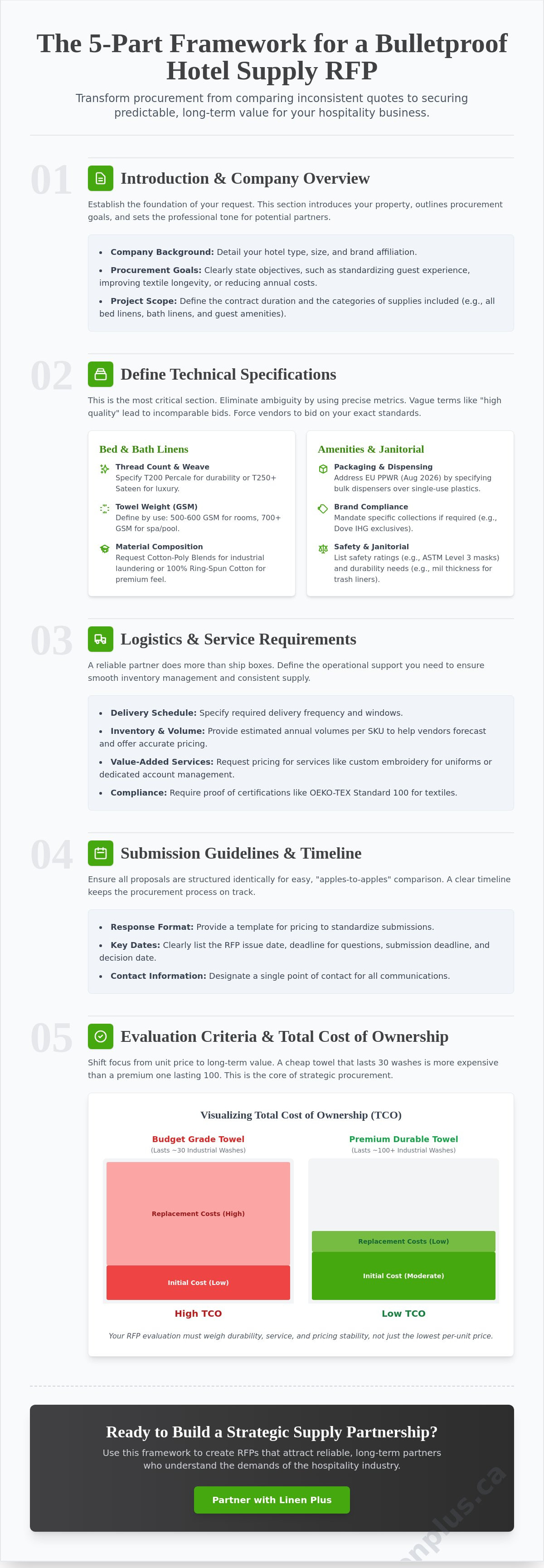
The 5-Part Framework: Structuring Your Hotel Supply RFP
A well-organized document prevents vendor confusion and ensures you receive actionable data. When mastering how to write a request for proposal for hotel supplies, you should follow a logical sequence that moves from broad brand goals to granular SKU requirements. This structure forces vendors to address your specific operational needs rather than providing a generic sales pitch. Use the following five steps to build your framework:
- Step 1: Company Overview and Procurement Goals – Define your brand identity and explain why you're seeking a new partnership. State whether you're focusing on cost reduction for the 2026 fiscal year or an upgrade of your guest experience.
- Step 2: Detailed Scope of Work – List every required SKU. This includes everything from duvet covers to janitorial essentials. Provide annual volume estimates to help vendors calculate bulk pricing.
- Step 3: Technical and Quality Requirements – Insert the specific GSM, thread count, and material metrics defined in the previous section.
- Step 4: Logistical and Delivery Expectations – Clearly define your required lead times, backorder policies, and whether you need nationwide distribution or local drop-shipping.
- Step 5: Submission Guidelines and Evaluation Criteria – Tell vendors exactly how to format their response and how you'll score their bid, such as weighting price at 40% and logistical reliability at 30%.
Setting Realistic Lead Times and Delivery Schedules
Your RFP must demand total transparency regarding a vendor's stock levels. In the current market, "just-in-time" delivery capabilities are essential to avoid overstocking your limited storage space. Include a mandatory section for "Emergency Sourcing." This reveals how a distributor handles sudden occupancy spikes or unexpected supply chain disruptions. A partner who can't guarantee a fast turnaround for emergency medical supplies or linens may not be the right fit for high-stakes operations.
Pricing Transparency and Volume Discounts
Request a tiered breakdown of unit costs versus bulk pricing. This helps you understand how your costs scale as occupancy grows. Vendors should include all shipping, handling, and fuel surcharges in their initial bid to prevent "landed cost" surprises later. If you're ready to implement these standards, you can explore our hospitality procurement programs to see how standardized supply chains improve your bottom line.
Evaluating Proposals and Selecting a Long-Term Supply Partner
Once you've distributed your document, the focus shifts to vetting the responses. Knowing how to write a request for proposal for hotel supplies is only half the battle; you must also know how to interpret the data provided. Prioritize vendors who maintain direct manufacturer partnerships. These relationships are critical for ensuring pricing stability throughout 2026, as they bypass middleman markups and provide more accurate lead time forecasts. A partner who controls their supply chain is better equipped to handle the high-stakes nature of hospitality operations.
Efficiency is another major selection factor. Look for a "total provider" model that covers everything from bed linen to medical-grade safety gear and janitorial essentials. Consolidating your SKUs under one distributor reduces administrative overhead and simplifies your accounts payable process. Additionally, assess their ability to handle custom branding. If your facility requires specific embroidery for chef coats or staff aprons, your vendor should manage this in-house to maintain quality control. In Canada, logistical expertise is non-negotiable. Ensure your chosen partner has a national distribution footprint to provide consistent service across all your property locations, regardless of regional challenges.
The Importance of Physical Samples
Never sign a contract based on a digital catalog alone. Mandate a "sample phase" in your RFP where finalists must submit physical products for rigorous testing. This is the only way to compare the hand-feel and structural integrity of duvet covers and towels after they've undergone multiple industrial wash cycles. If a textile plys or fades after just five washes, it doesn't meet the durability standards required for professional hospitality use.
Vetting for Supply Chain Resilience
Ask potential partners to detail their inventory management systems. You need to know how they mitigate global shipping delays and what their contingency plans are for stock shortages. A reliable partner should offer real-time tracking and proactive communication regarding backorders. For a deeper look at navigating the current market, review the Wholesale Linens Canada: 2026 Procurement Guide to align your strategy with the latest industry trends and logistical requirements.
Securing Your Supply Chain for 2026 and Beyond
A professional procurement strategy transforms your inventory from a recurring expense into a strategic asset. By mastering how to write a request for proposal for hotel supplies, you establish the technical boundaries needed to protect your facility from low-quality substitutes and unpredictable price hikes. The most effective RFPs prioritize measurable metrics like GSM and thread count while mandating physical wash tests to verify long-term durability. These steps ensure your 2026 budget remains stable and your guest experience stays consistent across every property in your portfolio.
Moving from planning to execution requires a partner with direct manufacturer relationships and a nationwide Canadian distribution network. We provide a total provider solution with an inventory ranging from T200 percale linens to medical-grade PPE, designed to simplify your logistics and enhance operational excellence. Partner with Linen Plus for your 2026 Hospitality Procurement Needs and gain the reliability of a vendor that understands the high-stakes nature of your business. Your path to a more efficient and cost-effective supply chain starts with a single, well-structured document.
Frequently Asked Questions
What is the difference between an RFI and an RFP for hotel supplies?
An RFI is a preliminary document used to gather general market information and identify potential vendors, whereas an RFP is a formal invitation to bid on a specific scope of work. Use an RFI if you're exploring new textile technologies or 2026 regulatory impacts. Transition to an RFP when you're ready to commit to a contract and need firm pricing on SKUs like T250 sateen sheets or bulk amenities.
How long should the RFP process take from draft to contract signature?
A standard hospitality procurement cycle typically spans six to twelve weeks from the initial draft to the final contract signature. This duration allows two weeks for drafting, three weeks for vendor responses, and several weeks for physical wash-testing and logistical vetting. Rushing this process often leads to overlooked delivery fees or technical mismatches in linen specifications that hurt your long-term fiscal stability.
Should I include my current pricing in the RFP document?
You shouldn't include your current pricing in the document because it limits your negotiation leverage and encourages vendors to bid just below your current rate rather than providing their best wholesale price. Instead, focus on providing accurate annual volume estimates. When you're learning how to write a request for proposal for hotel supplies, the goal is to force vendors to compete on their own cost efficiencies and logistical capabilities.
How many vendors should I invite to participate in a hospitality RFP?
Inviting three to five qualified vendors is the industry standard for a manageable and competitive RFP process. Including too many participants creates an administrative burden during the evaluation phase, while inviting fewer than three limits your ability to benchmark pricing and service levels. Ensure every invited vendor has a proven national distribution footprint and direct manufacturer partnerships to guarantee inventory reliability for your properties.
What are the most common mistakes in hotel supply RFPs?
The most frequent errors include using vague technical specifications and failing to account for "landed costs" like shipping and fuel surcharges. Many managers forget to mandate physical samples, resulting in guest rooms stocked with linens that fray after minimal use. Another mistake is ignoring a vendor's emergency sourcing capabilities, which leaves your facility vulnerable during sudden occupancy spikes or supply chain disruptions.

Article by
Sohel Shahriar
Sohel Shahriar is the Chief Growth Officer (CGO) at Linen Plus Inc., Canada, bringing a strategic blend of growth marketing, brand leadership, and content expertise. Through his writing, he explores how quality linen, smart sourcing, and long‑term partnerships can create measurable impact for healthcare and hospitality organizations.


