


A stripped hex socket rarely announces itself. The key slips a quarter-turn, the edges round over, and a two-minute adjustment becomes a drill-out-and-replace job. In Canada, that problem has a local twist: our hotels, clinics, workshops and fleets run on a mix of metric and imperial fasteners, so the "close enough" key is always within reach. That's a big reason so many maintenance professionals have switched to Wera Allen keys, and it's also why the set you choose matters more than the logo on it.
This guide goes further than the usual product roundup. We'll look at what Wera's Hex-Plus profile actually changes inside the screw head, how to avoid Canada's metric-imperial "near-miss" sizes, when a ball end helps (and when it can snap), what facility teams should keep on the maintenance cart, and which 2026 trade and currency factors are shaping hand-tool supply across the country. Wherever we cite a number, we tell you where it comes from.
Wera Allen keys are hex L-keys made by Wera Werkzeuge, a German toolmaker founded in Wuppertal in 1936. Their signature Hex-Plus profile pushes force onto the flat sides of the screw socket instead of its corners, which reduces rounding and lets you apply more torque before the key slips. Hex-Plus keys fit standard hex sockets, so no special screws are needed. For Canadian buyers, the smartest setup is a colour-coded metric Wera set paired with a separate imperial set, plus a TORX set for appliances, fixtures and newer furniture. You can compare options in the Linen Plus tools category.
What Makes Wera Allen Keys Different From a Standard Hex Key?
A standard hex key is a straight-sided hexagon. Under load, its six corners press into the six corners of the socket, which are the weakest points of both the key and the screw. Push hard enough, once or a hundred times, and those corners deform. The key starts rotating inside the screw instead of turning it.
Wera's answer was to rethink the shape of the key rather than simply harden the steel. That design choice is what separates Wera Allen keys from most commodity sets.
The Hex-Plus profile
The Hex-Plus profile is shaped so contact happens along the flat flanks of the socket, away from the corners. Wera states that this creates a larger contact surface and allows noticeably higher torque transmission than a conventional hexagon, with the company citing figures of up to roughly 20 percent. Treat any manufacturer figure as a best case. Even so, the practical effect is easy to feel on the job: less "spring" in the key, less slip, and cleaner sockets after repeated use. Because Hex-Plus keys still fit sockets made to the ISO 2936 hex key standard, your existing fasteners don't need to change.
Colour coding you can read with gloves on
Wera's Multicolour sets give each size its own colour. It sounds cosmetic until you're on a step ladder in a hotel corridor, wearing work gloves, trying to tell a 4 mm key from a 5 mm key under dim lighting. Faster size identification means fewer wrong-key attempts, and fewer wrong-key attempts mean fewer damaged sockets. Bright keys are also harder to lose in a guest room or behind a dental chair.
Ball end on the long arm, full hex on the short arm
Most Wera L-key sets put a ball end on the long arm for angled entry and fast spinning, while keeping the full Hex-Plus profile on the short arm for final tightening and for breaking stubborn screws loose. Knowing which end to use is half the value of a premium set. We'll explain why in the comparison section below.

Wera 950/9 Hex-Plus Multicolour 2 L-Key Set, Metric (9 Keys)
Nine metric Hex-Plus keys, each colour-coded by size. A dependable core set for maintenance carts, workshops and fleet vans.
View Product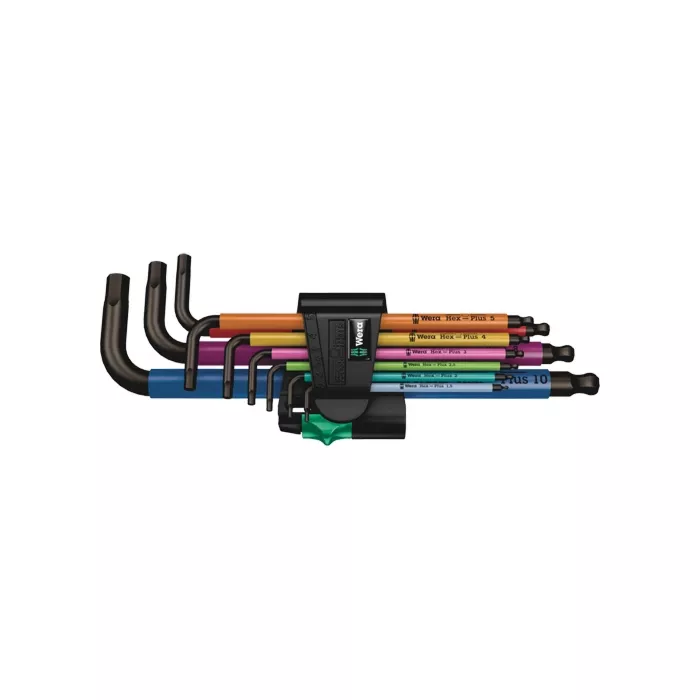
Wera Hex-Plus Key Set
Wera's anti-rounding Hex-Plus profile in a full key set. A strong choice for teams that tighten and loosen hex screws every day.
View ProductCanada's Metric-Imperial Problem: Why the "Almost Right" Key Strips Screws
Canada began converting to metric in the 1970s, yet a large share of the equipment we maintain still uses imperial (SAE) hex sockets. Think US-built furniture, HVAC units, door closers, older machinery, exercise equipment and many bicycle components. Several imperial and metric sizes are close enough that the wrong key will seat, and even turn, until the moment it doesn't.
Need Reliable Wholesale Supplies for Your Facility?
Hotels, healthcare facilities, restaurants, and commercial operations across Canada trust Linen Plus for consistent bulk supply and commercial-grade quality.

Bulk Wholesale Pricing
Competitive pricing for large-volume procurement.

Reliable Nationwide Supply
Consistent inventory and fast shipping across Canada.

Hospitality & Healthcare Grade
Products designed for demanding commercial environments.
Here are the pairs that cause the most damage. The millimetre figures are simple conversions (1 inch = 25.4 mm).
| Imperial size | Exact metric value | Nearest metric key | What usually goes wrong |
|---|---|---|---|
| 5/32" | 3.97 mm | 4 mm | The 4 mm key is fractionally oversize. It gets hammered in, jams, and damages the socket mouth. |
| 3/16" | 4.76 mm | 5 mm | A 3/16" key in a 5 mm socket has about 0.24 mm of play. It turns at first, then rounds the corners. |
| 1/4" | 6.35 mm | 6 mm | A 6 mm key in a 1/4" socket has roughly 0.35 mm of slop. This is one of the most common causes of stripped imperial screws. |
| 5/16" | 7.94 mm | 8 mm | Only about 0.06 mm apart, so it feels right. Under high torque, the mismatch still concentrates load on the corners. |
| 3/8" | 9.53 mm | 10 mm | A 3/8" key in a 10 mm socket has nearly half a millimetre of play. Expect rounding on the first hard pull. |
The fix is organisational, not heroic. Keep metric and imperial keys physically separate: different set, different pouch, clearly labelled. Wera's colour coding helps within a metric set, and a dedicated imperial set, such as the ball-end and folding sets featured below, covers the rest. Many facility managers simply mark carts and drawers "MM" and "SAE" so a new technician never has to guess.
Are Wera Allen Keys Worth the Price for Business Buyers?
Premium hex keys cost more than a bargain-bin set. The real question for a procurement manager isn't the price of the keys. It's the cost of a failure.
Consider an illustrative scenario. One stripped hex screw on a hotel bed frame can mean 20 to 40 minutes of extraction work, a replacement fastener, and, if the repair runs long, a room that can't be sold that night. In a clinic, a stuck adjustment on a stool or equipment bracket can delay appointments. If a better key prevents just two of those incidents per technician per year, the set has typically paid for itself. Your own numbers will vary, but the logic holds for most operations.
A total-cost checklist for hex keys
- Tool life: How many months before the tips round off and the set needs replacing?
- Fastener damage: Does the key protect sockets, or slowly wear them out?
- Time to find the size: Colour coding and clear markings shave seconds off every job, and seconds add up across a property.
- Loss rate: Brightly coloured keys and holders go missing less often than loose black ones.
- Standardisation: One trusted set per technician makes training and restocking simpler.
When a budget key is perfectly fine
Honesty matters here. If a key is used once to assemble a flat-pack desk and then goes in a drawer, a basic key will do the job. Wera Allen keys earn their keep in repeat-use, higher-torque work: maintenance rounds, equipment servicing, fleet work, and anywhere a damaged fastener costs real time or revenue.
Hex-Plus vs Ball-End vs Folding vs TORX: Which Set Does Your Team Need?
Most teams don't need every type of key. They need the right two or three. Use this table to match each format to the work you actually do.
| Key type | Best for | Watch out for |
|---|---|---|
| Hex-Plus L-key set (e.g. Wera 950/9) | Frequent, higher-torque work and protecting sockets from rounding | Still keep a separate imperial set for SAE fasteners |
| Ball-end L-key set (e.g. Eklind Ball-Drive) | Angled entry in tight spaces and fast run-down of long screws | The neck behind the ball is thinner. Never use it for final torque or breaking screws loose |
| Folding hex key set (e.g. Klein Tools) | Belt or pocket carry, quick adjustments, fewer lost keys | Shorter reach and less leverage. Can't reach deeply recessed screws |
| TORX L-key set (e.g. Wera 9-key TORX) | Appliances, electronics, automotive parts, newer fixtures and furniture | Security TORX screws have a centre pin and need tamper-resistant keys |
Why does a ball-end Allen key break?
A ball end lets you enter the screw at an angle. Ball-end makers commonly rate that angle at up to about 25 degrees. The trade-off is physics: the neck behind the ball is narrower than the main shaft, and contact inside the socket is limited. Use the ball end to spin screws in or out quickly, then switch to the straight hex end for the final tightening or the first hard break-loose turn. That one habit prevents most snapped ball ends.
When TORX beats hex
TORX drives have six rounded lobes that transmit torque with very little cam-out. Manufacturers increasingly use them in appliances, lighting, plumbing fixtures and equipment housings. If your team services anything newer than about a decade old, a TORX L-key set belongs beside your hex keys.

Wera L-Key Set, TORX® (9 Keys)
Nine TORX L-keys for appliances, fixtures, equipment housings and automotive work, built to Wera's professional standard.
View Product
Eklind Ball-Drive L-Style Hex Key Set (7 Keys)
Seven ball-end L-keys for angled access in tight spots behind furniture, fixtures and equipment.
View Product
Klein Tools Compact Folding Hex Key Set
All the common sizes in one fold-out handle. Easy to carry on a belt and hard to lose during room rounds.
View ProductThe Facility Maintenance Angle: Where Wera Allen Keys Earn Their Keep
Most Allen key guides are written for home workshops. Yet some of the heaviest hex-key users in Canada are facility teams: hotel engineers, clinic maintenance staff, property managers and fleet technicians. Their work is repetitive, time-sensitive and often done in guest-facing or patient-facing spaces where a quick, clean fix matters.
Hospitality
Bed frames and headboards, desk chairs, luggage racks, lever door handles, door closers, towel bars and shower handle set screws all rely on hex or TORX fasteners. Loose hardware generates guest complaints and negative reviews long before it causes a breakdown. A well-organised key kit lets one engineer tighten a whole floor in a single round.
Healthcare and dental
Exam stools, adjustable equipment arms, wall-mounted brackets, grab bar fittings and cabinet hardware all need periodic checks. In clinical settings, a loose fitting is a safety concern, not just an annoyance. Precise keys help technicians tighten hardware properly without damaging fasteners on expensive equipment.
A practical maintenance-cart kit
- One colour-coded metric Hex-Plus L-key set as the main workhorse
- One imperial ball-end set for SAE fasteners on US-built equipment
- One TORX L-key set for fixtures and appliances
- A folding hex set on each technician's belt for quick adjustments
- A small magnetic parts tray and a few spare set screws in your most common sizes
Pair the kit with the right powered tools for bigger jobs. A power screwdriver handles repetitive run-down work, while the hand key does the final, controlled tightening.
2026 X-Factors Shaping Hand-Tool Supply in Canada
Hand tools look like a stable category. Over the past two years, they've been anything but. Here's a clear-eyed read of the forces that affect what Canadian businesses pay for precision tools, based on publicly reported policy through mid-2026.
Tariffs and the supply route trap
The 2025 trade dispute reshaped tool pricing. Canada introduced counter-tariffs on many US goods in early 2025, then removed most of them on CUSMA-compliant products in September 2025, while keeping measures on steel, aluminum and autos. You can track the current list on the Government of Canada's tariff response page. Meanwhile, the US raised its own tariffs on steel and steel-containing products during 2025.
Here's the overlooked part. Wera tools are made in Europe, and under the Canada-EU trade agreement (CETA), qualifying EU-made goods can enter Canada duty-free. But when European tools reach Canada through US distribution, US-side import costs can already be baked into the wholesale price before the product crosses the border. Origin rules decide the Canadian duty; the route still shapes the cost. Ask suppliers how a tool reaches Canada, not just where it was made.
Currency swings
German-made tools are priced from euros, while US-made sets such as Eklind and Klein are priced from US dollars. Movements in EUR/CAD and USD/CAD can shift landed costs within a single quarter. Many procurement teams now review tool pricing quarterly and buy complete sets when pricing is favourable, rather than topping up individual keys.
Right to repair is growing in-house maintenance
In November 2024, Canada passed two federal right-to-repair bills, C-244 and C-294, which widened the legal room to diagnose, maintain and repair devices and equipment. More in-house repair means more demand for precise drivers, especially TORX and small hex sizes used in equipment housings.
What smart buyers are doing now
- Standardising on fewer, better sets so restocking is predictable
- Consolidating tool orders with other facility supplies to simplify freight
- Checking country of origin and supply route on steel-based tools
- Replacing worn keys proactively, before they damage costly fasteners
How Do You Make Wera Allen Keys Last?
Even the best keys wear out faster with bad habits. These practices extend tool life and protect your fasteners at the same time.
Seat the key fully, every time
Push the key all the way into the socket before turning. Partial engagement puts all the force on the tip edges, which is the fastest way to round both key and screw. Clear paint, dust or debris out of the socket first with a pick or a short blast of air.
Use the short arm for torque, and skip the cheater pipe
The short arm gives you control for final tightening and breaking screws loose. Sliding a pipe over the long arm for extra leverage can exceed what the key or screw is designed to handle. If a fastener truly needs more force, use a hex bit in a proper ratchet or torque tool.
Plan for Canadian cold and condensation
Steel is less forgiving in deep cold, so avoid shock-loading keys, such as hammering them into a socket, when tools have been sitting in an unheated vehicle at minus 30. The bigger winter risk is condensation. Bringing a cold toolbox into a warm building causes moisture to form on the steel, and that's where rust starts. Wipe tools dry and let the box air out before closing it for the night.
Retire keys before they cause damage
Check the tips regularly. If the corners look rounded or the key feels loose in a socket it used to grip, replace it. A worn key costs a few dollars to replace. A stripped screw in a piece of equipment can cost an afternoon.
Build Out the Rest of Your Toolkit
Allen keys are one part of a well-equipped maintenance operation. Explore related categories from the Linen Plus tools range:
 Power Fastening Tools
  Power Screwdrivers
  AV & Telecom Tools
  Pneumatic Vacuums
  Planers & Joiners
  Forestry Tools
Frequently Asked Questions About Wera Allen Keys
Are Wera Allen keys metric or imperial?
Wera makes both. The Wera 950/9 Hex-Plus Multicolour set featured in this guide is metric. Because many Canadian facilities maintain US-built equipment with imperial fasteners, the most practical setup is a metric Wera set plus a dedicated imperial set, stored separately.
What is the difference between Hex-Plus and a regular hex key?
A regular hex key presses on the corners of the screw socket, which are the first parts to deform. Wera's Hex-Plus profile shifts contact to the flat sides of the socket, giving more contact area, less rounding and more usable torque. Hex-Plus keys fit standard hex screws.
Can I use a ball-end Allen key to loosen a seized screw?
No. The narrow neck behind the ball is the weakest part of the key. Break the screw loose with the straight short arm first, then switch to the ball end to spin it out quickly.
Is a TORX key the same as an Allen key?
No. An Allen key has a six-sided hexagon tip, while a TORX key has six rounded lobes. They aren't interchangeable, and forcing one into the other will damage the fastener.
Where can I buy Wera Allen keys in Canada?
Linen Plus supplies Wera L-key sets alongside Eklind and Klein Tools hex key sets for businesses across Canada. Browse the full range in our tools category. US-based buyers can shop through Linen Plus USA.
The Right Key Protects More Than the Screw
Wera Allen keys stand out for one practical reason: they're designed to protect the fastener, not just turn it. Pair a colour-coded metric Hex-Plus set with a separate imperial set, add TORX for modern fixtures, and use the ball end only for speed. Those three habits will prevent most stripped screws your team will ever face.
Ready to equip your maintenance team? Explore professional hand tools and power tools for your facility, or read more practical guides on the Linen Plus blog.
Explore Professional Tools


