


Why are you replacing your kitchen staff's uniforms every six months when a commercial grade garment should last for over 50 industrial wash cycles? You already know that a professional appearance is non-negotiable, especially in open-concept Canadian restaurants where the kitchen is part of the guest experience. However, balancing the upfront cost of Chef Coats and Aprons with the daily reality of grease, high heat, and rigorous laundering is a constant operational challenge.
It's frustrating to watch your investment tear or stain within weeks, or see your team struggle with overheating in poorly ventilated fabrics. This 2026 buyer's guide provides the technical specifications you need to select apparel that minimizes heat stress and maximizes garment longevity. We'll help you master the nuances of fabric weight and construction to ensure your team stays safe and your branding remains consistent.
We'll break down the specific GSM requirements for Canadian safety standards, evaluate moisture-wicking technologies, and show you how to maintain a cohesive look across every role in your facility.
Key Takeaways
- Understand why double-breasted designs are a functional necessity for thermal protection and maintaining a professional appearance throughout a demanding shift.
- Identify the ideal 175-240 GSM range to ensure your culinary apparel withstands the rigors of industrial laundering without sacrificing employee comfort.
- Select station-specific styles that balance executive aesthetics with the high-utility, ventilated designs required for line and prep staff.
- Learn how bulk procurement of Chef Coats and Aprons and custom embroidery can lower your total cost of ownership while strengthening brand trust in the Canadian hospitality market.
The Essential Role of Chef Coats and Aprons in Food Service Safety
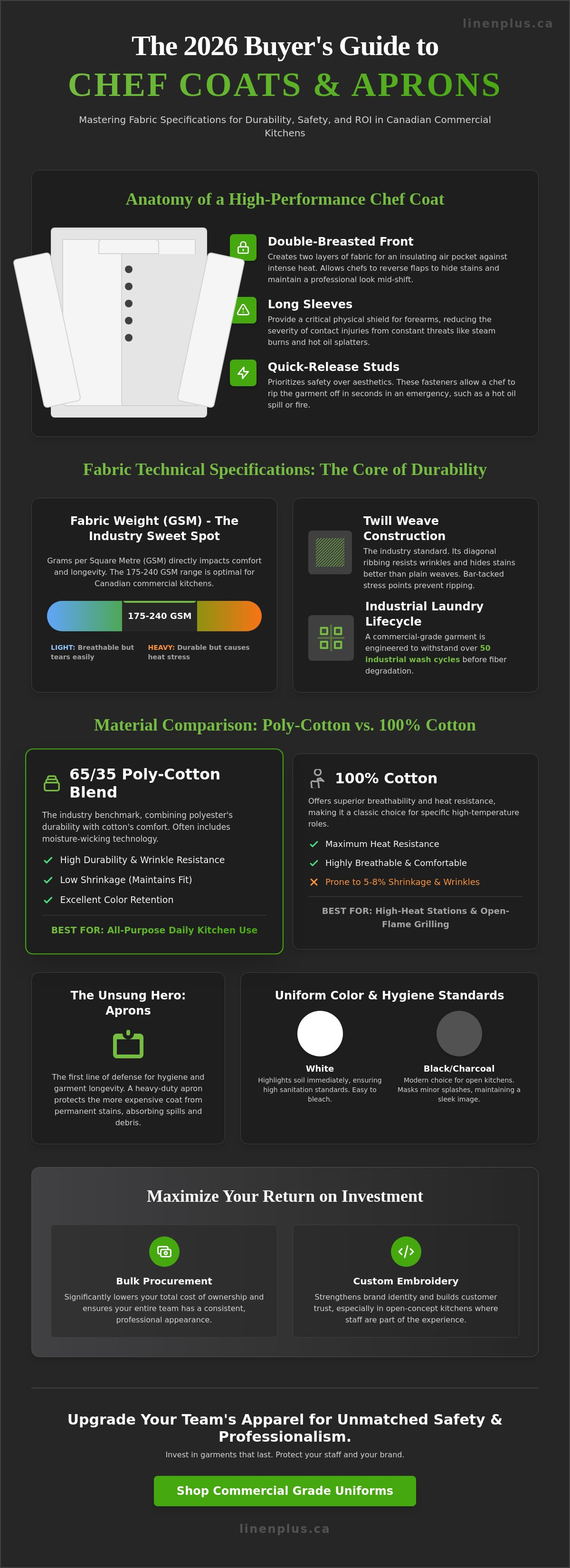
Professional chef coats function as a primary barrier between the wearer and the intense thermal hazards of a commercial range. Within the structure of a traditional chef's uniform, the double-breasted jacket provides two layers of heavy-duty cotton or poly-cotton blend. This design creates an insulating air pocket against heat and allows a chef to reverse the front flaps if one side becomes soiled. It's a practical solution for maintaining a clean appearance during a long shift without requiring a full garment change during service peaks.
Aprons act as the first line of defense for both hygiene and garment longevity. By absorbing the brunt of spills and organic debris, they protect the more expensive coat underneath from permanent staining and degradation. In Canada, food safety regulations such as the Food Premises Regulation require staff to wear clean, functional outer garments. High-quality Chef Coats and Aprons are engineered with reinforced stitching and specific weave densities to prevent fiber shedding. This helps hospitality operations avoid physical contamination risks and maintain compliance during health inspections.
Thermal Protection and Kitchen Safety
Long sleeves are essential in high-volume environments where steam burns and oil splatters are constant risks. These sleeves provide a physical shield for the forearms, reducing the severity of contact injuries. Most commercial coats use quick-release studs rather than standard buttons. These fasteners allow a chef to rip the garment off in seconds if hot oil penetrates the fabric or in the event of a fire emergency. It's a safety feature that prioritizes rapid response over aesthetic tradition, ensuring staff protection in high-pressure scenarios.
Hygiene Standards and Cross-Contamination
White remains the industry standard for Chef Coats and Aprons because it highlights soil, grease, and potential contaminants immediately. This high visibility ensures that sanitization issues aren't overlooked. While white is easy to bleach and sanitize, many Canadian open-concept kitchens are moving toward charcoal and black options. These darker tones provide a sleek look for front-of-house transparency while masking minor splashes that occur during active service. This shift allows the kitchen to maintain a professional image without compromising the rigorous cleaning schedules required for food safety.
Technical Specifications: Evaluating Fabric Durability and GSM
Selecting the right weight for Chef Coats and Aprons directly impacts staff performance and long-term procurement costs. Fabric weight is measured in Grams per Square Metre (GSM). For high-volume Canadian kitchens, the 175 to 240 GSM range serves as the industry sweet spot. A coat at 175 GSM offers enough breathability for line cooks working near high-BTU ranges, while a 240 GSM heavy-duty apron provides a thick barrier against hot liquid splashes and mechanical abrasions. Choosing fabrics outside this range often results in either premature tearing or excessive heat retention that leads to staff fatigue.
Need Reliable Wholesale Supplies for Your Facility?
Hotels, healthcare facilities, restaurants, and commercial operations across Canada trust Linen Plus for consistent bulk supply and commercial-grade quality.

Bulk Wholesale Pricing
Competitive pricing for large-volume procurement.

Reliable Nationwide Supply
Consistent inventory and fast shipping across Canada.

Hospitality & Healthcare Grade
Products designed for demanding commercial environments.
Durability depends on the weave and reinforcement techniques used during manufacturing. Twill weaves are the standard for commercial kitchen wear because the diagonal ribbing hides stains and resists wrinkles better than plain weaves. In high-stress environments, look for bar-tacking, a series of tight zigzag stitches, at pocket corners and apron strap attachments. These reinforcements prevent the fabric from ripping during the repetitive motions of a busy service. Compliance with Canadian food safety regulations requires that protective clothing remains intact and free from loose threads that could contaminate food products, making high-quality construction a legal necessity rather than just a preference.
Material Comparison: Poly-Cotton vs. 100% Cotton
The industry benchmark for commercial durability is a 65/35 poly-cotton blend, which combines the comfort of natural fibers with the structural integrity of polyester. While 100% cotton offers superior heat resistance for open-flame grilling, it often shrinks by 5% to 8% after the first few high-temperature washes. Modern performance blends now incorporate moisture-wicking technology, using micro-channeled fibers that pull sweat away from the skin. This keeps chefs dry in kitchens where ambient temperatures frequently exceed 30 degrees Celsius.
Laundry Lifecycle and Cost-Per-Use
Fabric weight dictates how many industrial laundry cycles a garment survives before the fibers break down. A 210 GSM twill coat typically withstands 100 to 130 high-temperature washes, whereas lighter 150 GSM alternatives often fail after 60 cycles. Understanding these metrics is vital for effective Wholesale Linens Canada procurement strategies. Investing in higher GSM materials reduces the replacement frequency, lowering the total cost-per-use over a fiscal year. You can find high-performance Chef Coats and Aprons designed for industrial longevity at Linen Plus.
Selecting the Right Style for Every Kitchen Station
Canadian kitchen managers must match uniform specifications to the physical demands of each station to maintain safety and efficiency. Executive chefs often require premium Chef Coats and Aprons featuring 220 GSM fabrics and sophisticated detailing like hand-rolled buttons. These garments prioritize a tailored fit for public-facing roles while maintaining professional standards. In contrast, line cooks and prep staff need utility. High-durability poly-cotton blends with reinforced stitching withstand the rigors of high-volume service. Modern fleet procurement now leans toward unisex sizing and adjustable features, simplifying inventory management for large-scale hospitality operations across Canada.
Apron Varieties: Bib, Waist, and Bistro Styles
Choosing the correct apron depends on the specific task. Full-length bib aprons offer maximum coverage against splashes and heat, making them essential for prep stations. For servers, waist or bistro styles provide better mobility and a streamlined look. High-movement roles benefit from adjustable neck straps and reinforced ties to prevent fatigue. Proper attire isn't just about aesthetics; it's a safety requirement. The FDA Food Code outlines how clean, functional clothing prevents cross-contamination, a standard that Canadian health inspectors mirror during facility audits.
Kitchen Ventilation and Comfort Features
Heat stress is a primary concern in commercial kitchens. Cool vent technology, typically integrated into underarm and back panels, allows for constant airflow. This feature is most effective when paired with cloth-covered buttons. Unlike plastic or metal, cloth-covered buttons don't transfer heat to the skin, which reduces the risk of contact burns in tight, high-temperature spaces. Dishwashers and heavy-duty cleaning staff should utilize waterproof materials or heavy vinyl bibs to ensure they stay dry throughout their shift. Selecting the right Chef Coats and Aprons ensures every team member stays focused on performance rather than discomfort.
Equip your team with professional-grade apparel designed for the Canadian market. Browse our durable kitchen apparel collection.
Maximizing ROI Through Custom Branding and Bulk Procurement
Investing in high-quality Chef Coats and Aprons isn't just about aesthetics; it's a strategic move for your bottom line. Canadian kitchens face high turnover rates, often exceeding 75 percent in the hospitality sector according to recent labor market data. Standardizing your uniform program allows you to buy in bulk, which typically reduces the per-unit cost by 10 to 15 percent compared to ad-hoc purchases. This approach ensures you have immediate stock for seasonal hires without waiting on individual shipping cycles.
Custom Branding and Embroidery Logistics
Positioning a logo on the left chest or upper sleeve ensures high visibility during customer interactions. This branding reinforces professional trust and brand recall. It also impacts staff culture significantly. When employees wear a personalized uniform, they report a higher sense of belonging and professional pride. This psychological boost can improve retention in high-pressure environments. Choose embroidery over screen printing for kitchen gear. It withstands high-temperature industrial laundering without cracking or peeling, ensuring the garment's structural integrity remains intact over hundreds of wash cycles.
Streamlining Your Supply Chain
Consolidating your procurement through a national supplier ensures that a kitchen in Vancouver maintains the exact same standard as one in Halifax. You can simplify logistics by ordering your kitchen apparel alongside other Hospitality Industry essentials. This reduces the number of vendors you manage and cuts down on shipping overhead.
For facilities managing institutional food service, integrating these orders with Medical Supplies creates a one-stop-shop efficiency that saves administrative hours. Centralizing your inventory management helps you track usage patterns across multiple locations. It's a practical way to maintain quality while protecting your margins. You'll spend less time on paperwork and more time focusing on kitchen operations.
Equipping Your Kitchen for Long-Term Success
Selecting the right kitchen apparel for 2026 requires a focus on technical durability and fiscal responsibility. Successful Canadian food service operations prioritize fabrics tested for industrial laundry cycles to ensure longevity and consistent presentation. By evaluating specific GSM ratings and station-specific styles, you protect your staff and your bottom line. We provide a complete solution through direct manufacturer partnerships that deliver exceptional bulk value across the country. Our custom embroidery services allow you to integrate professional branding seamlessly into your uniform program nationwide. Investing in premium Chef Coats and Aprons isn't just about aesthetics; it's about operational excellence and safety. We've designed our procurement process to be a reliable support system for busy facility managers who need quality without the fluff. Take the next step in optimizing your kitchen's performance with gear that's built to last. Your team deserves the best tools to excel, and we're here to provide the plus in your supply chain.
Shop our full collection of professional Chef Coats and Aprons
We look forward to helping your Canadian kitchen reach its full potential this year.
Frequently Asked Questions
What is the best fabric for a chef coat in a high-heat kitchen?
A 65/35 poly-cotton blend with a weight of at least 215 GSM provides the most effective thermal protection and durability for high-heat Canadian kitchens. This specific fabric ratio balances the breathability of cotton with the structural integrity of polyester, allowing the garment to withstand 50 or more industrial wash cycles without losing its shape. While 100% cotton offers superior moisture-wicking properties, poly-cotton is the standard for commercial operations due to its resistance to shrinking and wrinkling.
How many chef coats should an individual staff member have?
Full-time culinary professionals should have five chef coats to ensure a fresh, hygienic uniform is available for every shift in a standard work week. This 1:1 ratio allows for a consistent laundering rotation and provides a buffer for unexpected spills during peak service hours. For part-time staff working 20 hours or less, an inventory of three coats is usually sufficient to maintain professional standards while managing the facility's upfront procurement costs effectively.
What is the difference between a bib apron and a bistro apron?
Bib aprons feature a neck strap and provide full torso coverage to protect the wearer from chest-level splashes, while bistro aprons tie at the waist and typically extend to the mid-calf. Choosing the right Chef Coats and Aprons depends on the specific role; line cooks require the comprehensive protection of a bib style to guard against hot grease. Bistro aprons are often preferred by front-of-house staff or pastry chefs who prioritize a streamlined, formal appearance over upper-body coverage.
How do I ensure my custom embroidered logos don't fade in industrial washes?
You must specify 100% colorfast polyester thread for all embroidery to ensure logos remain vibrant after exposure to 71°C sanitation cycles. Polyester thread is engineered to resist the harsh bleaching agents and high-alkali detergents used in commercial laundry facilities, unlike rayon which degrades quickly. It's also helpful to turn garments inside out during the wash and avoid drying temperatures that exceed 80°C to extend the life of the branding for the full 24 month garment lifecycle.
Are there specific Canadian regulations for kitchen uniform materials?
Kitchen uniforms must meet provincial health codes, such as Ontario Regulation 493/17, which requires food handlers to wear clean, functional outer garments during all stages of food preparation. While the CFIA doesn't provide a list of approved fabrics, materials must be durable and lint-free to prevent physical contamination of food products. Selecting professional Chef Coats and Aprons designed for industrial use ensures your facility remains compliant with these safety standards while providing the necessary protection for your staff.

Article by
Sohel Shahriar
Sohel Shahriar is the Chief Growth Officer (CGO) at Linen Plus Inc., Canada, bringing a strategic blend of growth marketing, brand leadership, and content expertise. Through his writing, he explores how quality linen, smart sourcing, and long‑term partnerships can create measurable impact for healthcare and hospitality organizations.


