


Did you know that with Canadian hotel occupancy rates reaching 66.1% in 2025, the average bed sheet now faces 20% more industrial wash cycles than it did five years ago? It's a frustrating reality for operations managers who see their linen budgets vanish due to premature thinning, graying, or significant shrinkage after high-heat drying. We understand that in healthcare and hospitality, quality and consistency are non-negotiable for your daily operations, and replacing inventory every few months is a drain on your bottom line.
This guide identifies the specific technical requirements for commercial laundry ready sheets, detailing the exact thread counts and blend ratios needed to withstand the rigors of industrial laundering. As a complete solution for Canadian facilities, we'll preview the essential specs for 2026, including compliance with the Textile Flammability Regulations (SOR/2016-194). You'll learn how to evaluate total cost of ownership to ensure your facility reduces its cost-per-use while maintaining a premium experience for every guest or patient.
Key Takeaways
- Identify the engineering requirements for commercial laundry ready sheets, including the tensile strength needed to withstand 160°F+ temperatures and high-pH chemical processing.
- Compare 60/40 and 50/50 polyester-cotton blends to optimize the balance between guest comfort and the rapid drying speeds required for high-volume Canadian operations.
- Learn how industrial-grade construction extends linen lifecycles from 30 washes to over 100 cycles, directly reducing your annual replacement costs and cost-per-use.
- Master the "Par Level" inventory system (3-par vs. 5-par) to maintain operational consistency and prevent linen shortages during peak occupancy periods.
- Ensure full compliance with Canadian safety standards by sourcing textiles that meet the SOR/2016-194 flammability requirements for commercial facilities.
What Does 'Commercial Laundry Ready' Actually Mean?
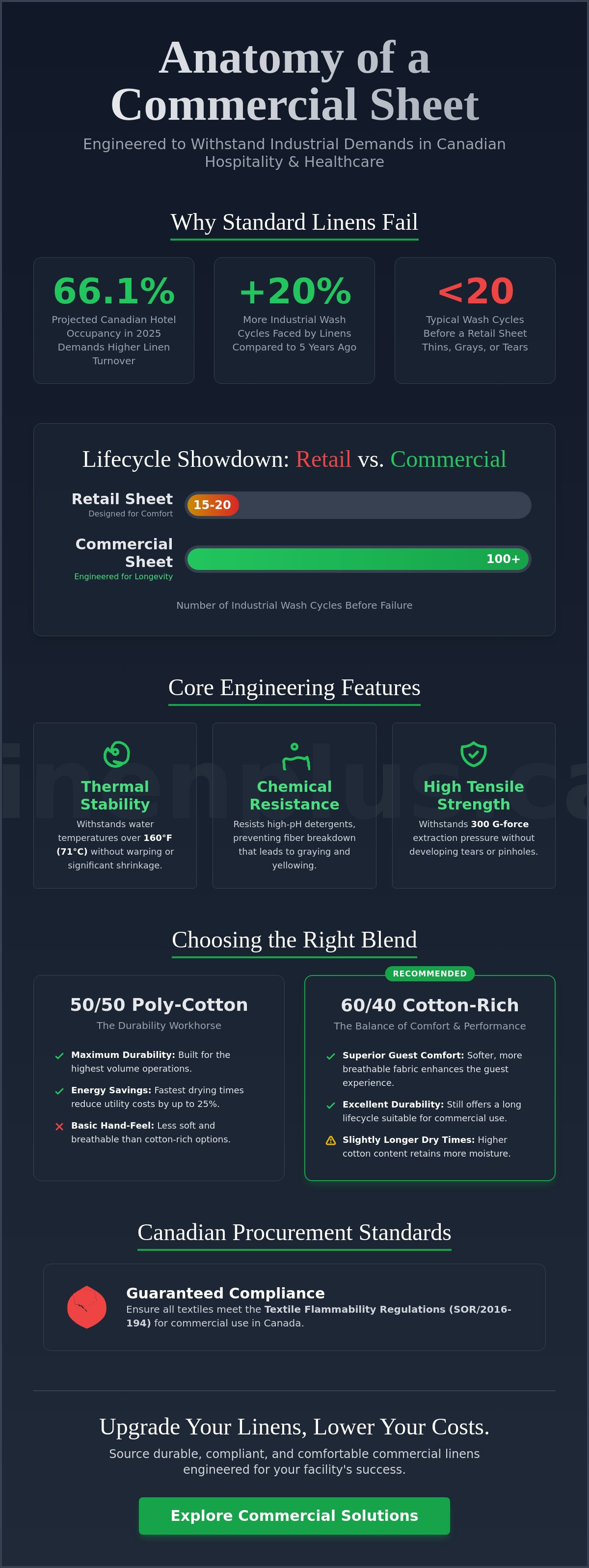
In the Canadian hospitality and healthcare sectors, the term "commercial laundry ready" isn't a vague marketing claim. It describes textiles engineered to survive a punishing cycle of high-pH chemicals, water temperatures exceeding 160°F (71°C), and high-pressure mechanical extraction. While residential sheets prioritize initial "hand feel" or softness, commercial laundry ready sheets are designed for structural integrity. A standard retail sheet typically fails within 15 to 20 cycles in a tunnel washer, resulting in frayed edges and thinning fabric. In contrast, commercial-grade linens are built to maintain their form for over 100 industrial washes.
True readiness is identified through several technical markers. These include reinforced selvedge construction to prevent unravelling, high pilling resistance to keep surfaces smooth, and thermal stability to prevent warping under intense heat. Without these features, linens quickly lose their "crisp white" appearance, turning gray or yellow as chemicals break down weaker fibers.
The Role of Industrial Processing
Canadian facilities often use large-scale ironers and automated folders to maintain efficiency. These machines apply significant tension and heat to damp fabric. If a sheet isn't specified as "preshrunk" or thermally stable, the dimensions will shift after the first few runs. This leads to fitted sheets that no longer fit standard 60"x80" queen mattresses, a common operational headache that disrupts housekeeping workflows.
Tensile Strength and Fabric Density
Fabric density is critical for longevity. Higher density prevents the "see-through" thinning that occurs after repeated bleaching cycles. When evaluating sheets and pillowcases, buyers should consult textile measurement standards to understand how thread count and GSM (grams per square meter) impact durability. Tensile strength is the fabric's ability to resist tearing under mechanical stress during extraction. This metric determines if a sheet can withstand the 300 G-force speeds of an industrial extractor without developing pinholes or tears.
Technical Specifications: Thread Count and Material Blends
Choosing the right commercial laundry ready sheets requires a technical balance between guest comfort and operational overhead. The debate between 60/40 and 50/50 polyester-cotton blends is central to this decision. While a 50/50 blend offers maximum durability and the fastest drying times, a 60/40 cotton-rich blend provides the superior "hand feel" expected in premium environments. In 2026, Canadian facilities are increasingly moving toward these cotton-rich blends to justify rising Average Daily Rates (ADR), which reached C$208.71 in 2024. A standard T-180 economy queen fitted sheet, typically priced around C$149.89 per dozen, often utilizes the 50/50 blend to prioritize budget over luxury.
Need Reliable Wholesale Supplies for Your Facility?
Hotels, healthcare facilities, restaurants, and commercial operations across Canada trust Linen Plus for consistent bulk supply and commercial-grade quality.

Bulk Wholesale Pricing
Competitive pricing for large-volume procurement.

Reliable Nationwide Supply
Consistent inventory and fast shipping across Canada.

Hospitality & Healthcare Grade
Products designed for demanding commercial environments.
Thread count is another area where retail logic fails. While high-end consumer sheets boast T-400 or T-600 counts, these are impractical for industrial use. The fine, densely packed threads trap heat and are prone to snapping during high-pressure extraction. Most Canadian hotels find their "sweet spot" between T-180 and T-250. For a more accurate measure of durability, managers should look at GSM (Grams per Square Meter). A higher GSM indicates a heavier, more durable fabric that complies with Canadian textile testing standards for colorfastness and shrinkage resistance.
T-200 Percale: The Hospitality Workhorse
T-200 percale is the standard for mid-scale hotels across Canada. It provides a crisp, breathable surface that stays cool for the guest while maintaining the structural integrity needed for 100+ wash cycles. When stocking your facility, choosing professional-grade sheets and pillowcases in a T-200 construction ensures you aren't overpaying for thread counts that won't survive the laundry. It's a dependable choice for facilities with high turnover rates.
Polyester Ratios and Energy Efficiency
Polyester isn't just a filler; it's an energy-saving tool. Because polyester is hydrophobic, these blends dry significantly faster than 100% cotton. This reduces dryer run times by 15% to 25%, directly lowering utility costs for in-house laundries. You can browse our bulk selection to find the specific blend that matches your facility's energy and comfort targets. This strategic choice helps manage the total cost of ownership in a high-inflation market.
Operational Benefits of Industrial-Grade Bedding
Investing in commercial laundry ready sheets shifts your linen budget from a recurring drain to a managed operational asset. While retail-grade bedding often ends up in the "rag out" bin after just 30 cycles, industrial-grade textiles are engineered to maintain their tensile strength for 100+ washes. This 233% increase in product lifespan significantly reduces the frequency of bulk reordering and stabilizes your inventory levels. Consistency in presentation is equally vital. High-quality linens resist the "graying" effect caused by hard water minerals and industrial detergents common in many Canadian municipal water systems, ensuring guests always enter a room that looks pristine.
Labor efficiency is another critical benefit. Labor represents roughly 50% of total laundry operating costs in Canada. Sheets that feature wrinkle-resistant finishes and stay dimensionally stable feed more smoothly into automated ironers and folders. This reduces manual intervention and speeds up the folding process. Safety and compliance are also built into these products. Every item must adhere to the Canadian Textile Flammability Regulations (SOR/2016-194), which provides a legal safety net for your facility and ensures you meet national standards for commercial bedding.
Cost-Per-Use Calculation
Smart managers prioritize cost-per-use over the initial invoice price. A sheet that costs C$15 but lasts 100 washes results in a cost of C$0.15 per use. In contrast, a budget sheet at C$10 that fails after 30 washes costs C$0.33 per use. This math proves that higher upfront quality leads to long-term fiscal responsibility. To refine your broader purchasing strategy, consult our Wholesale Linens Canada guide for a deeper look at 2026 procurement trends.
Chemical Resistance in Healthcare
Healthcare linens face unique challenges, specifically frequent exposure to chlorine and peroxide-based disinfectants. These chemicals accelerate fiber degradation in standard textiles, leading to thinning and tearing. Our specialized medical supplies are engineered to withstand these high-level disinfection protocols. This ensures that even after intensive sanitization, the sheets remain soft and structurally sound for patient comfort. You can view our bulk inventory to find linens that meet these rigorous hygiene requirements.
Procurement Strategies for Canadian Facilities in 2026
Successful procurement for Canadian facilities in 2026 requires a shift from reactive buying to data-driven inventory management. The foundation of this strategy is the "Par Level" system. A standard 3-par system, consisting of one set on the bed, one in the laundry, and one in storage, is the bare minimum for operational continuity. Many high-turnover facilities are now adopting a 5-par model to account for the national RevPAR increase, which reached C$142.89 in 2025. This extra cushion prevents service disruptions and allows commercial laundry ready sheets enough "rest time" between wash cycles. This rest period helps fibers recover their shape and significantly extends the product's total lifespan.
Evaluating suppliers is no longer just about finding the lowest price per unit. Operations managers must prioritize batch consistency to ensure that a queen sheet ordered in January matches the weight and shade of one ordered in July. Direct manufacturer partnerships eliminate the variance often found with secondary wholesalers. As facilities look to elevate their guest experience, transitioning from T-180 to T-200 percale is a strategic move. While T-180 serves economy needs, the T-200 standard provides a noticeable upgrade in texture and durability that justifies higher room rates in a competitive market.
Establishing a Reliable Supply Chain
Managing multiple vendors increases administrative costs and shipping overhead. Utilizing a one-stop shop for all hospitality needs streamlines logistics and ensures year-round availability across Canada. This centralized approach prevents the need for emergency retail purchases. Such purchases can cost 40% more than wholesale rates and lack the technical specifications required for commercial laundry ready sheets. Consistent supply chains are the backbone of a predictable budget.
Customization and Branding
Linen loss is a significant hidden cost, often reaching 15% of inventory annually in shared laundry environments. Custom embroidery or discrete branding helps recover these lost assets. Additionally, color-coded stitching for size identification, such as blue for queen and gold for king, speeds up the sorting process for housekeeping teams. These small technical details reduce labor hours and ensure that the right linens reach the right rooms every time.
Optimizing Your Facility for 2026 and Beyond
Managing a high-turnover facility in Canada requires moving beyond simple bulk purchasing to a strategy centered on technical durability and lifecycle value. By prioritizing tensile strength and thermal stability over retail softness, you ensure your inventory survives the 160°F temperatures of industrial processing. Implementing a robust 5-par inventory system and selecting commercial laundry ready sheets with a 60/40 or 50/50 blend will lower your long-term cost-per-use and stabilize your operational budget against rising inflation.
Linen Plus supports your facility's growth through direct manufacturer partnerships that guarantee batch consistency across every order. Our specialized T-200 and T-250 hospitality lines are engineered for the specific rigors of the Canadian market, backed by nationwide distribution to keep your supply chain resilient. We're here to ensure your linens remain a dependable asset rather than a recurring headache.
Shop Commercial Ready T-200 Bed Sheets at Linen Plus to start maximizing your linen lifespan today. With the right textiles in place, you can focus on delivering an exceptional guest experience while we handle the logistical heavy lifting.
Frequently Asked Questions
What is the best thread count for commercial laundry ready sheets?
The optimal thread count for commercial laundry ready sheets ranges between T-180 and T-250. While retail consumers often chase T-400 counts, these dense weaves trap heat and are prone to fiber breakage during high-speed industrial extraction. T-200 percale offers the best balance of durability and guest comfort. It allows for efficient airflow in the dryer and maintains structural integrity through 100 plus industrial cycles.
How do I prevent my commercial sheets from graying?
Graying is typically caused by soil redeposition or mineral buildup from hard water, which affects approximately 60% of Canadian municipal water supplies. To prevent this, ensure your laundry process includes a water softener and a high-quality surfactant to keep soils suspended. Regularly testing the pH levels of your final rinse cycle helps verify that chemical residues are fully neutralized, preserving the crisp white appearance of your facility's linens.
What is the difference between Percale and Sateen in a commercial setting?
Percale uses a traditional one-under-one-over weave that produces a matte, crisp finish with high tensile strength. This makes it ideal for high-turnover environments like mid-scale hotels. Sateen features a four-over-one weave, offering a silkier feel and lustrous sheen. However, sateen is more susceptible to pilling and snagging in industrial machines. Most Canadian facilities choose T-200 percale for longevity or T-250 sateen for premium guest experiences.
How many wash cycles should a commercial sheet last?
A high-quality commercial laundry ready sheets set should withstand between 100 and 150 industrial wash cycles before showing signs of thinning or significant pilling. In contrast, residential-grade linens often fail after 20 cycles in a tunnel washer environment. To reach the 150-cycle benchmark, facilities must maintain a 5-par inventory level. This allows fibers to rest for 24 hours between uses, preventing the premature breakdown caused by constant mechanical stress.
Why are polyester-cotton blends preferred over 100% cotton in hotels?
Polyester-cotton blends, typically 60/40 or 50/50, are preferred because they significantly reduce operational costs. Polyester is a hydrophobic fiber, meaning it absorbs less water and dries 25% faster than 100% cotton. This reduces utility expenses and labor time. Additionally, the synthetic fibers add tensile strength and wrinkle resistance, ensuring sheets look professional without the intensive pressing required for pure cotton textiles in large-scale operations.

Article by
Sohel Shahriar
Sohel Shahriar is the Chief Growth Officer (CGO) at Linen Plus Inc., Canada, bringing a strategic blend of growth marketing, brand leadership, and content expertise. Through his writing, he explores how quality linen, smart sourcing, and long‑term partnerships can create measurable impact for healthcare and hospitality organizations.


