


Did you know that hotel laundry departments saw a 25.6% spike in overtime hours throughout 2025? If you're managing a Canadian facility, you're likely feeling the pressure of rising utility rates and natural gas prices forecasted to average C$4.80 per MMBtu this year. It's frustrating to watch profit margins erode due to premature graying in your T200 percale sheets or high textile turnover. You aren't alone in searching for how to reduce hotel laundry operational costs while maintaining the premium guest experience your brand promises.
This strategic guide provides the technical roadmap you need to master laundry room efficiency. You'll learn how to slash utility bills, minimize labor requirements, and significantly extend the lifespan of your towels and linens through smarter procurement. We'll examine the latest 2026 compliance standards, such as the November 20 OSHA Hazard Communication deadline, and demonstrate how to lower your cost-per-load metrics by focusing on wash-hardy textile selection. It's time to transform your laundry operation from a draining cost center into a streamlined, value-driven department.
Key Takeaways
- Optimize drying phases with high-extract cycles and moisture sensors to prevent fiber brittleness and cut energy waste.
- Implement a 4-Par inventory system to stabilize your supply chain and reduce the physical stress on individual bed sheets and towels.
- Learn how to reduce hotel laundry operational costs by prioritizing ring-spun textiles and T200 percale fabrics designed for heavy commercial use.
- Standardize laundry room SOPs with FIFO rotation and precise sorting to eliminate labor inefficiencies and premature textile replacement.
Optimizing Wash Cycles and Utility Consumption
Laundry operations account for a significant portion of a facility's utility budget. Implementing high-extract spin cycles is the first step in mastering how to reduce hotel laundry operational costs. These high-speed cycles remove more water mechanically, which slashes the time needed in the dryer. Since drying is the most energy-intensive phase of the process, every minute saved directly lowers your C$ per load. Integrating moisture sensors further protects your investment by preventing over-drying. When bed sheets are exposed to excessive heat after they're already dry, fibers become brittle and prone to tearing.
Strategic hotel energy management also requires precise chemical calibration. In many Canadian regions, hard water minerals interfere with detergent performance. Calibrating your dosing systems to match local water hardness prevents the dingy appearance that leads to premature textile retirement. For high-volume facilities, shifting to ozone laundry systems allows for cold-water disinfection. This transition can reduce thermal energy consumption by up to 80% while extending the life of delicate linens.
The Math of Load Sizing
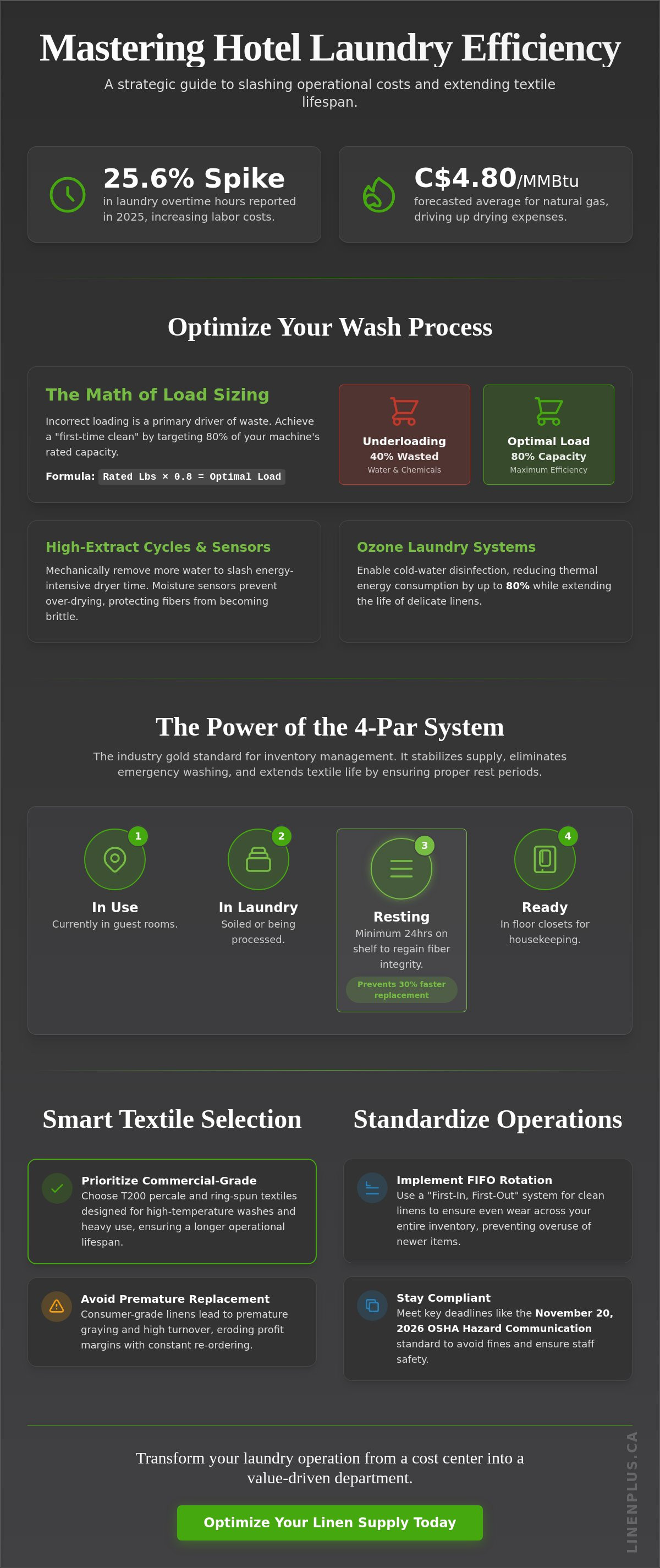
Underloading a 50lb machine with only 30lbs of laundry wastes 40% of the water and chemicals used. Conversely, overloading prevents proper mechanical action, leading to frequent re-washes. To find your Optimal Capacity, multiply the machine’s rated poundage by 0.8. A 100lb washer performs best at 80lbs. This ensures textiles have enough space to tumble, providing a "first-time clean" that protects your bottom line.
Water Recovery and Heat Exchange
High-volume laundries often see a return on investment for water recycling systems within 18 to 24 months. These systems filter and reuse up to 70% of rinse water for the next initial wash cycle. Additionally, installing heat exchangers allows you to repurpose dryer exhaust to pre-heat incoming wash water. This closed-loop approach is a cornerstone for any manager looking at how to reduce hotel laundry operational costs in a high-utility environment.
Strategic Inventory Management: The Power of Par Levels
Managing inventory isn't just about having enough towels; it's a precise calculation that dictates your bottom line. A "Par Level" represents the minimum amount of inventory required to support your guest rooms without operational stress. Establishing a 4-Par system is the industry gold standard for anyone investigating how to reduce hotel laundry operational costs. While it requires a higher upfront investment, it prevents the destructive cycle of emergency washing that ruins textiles and inflates labor budgets.
One of the most overlooked aspects of textile longevity is the "fiber rest" period. Cotton and poly-cotton blends are organic materials that require at least 24 hours of rest between the dryer and the guest bed. This rest allows the fibers to regain their natural moisture balance. Without it, linens become brittle and lose tensile strength, leading to a 30% faster replacement rate. Following expert advice on shrinking laundry expenses often highlights that proper rotation is more effective than any chemical additive for extending fabric life.
Need Reliable Wholesale Supplies for Your Facility?
Hotels, healthcare facilities, restaurants, and commercial operations across Canada trust Linen Plus for consistent bulk supply and commercial-grade quality.

Bulk Wholesale Pricing
Competitive pricing for large-volume procurement.

Reliable Nationwide Supply
Consistent inventory and fast shipping across Canada.

Hospitality & Healthcare Grade
Products designed for demanding commercial environments.
Low inventory levels trigger "Emergency Washing," which is a primary driver of waste. When you're short on stock, staff often run half-empty machines to meet immediate room turnovers. This practice doubles your water and energy costs per pound of laundry. It also leads to overtime pay for laundry staff who must stay late to finish small, urgent loads. Maintaining a healthy stock of hotel bed sheets ensures your machines always run at optimal capacity, maximizing every C$ spent on utilities.
Calculating Your Ideal Par Level
The 4-Par system provides a seamless rotation that protects your assets. It breaks down into four distinct locations:
- 1 Par: Currently in the guest rooms.
- 1 Par: In floor closets, ready for immediate housekeeping use.
- 1 Par: In the laundry room, soiled or currently being processed.
- 1 Par: Resting in the main linen room to regain fiber integrity.
High-occupancy periods in the Canadian market, such as peak summer tourism or winter festival seasons, may require an additional 0.5 par buffer. This prevents the need for expedited shipping costs from your hospitality supply partner when demand spikes unexpectedly.
Extending Textile Lifespan through Correct Selection
Procurement isn't just about finding the lowest unit price; it's about calculating the "Cost Per Wash." While a lower-grade textile might save capital upfront, it often doubles your long-term expenses through frequent replacement and higher utility consumption. Understanding textile engineering is essential when planning how to reduce hotel laundry operational costs. For example, T200 Percale Bed Sheets are the workhorse of high-turnover hospitality environments. Their plain weave structure offers superior resistance to the mechanical stress of industrial extractors compared to sateen alternatives which feature longer, more fragile thread floats.
The choice between ring-spun and open-end yarns also dictates your replacement rate. Ring-spun towels use longer, twisted fibers that provide significantly higher tensile strength. This construction prevents the fraying and "balding" often seen in cheaper open-end alternatives after only 30 or 40 washes. By investing in ring-spun products, you're effectively buying more "life cycles" per C$ spent, which is a far more accurate metric for profitability than the initial purchase price.
Thread Count and Weave ROI
Percale weaves typically outperform sateen in longevity because the one-over-one thread pattern is less likely to snag or pill. Sateen, while luxurious, is more prone to surface damage during high-speed agitation. In the towel category, the weight measured in GSM (Grams per Square Metre) directly impacts your energy bill. High-GSM bath towels feel premium but require significantly more drying time. Choosing a mid-weight, ring-spun towel provides the best balance of guest comfort and drying efficiency, ensuring the product survives 15% to 20% more wash cycles.
Bleach Guard and Technical Textiles
Specialized technical textiles, such as Bleach Guard towels, are engineered to resist chemical discoloration from heavy-duty disinfectants or guest cosmetics. These products eliminate the "spotting" that forces managers to retire towels long before they're physically worn out. Integrating these into your inventory is a proven tactic for how to reduce hotel laundry operational costs in specialized departments like spas or fitness centers. For a deeper dive into 2026 procurement trends, consult our guide on wholesale linens canada to align your purchasing with current market conditions.
Ready to optimize your facility's textile performance? Explore our hospitality programs for durable, high-performance linens designed for the Canadian market.
Standardizing Laundry Room SOPs and Staff Training
Labor represents nearly 50% of laundry room expenses in the Canadian hospitality sector. Training staff on standardized sorting protocols prevents expensive errors, such as washing delicate duvet covers on high-heat cycles meant for heavy towels. Multi-lingual visual aids and color-coded bins reduce human error in chemical loading, ensuring you don't waste C$ on over-titration or ruin loads with excessive bleach. These simple SOPs are fundamental to how to reduce hotel laundry operational costs while maintaining consistent quality across every shift.
Implementing a First In, First Out (FIFO) rotation system ensures even wear across your entire inventory. Without this, the same 20% of your linens get used 80% of the time, leading to premature thinning and graying. Additionally, daily maintenance of lint screens and trap filters is non-negotiable. A clogged screen can increase drying time by 15 minutes per load. Over a year, this adds up to hundreds of hours in wasted labor and thousands in unnecessary utility costs.
Reducing Labor Through Ergonomics
Folding is the most labor-intensive part of the laundry process. Ergonomic folding stations and adjustable cart heights prevent staff fatigue and repetitive strain injuries, which helps stabilize your labor pool. For high-volume facilities, automated folding machines for sheets and duvet covers can double your throughput. These investments pay for themselves by slashing the overtime hours that many hotel departments saw spike by over 25% in 2025.
Tracking Key Performance Indicators (KPIs)
You can't manage what you don't measure. Every manager should track three core KPIs: Pounds per Operator Hour (PPOH), Cost per Pound, and the monthly Replacement Rate. Conduct weekly audits of your "discard piles" to see if items are being retired due to permanent stains or physical damage. This data-driven approach is the ultimate strategy for how to reduce hotel laundry operational costs because it identifies exactly where your budget is leaking. Partnering with a reliable hospitality supplier ensures you have the high-quality stock needed to keep these KPIs within a profitable range.
Maximizing Operational Efficiency for 2026
Implementing a data-driven strategy is the most effective way to address how to reduce hotel laundry operational costs in the current Canadian market. By combining mechanical utility optimization with a disciplined 4-Par inventory system, you protect both your equipment and your textile assets. Transitioning from reactive emergency washing to standardized SOPs ensures that every load processed contributes to a healthier bottom line rather than draining resources through overtime and utility waste. These small, technical adjustments create a compounding effect on your annual profitability.
Success in 2026 requires a supply partner who understands the technical demands of industrial laundering. Linen Plus provides high-durability textiles designed to withstand 200 plus commercial wash cycles, ensuring your replacement rates stay low. Our direct manufacturer partnerships for T200 and T250 linens, combined with nationwide Canadian distribution, offer the consistency your facility needs to thrive. Optimize your hospitality procurement with Linen Plus wholesale solutions and take control of your facility's operational future today. You've the tools and the strategy; now it's time to execute.
Frequently Asked Questions
What is the most expensive part of hotel laundry operations?
Labor costs represent the largest expense in commercial laundry, typically accounting for 45% to 50% of the total operating budget. This includes wages for sorting, washing, and folding, as well as the 25.6% spike in overtime pay seen across the industry in 2025. Managers focus on how to reduce hotel laundry operational costs by optimizing staff throughput and reducing re-wash rates, as labor hours spent on stains or errors quickly erode margins.
How many par levels should a hotel have for linens?
A 4-Par inventory level is the industry standard for efficient hospitality operations. This distribution includes one par in the guest room, one in the floor closet, one in the laundry process, and one resting in the linen room. Maintaining this level prevents "emergency washing" in half-empty machines, which is a key tactic for how to reduce hotel laundry operational costs. It also ensures textiles have a 24-hour rest period to recover fiber integrity.
Does washing in cold water actually save money in a hotel?
Cold water washing can reduce thermal energy consumption by up to 80% when combined with ozone laundry systems. Since heating water accounts for a large portion of Canadian utility bills, this shift significantly lowers the C$ spent per load. However, it requires specialized detergents or ozone generators to ensure disinfection. Without these technologies, cold water may fail to remove body oils, leading to higher discard rates and increased replacement costs.
How often should hotel bed sheets be replaced to stay cost-effective?
Commercial bed sheets should typically be replaced after 150 to 200 wash cycles to maintain guest satisfaction standards. For high-occupancy Canadian hotels, this usually translates to a 12 to 18-month lifespan. Monitoring your "Replacement Rate" KPI helps identify if textiles are failing early due to chemical imbalance or mechanical stress. Retiring linens before they show visible graying or fraying prevents negative guest reviews while ensuring efficient drying times.
What is the difference between T200 and T250 sheets for laundry efficiency?
T200 percale sheets are generally more laundry-efficient than T250 sateen due to their durable one-over-one weave structure. They withstand high-speed extraction better and typically have shorter drying times, which lowers energy costs. While T250 sateen offers a silkier feel, the longer thread floats are more susceptible to snagging and pilling during industrial laundering. Choosing T200 often results in a lower cost-per-wash over the product's entire lifespan.

Article by
Sohel Shahriar
Sohel Shahriar is the Chief Growth Officer (CGO) at Linen Plus Inc., Canada, bringing a strategic blend of growth marketing, brand leadership, and content expertise. Through his writing, he explores how quality linen, smart sourcing, and long‑term partnerships can create measurable impact for healthcare and hospitality organizations.


