


What if the "affordable" wholesale linens you purchased last quarter are actually driving your facility's overhead into the red? With the Producer Price Index for commercial detergents hitting 197.04 as of late 2025 and utility rates climbing across Canada, every extra minute in the dryer erodes your bottom line. Understanding how linen quality impacts laundry operational costs is no longer just about procurement; it's about maintaining profitability in a market where 90% of a washer's energy consumption goes toward heating water. Most operations managers agree that rising utility bills and frequent re-wash cycles are unsustainable for long-term growth.
This analysis demonstrates how investing in premium commercial textiles reduces utility consumption, labour requirements, and replacement frequency. You'll discover how selecting the right GSM and thread count can lower your annual replacement rates by 20% or more while cutting energy consumption per pound of laundry. We will examine the specific TCO metrics that help you improve staff efficiency by reducing ironing and sorting time, ensuring your facility remains a reliable and cost-effective operation.
Key Takeaways
- Shift your procurement focus from initial acquisition price to Total Cost of Ownership (TCO) to avoid hidden spikes in utility and labour overhead.
- Identify how specific textile benchmarks like GSM and thread count directly influence moisture retention and the institutional lifespan of your inventory.
- Examine how linen quality impacts laundry operational costs through shortened drying cycles and reduced chemical consumption per pound of laundry.
- Establish effective par levels and discard tracking to prevent over-washing and ensure a consistent supply of premium textiles for your facility.
- Reduce re-wash rates and persistent staining by selecting high-quality fibers designed to release organic soils more efficiently during the wash cycle.
The Financial Reality of Commercial Linen Quality
In high-volume hospitality and healthcare settings, procurement decisions are often skewed by the immediate sticker price. However, focusing solely on the invoice ignores the compounding expenses found in the wash cycle. Linen TCO is the sum of purchase price, laundry processing costs, and replacement frequency over the product lifecycle. When facilities fall into the "Cheap Linen Trap," they trade a lower acquisition cost for higher utility consumption and increased labour overhead. This financial oversight directly influences how linen quality impacts laundry operational costs, as inferior textiles often fail under the mechanical stress of commercial machinery. Facilities that track how linen quality impacts laundry operational costs often find that premium fibers pay for themselves within six months of heavy use.
Acquisition Price vs. Processing Costs
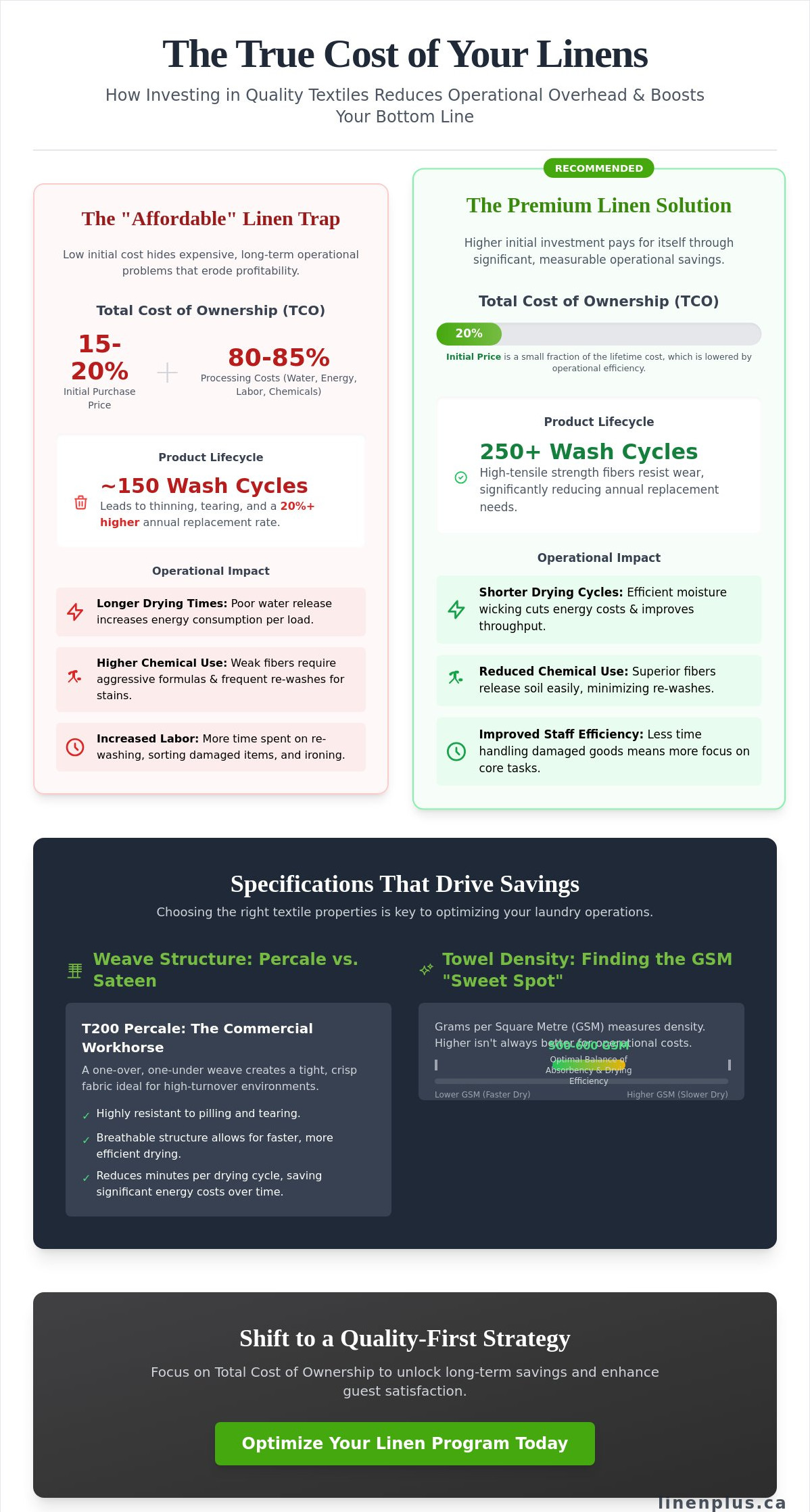
Industry data indicates that the initial purchase price of a sheet or towel represents only 15% to 20% of its total lifetime cost. The remaining 80% is consumed by water, energy, chemicals, and labour. Low-quality fabrics with irregular weaves require aggressive chemical treatment to remove organic soils. By understanding the properties of linen fabric and high-grade cotton blends, managers can select products like T200 percale bed sheets that offer better soil release. Higher fabric density doesn't just feel better for the guest; it reduces the need for expensive re-wash cycles that inflate your chemical budget.
Replacement Frequency and Lifecycle Expectancy
Longevity is the primary driver of cost-per-use. Standard institutional linens may only survive 150 wash cycles before thinning or tearing, whereas premium hospitality linens are engineered for 250 or more cycles. High-tensile strength fibers resist the "thinning" effect caused by high-heat commercial dryers in Canadian facilities. When linens degrade prematurely, your annual replacement rate can spike by 20% or more. This degradation also impacts guest satisfaction scores, as pilling and fraying create a poor brand impression that can lead to lost revenue.
Textile Specifications That Drive Operational Savings
Operational efficiency in a commercial laundry starts with technical specifications. Procurement managers often equate higher thread counts with superior quality, but in a high-turnover environment, the weave structure dictates the bottom line. A T200 percale offers a balanced ratio of durability and breathability, whereas a T250 sateen provides a smoother hand-feel at the potential cost of increased drying times. By aligning fiber selection with your equipment's capacity, you can directly influence how linen quality impacts laundry operational costs. Utilizing laundry operations benchmarks allows facilities to set realistic KPIs for throughput based on these textile variables. For many Canadian hospitality providers, choosing T200 Percale Bed Sheets for hospitality ensures a crisp finish that survives the intense mechanical agitation of industrial washers.
Need Reliable Wholesale Supplies for Your Facility?
Hotels, healthcare facilities, restaurants, and commercial operations across Canada trust Linen Plus for consistent bulk supply and commercial-grade quality.

Bulk Wholesale Pricing
Competitive pricing for large-volume procurement.

Reliable Nationwide Supply
Consistent inventory and fast shipping across Canada.

Hospitality & Healthcare Grade
Products designed for demanding commercial environments.
Percale vs. Sateen in Commercial Environments
The structural difference between these weaves impacts more than just guest comfort. Percale uses a one-over, one-under pattern that creates a tight, matte finish. This structure is naturally resistant to pilling and tearing, which are common causes for early inventory retirement. Because percale is more breathable, industrial dryers move air through the fabric more efficiently. This reduces cycle times by several minutes per load. Over 1,000 wash cycles, these saved minutes translate into measurable savings on gas and electricity bills.
GSM and Towel Drying Efficiency
Grams per Square Metre (GSM) measures the density of a towel, but a higher number isn't always better for your budget. While a 700 GSM towel feels luxurious, it acts like a sponge, retaining significant water that extends drying cycles. The "sweet spot" for most commercial applications is usually between 500 and 600 GSM. By selecting Premium Ring Spun Towels, you benefit from longer, more aligned cotton fibers. These fibers provide superior strength and softness without the excessive bulk that leads to inflated utility costs. If you want to optimize your laundry floor, you can view our Premium Ring Spun Towels to see how fiber alignment improves moisture release during the spin cycle.
How Premium Linens Optimize the Laundry Cycle
The efficiency of a laundry floor depends on how quickly textiles move through the equipment. While technical specifications define durability, the real-world application shows how linen quality impacts laundry operational costs during the drying and finishing phases. High-quality cotton-poly blends are engineered to release water more efficiently than low-grade cotton during the final extraction spin. A 10% reduction in drying time can save thousands in annual gas and electricity costs for high-volume facilities. Beyond energy, premium fibers maintain their tensile strength during aggressive bleach cycles. This prevents the microscopic fraying that traps organic soils and leads to expensive re-wash rates.
Labour Efficiency and Finishing Requirements
Labour often accounts for the largest portion of a laundry budget in Canada. High-quality sheets and pillowcases often feature natural wrinkle resistance. This minimizes the need for industrial pressing or prolonged ironing cycles. Standardized sizing and reinforced edge-stitching also speed up the sorting and folding process. When every item in a batch is identical in dimensions, staff move through thousands of pounds of laundry without the delays caused by misshapen or shrinking items.
Utility Consumption and Sustainability
Modern sustainability goals require textiles that perform in cold-water washing programmes. Premium linens are often treated with finishes that allow detergents to break down soils at lower temperatures. This significantly reduces the energy load, as heating water accounts for roughly 90% of a washer's energy use. By lowering the carbon footprint per pound of processed laundry, facilities meet both environmental targets and fiscal requirements. If you're looking to upgrade your inventory for better throughput, you can explore our hospitality supply programs to find textiles designed for high-efficiency cycles.
Implementing a Quality-First Procurement Strategy
Transitioning from reactive purchasing to a strategic procurement model requires a deep dive into your facility's discard rates. A laundry audit is the most effective way to quantify how linen quality impacts laundry operational costs within your specific environment. By tagging a sample batch of new inventory and tracking its journey, you can identify exactly when thinning or tearing occurs. If your current SKUs are failing before reaching the 150-wash benchmark, the "savings" from a lower purchase price have already been negated by early replacement costs. For a comprehensive look at modern sourcing, consult our Wholesale Linens Canada: The 2026 Commercial Procurement Guide.
Maintaining proper par levels is equally critical for inventory longevity. Ideally, a facility should operate on a 3-par or 4-par system: one in the room, one in the laundry, and one or two in storage. This rotation allows cotton fibers to "rest" and recover their shape between uses. Over-washing due to low par levels accelerates mechanical wear, forcing you back into the procurement cycle prematurely. Selecting a manufacturer-direct partner ensures you receive consistent textile specifications, which prevents the operational headache of mismatched sizes and varying drying requirements across your fleet.
Evaluating Vendor Specifications
When reviewing a sales sheet, look beyond the basic GSM or thread count. Ask your supplier for specific data on tensile strength and projected shrinkage rates. Commercial linens in the Canadian market typically experience 5% to 8% shrinkage; anything higher indicates a loose weave that will likely fail in high-heat industrial dryers. Consistent supply chains are vital for facility-wide uniformity. If a vendor frequently switches manufacturers, your staff will waste time sorting through slightly different shades of white or varying hem styles, which quietly erodes labour efficiency.
Calculating Your ROI on Premium Linens
To find the true value of a textile, use a cost-per-use formula: (Purchase Price + Total Lifetime Processing Costs) / Number of Wash Cycles. Even if a premium sheet costs C$5.00 more upfront, its ability to survive 100 additional cycles while requiring 10% less drying time makes it the fiscally superior choice. Factoring in the reduction in re-wash rates and chemical consumption provides a clear picture of your total return on investment. If you're ready to optimize your facility's budget, you can contact Linen Plus for a bulk hospitality quote to secure durable, high-performance textiles.
Future-Proof Your Facility with Strategic Textile Procurement
Stabilizing your facility's bottom line requires moving beyond the initial invoice to a comprehensive lifecycle perspective. By prioritizing textiles that survive 250 plus wash cycles and release moisture quickly, you eliminate the hidden overhead associated with inferior fabrics. We've explored exactly how linen quality impacts laundry operational costs through reduced drying times and lower chemical consumption. These operational gains allow your staff to focus on guest care rather than managing constant inventory shortages. It's a shift that pays dividends in both labour efficiency and utility savings across your entire operation.
You can optimize your facility spend with Linen Plus wholesale textiles to benefit from our direct manufacturer partnerships. Our nationwide Canadian distribution ensures rapid restocking, while our specialized solutions for the hospitality and healthcare sectors provide the durability your high-volume operation demands. Taking control of your textile lifecycle today ensures a more profitable and efficient operation for years to come.
Frequently Asked Questions
How much does linen replacement typically cost a hotel annually?
Annual replacement costs typically range from 20% to 25% of a hotel's total laundry operating budget. For a mid-scale facility in Canada, this expense is heavily influenced by high-heat drying and chemical exposure. Tracking these replacement rates helps managers understand how linen quality impacts laundry operational costs over several fiscal quarters as inventory degrades.
Does a higher thread count always mean better quality for commercial laundry?
No, higher thread count doesn't automatically equate to better commercial durability. While a T300 or T400 sheet feels soft, the thinner yarns often fail faster under industrial mechanical stress compared to a robust T200 percale. For institutional use, the weave structure and tensile strength are more reliable indicators of a product's lifecycle than thread count alone.
How do cotton-polyester blends impact laundry operational costs compared to 100% cotton?
Cotton-polyester blends significantly lower operational costs by reducing drying times and minimizing the need for industrial pressing. These blends typically release water more efficiently during the extraction cycle than 100% cotton. This efficiency directly reduces how linen quality impacts laundry operational costs by lowering the total energy load per pound of laundry processed in your facility.
Can high-quality linens actually reduce our labour costs in the laundry room?
High-quality linens reduce labour costs by streamlining the finishing and sorting phases of the laundry cycle. Consistent sizing and superior edge-stitching allow staff to fold items up to 15% faster than irregular, low-grade textiles. Additionally, premium fibers with soil-release finishes reduce the time spent on manual stain pre-treatment and re-washing, which are major labour drains in high-volume facilities.
What is the most common cause of premature linen failure in commercial facilities?
Chemical degradation from excessive bleach and high-heat drying are the leading causes of premature linen failure. When facilities operate with low par levels, the constant wash-dry-use cycle prevents fibers from resting, which leads to rapid thinning and tearing. Using high-tensile strength fibers helps mitigate this damage, extending the inventory's lifespan even under the intense conditions of a 24/7 operation.

Article by
Sohel Shahriar
Sohel Shahriar is the Chief Growth Officer (CGO) at Linen Plus Inc., Canada, bringing a strategic blend of growth marketing, brand leadership, and content expertise. Through his writing, he explores how quality linen, smart sourcing, and long‑term partnerships can create measurable impact for healthcare and hospitality organizations.


