


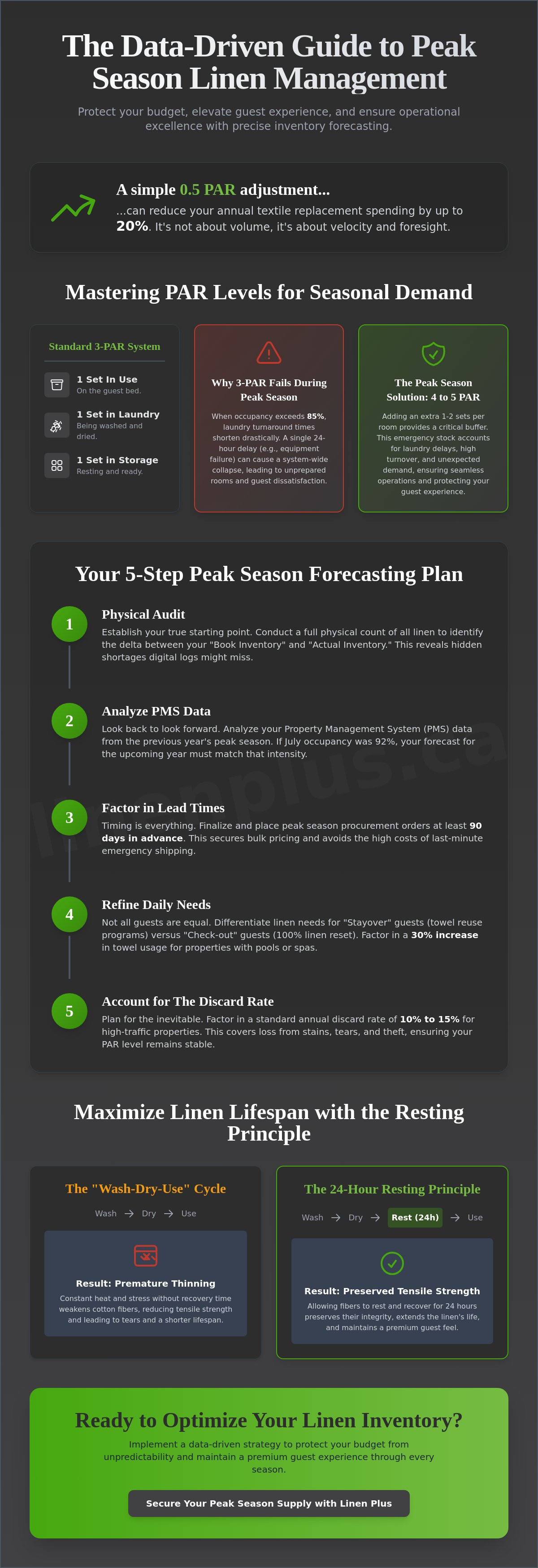
A simple 0.5 adjustment in your PAR levels can reduce your annual textile replacement spending by 20%. While it's tempting to focus solely on total volume, the real challenge during high-occupancy periods is managing the laundry-to-room velocity and ensuring adequate fiber recovery time. You've likely felt the pressure of emergency laundry fees or noticed premature thinning in your T250 sateen sheets when your inventory doesn't have time to rest between 90% occupancy turns. Understanding how to forecast linen needs for peak hotel season is the only way to protect your budget from unpredictability while maintaining a premium guest experience.
We understand that maintaining operational excellence requires more than just guesswork; it requires a reliable supply partner and precise data. This guide provides the data-driven formulas you need to account for a standard 2% to 5% monthly loss rate and the necessary 0.5 PAR emergency buffer. We'll cover everything from digital inventory management trends to the specific logistics of maintaining a 4 to 5 PAR level for seasonal resort spikes, providing a complete solution for your 2026 operational planning.
Key Takeaways
- Implement a strict 3-PAR inventory baseline to ensure one set is in use, one is in the laundry, and one is resting in storage.
- Learn how to forecast linen needs for peak hotel season by auditing physical stock against historical PMS data to identify actual replenishment requirements.
- Apply the 24-hour resting principle to your cotton linens to prevent premature thinning and preserve the tensile strength of your inventory.
- Finalize peak season procurement at least 90 days in advance to secure bulk pricing and avoid the high costs of last-minute emergency shipping.
Mastering PAR Levels for Seasonal Demand Spikes
PAR level is the baseline inventory threshold that triggers a replenishment order to prevent operational stockouts. In the hospitality industry, Periodic Automatic Replenishment (PAR) defines the minimum inventory required to support seamless operations without interruption. A standard 3-PAR system allocates one set of sheets and pillowcases for the guest room, one set in the laundry process, and one set stored in the linen closet. While this rotation is sufficient for average occupancy, it lacks the buffer needed for the high-pressure environment of peak summer or holiday seasons.
Efficient inventory control relies on foundational supply chain management principles to balance stock availability against storage costs. When your property transitions into peak season, moving to a 4-PAR or even 5-PAR model becomes a necessity rather than a luxury. This extra stock accounts for occupancy volatility and prevents the operational "choke points" that occur when laundry cycles cannot keep pace with guest turnover.
Why the 3-PAR Rule Fails During Peak Occupancy
When occupancy exceeds 85%, "velocity" becomes more critical than "volume." High turnover rates drastically shorten laundry turnaround time (TAT), often leaving zero margin for error. If your laundry facility or third-party provider experiences a 24-hour delay due to equipment maintenance or staffing issues, a 3-PAR system collapses instantly. This failure leads to the hidden costs of emergency laundry collections, expedited shipping fees for top-up orders, and the potential for guest dissatisfaction if rooms aren't ready for check-in.
Calculating Your Property's Base Inventory Threshold
To determine exactly how to forecast linen needs for peak hotel season, use the following formula: (Total Rooms x Linen Pieces per Room) x PAR Goal. You must calculate this for each bed size separately to ensure accuracy. A 100-room property with 40 Kings and 60 Queens requires a different stock profile than a property with a higher Twin count. For example, a 100-room hotel aiming for a 4-PAR system for flat sheets (two per bed) needs a total inventory of 800 sheets. Establishing this baseline early helps in securing wholesale hotel linens before seasonal demand spikes deplete local supplier stock.
A 5-Step Methodology for Accurate Peak Season Forecasting
Precision in your inventory starts with a comprehensive physical audit. You must establish the delta between your "Book Inventory" and "Actual Inventory" to reveal hidden shortages that digital logs might miss. This factual starting point is the foundation of adjusting PAR levels effectively. Once your baseline is set, analyze your Property Management System (PMS) data from the previous year. If your July 2025 occupancy reached 92%, your 2026 forecast should mirror that intensity to avoid stockouts.
Need Reliable Wholesale Supplies for Your Facility?
Hotels, healthcare facilities, restaurants, and commercial operations across Canada trust Linen Plus for consistent bulk supply and commercial-grade quality.

Bulk Wholesale Pricing
Competitive pricing for large-volume procurement.

Reliable Nationwide Supply
Consistent inventory and fast shipping across Canada.

Hospitality & Healthcare Grade
Products designed for demanding commercial environments.
Factor in lead times for national procurement to ensure your stock arrives before the surge. In the Canadian market, high-demand periods can strain logistics; a 90-day lead time is essential for large bulk orders. This proactive approach is central to how to forecast linen needs for peak hotel season while keeping your operational budget predictable. It's often more cost-effective to order hospitality supplies in bulk before the seasonal rush begins.
Integrating Occupancy Projections with Textile Needs
Differentiate between "Stayover" and "Check-out" guests to refine your daily requirements. Stayovers often participate in towel reuse programs, while check-outs always require a 100% linen reset. Properties with amenities like spas or pools typically see a 30% increase in bath towels and pool linen usage during summer months. Adjust your forecasts to account for these specific guest behaviors and high-traffic areas.
The Discard Rate: The Silent Budget Killer
An annual discard rate of 10% to 15% is standard for high-traffic properties and must be factored into every peak season order. This loss includes items like makeup-stained washcloths, torn pillowcases, or guest theft. Identifying these "high-loss" items early allows you to predict replacement needs before stock hits critical lows. Review your 2025 discard logs to determine the exact volume of new product required to maintain your desired PAR level through the busiest months of the year.
Factoring in Fabric Longevity and the 'Resting' Principle
The "wash-dry-use" cycle is a primary cause of premature textile failure during peak months. When inventory levels are insufficient, linens are often pulled directly from high-heat dryers and placed immediately onto guest beds. This practice prevents the natural fibers from cooling and rehydrating, which leads to brittle threads. Cotton fibers require a 24-hour recovery period to maintain elasticity and prevent premature shredding. By understanding the mechanical stress of industrial laundering, operations managers can see why higher PAR levels are a financial safeguard rather than an unnecessary expense.
Successfully learning how to forecast linen needs for peak hotel season requires accounting for this recovery window. If your turnaround is too fast, you risk a 22% increase in fabric thinning within just 30 wash cycles. Investing in a 4-PAR or 5-PAR system ensures that each set of sheets and pillowcases rests between uses, effectively extending the lifespan of your inventory by 12 to 18 months. This higher upfront investment yields a significant ROI by slashing your annual replacement costs and reducing emergency procurement needs.
Thread Count and GSM: Impact on Forecasting
T200 Percale sheets often outlast higher thread count alternatives in high-turnover environments because the tighter, simpler weave handles mechanical stress more effectively. When forecasting for durability, match the GSM (Grams per Square Meter) to your expected wash frequency. While heavier GSM towels provide a luxury feel, they require longer drying times and more energy. For high-occupancy periods, choosing durable, mid-range GSM textiles allows for efficient processing without sacrificing the guest experience or fabric integrity.
Managing the Lifecycle of Commercial Textiles
Efficiency in the linen closet is just as important as the total order volume. Implement a First-In, First-Out (FIFO) system to ensure all stock rotates evenly, preventing a scenario where a small portion of your inventory bears 80% of the laundry load. Train your housekeeping staff to identify visual cues such as "pilling" or a loss of opacity, which indicate that a textile's tensile strength is nearing its limit. To maintain a consistent guest experience through the busiest months, order high-durability hotel linens that are engineered for the rigors of commercial use.
Establishing a Proactive Procurement Cycle with National Logistics
Finalizing your peak season orders three months in advance is the benchmark for 2026 operational success. This "90-Day Rule" provides a necessary buffer against the volatility of national shipping routes and ensures your inventory is on-site before the seasonal surge begins. When you understand how to forecast linen needs for peak hotel season, you realize that procurement is as much about timing as it is about volume. Consolidating your orders allows you to maximize bulk discounts and significantly reduces the frequency of shipping fees, which can quickly erode your margins during high-occupancy periods.
Leveraging a national distributor provides a complete solution for your facility. By acting as a one-stop shop for linens, guest amenities, and janitorial supplies, we help you streamline your supply chain. This approach ensures consistent quality across multiple property locations and simplifies the accounts payable process for operations managers who don't have time to manage dozens of individual vendors.
Lead Time Planning for 2026 Market Conditions
Developing a "Safety Stock" buffer of 10% beyond your calculated peak PAR is a critical insurance policy for the upcoming year. This extra inventory protects your property from unexpected logistics delays or sudden spikes in local demand that might otherwise lead to stockouts. Partnering with a supplier that understands Canadian-specific logistics ensures that even if one regional hub faces a shortage, your supplies can be diverted from another part of the network to maintain your operational continuity.
Standardization: Percale vs. Sateen Procurement
Standardizing your inventory is a strategic move that simplifies staff training and inventory management. T200 Percale remains the industry standard for durability in high-turnover seasons, offering a crisp feel that withstands frequent industrial laundering. While hospitality facilities may occasionally opt for sateen for luxury suites, maintaining a primary stock of percale across the property ensures your housekeeping team can work efficiently without sorting through mismatched thread counts during 95% occupancy streaks.
Securing Your 2026 Operational Success
Transitioning your facility from a reactive 3-PAR system to a proactive 5-PAR model is the most effective way to eliminate stockouts during 90% occupancy surges. You've learned that allowing cotton fibers 24 hours to rehydrate isn't just about fabric care; it's a financial strategy that preserves tensile strength and reduces your annual discard rate. Mastering how to forecast linen needs for peak hotel season requires this precise blend of textile science and data-driven lead time planning.
By finalizing your orders 90 days in advance, you bypass the volatility of peak-season logistics and secure your budget against emergency fees. Our direct manufacturer partnerships and national distribution efficiency ensure your facility remains fully stocked with specialized T200 and T250 hospitality textiles. We're here to support your operational excellence with consistent quality and reliable delivery across the Canadian market. Streamline your peak season procurement with Linen Plus hospitality solutions and ensure your property is prepared for every guest arrival. Your high-occupancy season deserves a supply chain that is as resilient as your linens.
Frequently Asked Questions
What is the ideal PAR level for a mid-range hotel during peak season?
A 4 to 5 PAR level is the ideal threshold for mid-range hotels during peak season to manage occupancy volatility. This ensures you have enough stock to handle 90% plus occupancy without straining the laundry cycle. While a 3-PAR baseline works during off-peak periods, the additional buffer prevents the "wash-dry-use" cycle that causes premature fabric thinning. Maintaining this level is a core component of a data-driven procurement strategy.
How often should a hotel conduct a full physical linen inventory audit?
Hotels should conduct a full physical inventory audit quarterly to maintain accurate data for 2026 operational planning. Monthly spot checks on high-loss items like washcloths are also recommended to identify sudden spikes in the discard rate. Regular audits help you understand how to forecast linen needs for peak hotel season by comparing your actual shelf count against the book inventory in your Property Management System (PMS).
Does thread count affect how often I need to replace hotel sheets?
Yes, thread count directly impacts durability, as lower counts like T200 often feature a thicker yarn that withstands industrial laundering better than high-count sateen. While a higher thread count offers a smoother feel, the finer threads are more susceptible to snapping under high-heat drying. Choosing T200 percale for high-traffic rooms can extend your replacement cycle by approximately 15% compared to delicate luxury blends that require more sensitive handling.
How do I calculate the discard rate for my hotel linens?
Calculate your discard rate by dividing the number of items removed from service by your total inventory over a specific period. For example, if you retire 50 sheets from a 1,000-sheet inventory in one month, your monthly discard rate is 5%. Tracking this percentage monthly is essential when learning how to forecast linen needs for peak hotel season. This practice ensures your 0.5 PAR emergency buffer remains intact during high-demand months.
What is the difference between T200 and T250 sheets for high-occupancy use?
T200 sheets use a percale weave for maximum durability and a crisp feel, while T250 sheets typically use a sateen weave for a softer, silkier finish. For high-occupancy use, T200 is often preferred for its resistance to pilling and its ability to maintain structure through frequent 140-degree wash cycles. T250 is an excellent choice for premium rooms where guest comfort is prioritized alongside commercial-grade longevity and aesthetic appeal.

Article by
Sohel Shahriar
Sohel Shahriar is the Chief Growth Officer (CGO) at Linen Plus Inc., Canada, bringing a strategic blend of growth marketing, brand leadership, and content expertise. Through his writing, he explores how quality linen, smart sourcing, and long‑term partnerships can create measurable impact for healthcare and hospitality organizations.


