


The invoice price of a hospitality sheet represents only 15% of its true lifetime expense. If you're managing a hotel or healthcare facility, you've likely noticed that the cheapest bulk linens often lead to the highest budget variances. It's a common trap to focus on the initial purchase price, but with wholesale cloth prices rising by up to 8% in early 2026, relying on low-quality textiles is a recipe for financial instability. You need a way to justify the purchase of durable, high-GSM products that actually survive the industrial wash cycle.
We'll teach you exactly how to calculate total cost of ownership for commercial linens by moving beyond the sticker price. You'll master a financial formula that incorporates current 2026 utility rates, such as the 14.12¢ per kilowatt-hour national average for electricity, and labor costs that now account for up to 50% of total laundry expenses. This article provides a clear roadmap to lower your cost-per-use metrics and build a predictable linen budget. We'll explore the data-driven shift from short-term savings to long-term value, ensuring your facility remains stocked with premium textiles without the hidden financial drain.
Key Takeaways
- Master the 5-step formula for how to calculate total cost of ownership for commercial linens to uncover the true impact of laundering and replacement cycles on your bottom line.
- Understand why initial invoice prices are misleading and how premium textiles like T250 Sateen provide a lower cost-per-use through superior tensile strength.
- Discover how pallet-level shipping and standardized linen procurement across Canada can significantly reduce your acquisition and labor costs.
- Identify the specific variables in cost-per-wash calculations, including chemical titration and the labor-intensive sorting processes that drive up operational overhead.
- Shift your procurement strategy from reactive replacement to data-driven purchasing that ensures a predictable and stable annual budget for your facility.
What is Total Cost of Ownership (TCO) for Commercial Linens?
Understanding Total Cost of Ownership (TCO) is a fundamental skill for procurement managers in the hospitality and healthcare sectors. It's the comprehensive sum of the initial purchase price, ongoing laundering expenses, and the eventual replacement costs over a textile's functional life. When you learn how to calculate total cost of ownership for commercial linens, you uncover the hidden expenses that often lead to budget variances. Relying on the invoice price alone ignores the reality of the industrial laundry cycle.
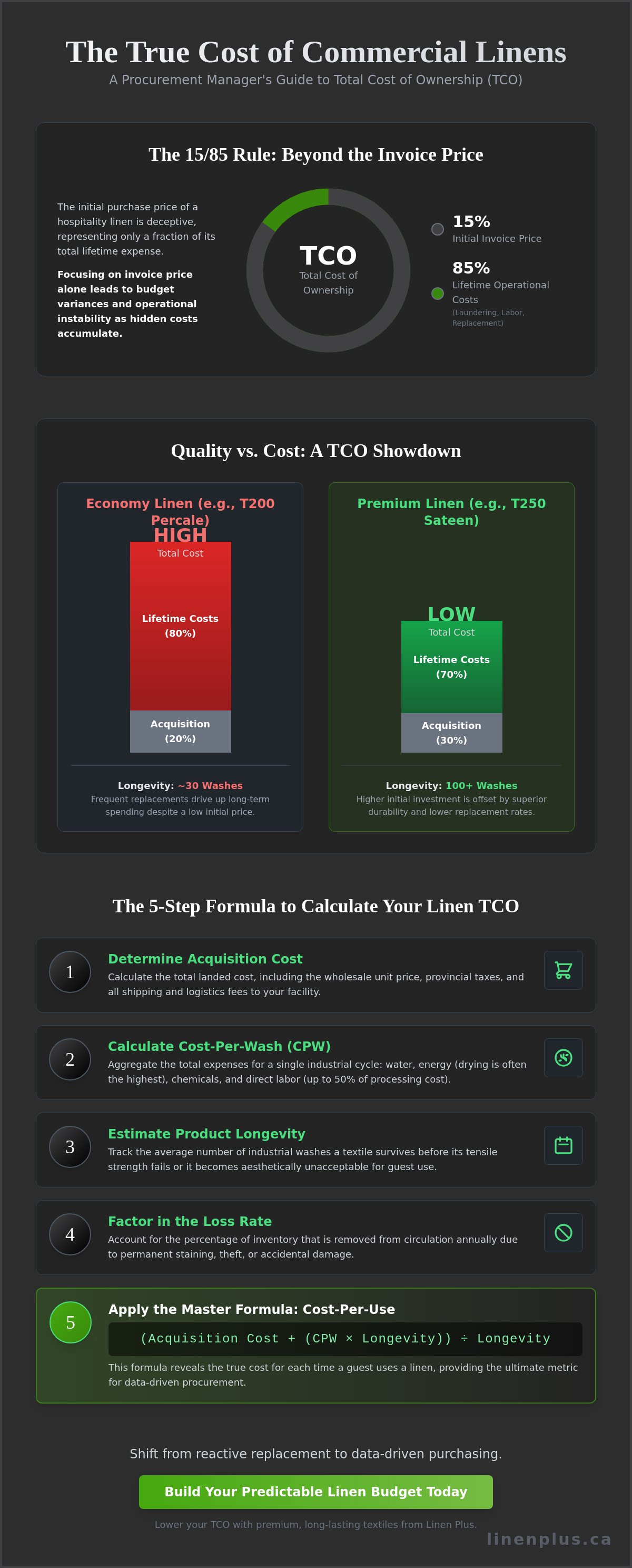
In the commercial textile industry, the "15/85 Rule" is a standard benchmark. This data suggests that the acquisition price typically represents only 15% of a sheet's total lifetime cost. The remaining 85% is driven by operational expenses like labor, water, and energy. A low sticker price is often a red flag for poor durability. While an economy sheet might thin or tear after 30 industrial washes, premium sheets and pillowcases are engineered to survive 100 or more cycles. This longevity directly dictates your annual replacement rate.
A full TCO analysis tracks four specific lifecycle stages:
- Acquisition: The unit price plus taxes and shipping logistics.
- Processing: The daily recurring cost of laundering and chemicals.
- Maintenance: Labor for sorting, folding, and inventory management.
- Retirement: The financial impact of replacing items lost to theft or permanent staining.
The Lifecycle of a Commercial Textile
Procurement for Canadian facilities involves specific shipping considerations and lead times that affect the acquisition phase. Managing these textiles also requires a strict "par" level, often three to four sets per bed, to prevent premature wear. This storage phase carries a cost in both space and capital. When a textile finally reaches the end of its functional life, smart operations repurpose retired bath towels as cleaning rags. This transition ensures you extract maximum value from the material before it leaves your facility.
The 5-Step Formula to Calculate Your Linen TCO
Mastering how to calculate total cost of ownership for commercial linens requires a shift from viewing textiles as fixed assets to viewing them as cost-per-use consumables. This transition allows you to identify exactly where your budget is leaking. To find your true expense, follow these five steps:
- Step 1: Determine Acquisition Cost. This is the total landed cost, including the wholesale unit price, provincial taxes, and shipping fees to your facility.
- Step 2: Calculate Cost-Per-Wash (CPW). This is the aggregate expense of water, energy, chemicals, and labor for a single industrial cycle.
- Step 3: Estimate Product Longevity. Track the total number of industrial washes a textile survives before its tensile strength fails or it becomes aesthetically unacceptable.
- Step 4: Factor in the Loss Rate. Account for the percentage of inventory lost annually to permanent staining, theft, or guest-room migration.
- Step 5: Apply the Master Formula. Use the calculation: (Acquisition + (CPW x Longevity)) / Longevity.
Calculating Cost-Per-Wash (CPW)
Determine your CPW by weighing a standard load and dividing utility costs by poundage. Evaluating the Total Cost of Ownership in Laundry reveals that energy and chemicals are only part of the equation. Drying time is often the most expensive variable. For instance, switching to premium ring spun towels can reduce drying cycles by 15% compared to heavy-looped alternatives, significantly lowering your energy spend per unit. Don't forget to include the labor costs for folding and distribution, which often represent 50% of the total processing expense.
Need Reliable Wholesale Supplies for Your Facility?
Hotels, healthcare facilities, restaurants, and commercial operations across Canada trust Linen Plus for consistent bulk supply and commercial-grade quality.

Bulk Wholesale Pricing
Competitive pricing for large-volume procurement.

Reliable Nationwide Supply
Consistent inventory and fast shipping across Canada.

Hospitality & Healthcare Grade
Products designed for demanding commercial environments.
Factoring in Par Levels and Accelerated Wear
A "1-par" system, where linens are washed and returned to service immediately, prevents fiber recovery and doubles your TCO. Cotton fibers need a 24-hour rest period to regain their shape and moisture balance after the high heat of an industrial dryer. Maintaining a 3-par or 4-par inventory of sheets and pillowcases ensures each set lasts longer. This professional management strategy effectively spreads the acquisition cost over a greater number of uses, protecting your investment from premature thinning. If you're looking to optimize your budget, you can explore hospitality supply programs designed to maintain these critical par levels efficiently.
Case Study: T200 Percale vs. T250 Sateen TCO Comparison
Choosing between a standard economy sheet and a premium hospitality option is often where the budget is won or lost. When you evaluate how to calculate total cost of ownership for commercial linens, the comparison between T200 and T250 textiles reveals significant differences in "tensile loss." Industrial laundering is aggressive. A T200 Percale Bed Sheet, while a reliable baseline, often experiences a faster rate of fiber degradation per wash compared to a high-density T250 sateen. This means the lower thread count sheet may reach its retirement stage 25% sooner, forcing a replacement cycle that cancels out any initial savings.
Canadian facilities must also account for the energy impact of these choices. Heavier thread counts often trap more moisture, extending drying times. However, premium sateen weaves utilize finer yarns that allow for better airflow during the tumble cycle. With U.S. commercial electricity rates averaging 14.12¢ per kilowatt-hour as of May 2026, even a 5-minute reduction in drying time per load generates massive annual savings. Every minute saved in the dryer is a direct reduction in your operational overhead.
The Durability Gap
Durability isn't just about thickness; it's about the quality of the fiber. Long-staple cotton used in premium linens reduces pilling, which is the primary reason guests perceive sheets as old or uncomfortable. Instead of looking at the cost-per-sheet, operations managers should calculate the "Cost-Per-Stay." If a standard sheet lasts for 75 stays while a T250 lasts for 120, the premium option is the superior financial choice despite a higher acquisition price. This longevity ensures your facility maintains a consistent guest experience without the constant churn of new inventory.
Energy and Labour Efficiency
TCO calculations extend to your terry inventory as well. Premium Ring Spun Towels offer a case study in efficiency. These towels use a spinning process that creates a smoother, stronger yarn, allowing for high absorption without the excessive weight of a high-GSM towel. Lighter, high-performance towels require less energy to dry and are easier for staff to handle and fold. This efficiency directly lowers your processing costs, proving that heavier doesn't always mean better for your bottom line. Browse our hospitality supply programs to compare textile specifications and optimize your facility's budget today.
Strategic Procurement: Reducing TCO Without Sacrificing Quality
Once you understand the variables involved, the next step is implementing procurement strategies that drive those numbers down. Bulk procurement is a primary lever for reduction. Pallet-level shipping across Canada minimizes the acquisition variable by spreading freight costs across larger volumes. Consolidating orders for sheets and pillowcases reduces administrative overhead and ensures consistent quality across your facility. This strategy transforms procurement from simple buying into active supply chain management.
Standardization simplifies the laundry workflow. Limiting your inventory to a single textile specification reduces sorting labor and minimizes laundry errors. With commercial laundry worker wages in 2026 reaching up to $22.86 per hour, these efficiencies significantly lower the final figure when you determine how to calculate total cost of ownership for commercial linens. Reducing the variety of linens in circulation prevents the accidental use of improper wash cycles, which is a leading cause of premature textile failure.
Preventative Maintenance for Textiles
Longevity depends on laundry chemistry. Chemical titration is vital to ensure pH levels don't destroy cotton fibers prematurely. Effective stain management protocols also allow staff to salvage linens before they reach the retirement phase. Treating a stain immediately is far more economical than replacing a premium bath towel that still has significant functional life. These small operational shifts protect your investment from the aggressive nature of industrial processing.
Leveraging Direct-to-Manufacturer Partnerships
Linen Plus acts as a critical B2B partner by providing direct manufacturer access. This model eliminates middleman markups and ensures a reliable flow of inventory. Our partnership model helps you master how to calculate total cost of ownership for commercial linens by providing transparency in the acquisition phase. Consistent supply prevents the need for expensive emergency shipping or the use of mismatched textiles. By focusing on these procurement habits, you secure a complete solution for your facility’s long-term financial health. Explore our hospitality programs to begin optimizing your supply chain.
Mastering the Financial Lifecycle of Your Facility Linens
Transitioning from simple purchasing to strategic supply chain management is the most effective way to stabilize your facility's budget. You've learned how to calculate total cost of ownership for commercial linens by integrating acquisition costs with the recurring expenses of laundering and premature replacement. By prioritizing high-tensile textiles and maintaining proper par levels, you ensure your investment lasts through 100 or more industrial cycles. This data-driven approach reduces your cost-per-use and eliminates the budget variances caused by poor-quality textiles that fail under the stress of commercial processing.
Linen Plus supports your facility with direct manufacturer partnerships that secure the lowest acquisition costs and a specialized inventory tailored for hospitality and healthcare professionals. Our nationwide Canadian distribution ensures your supply chain remains resilient and efficient. Calculate your savings with our Wholesale Bedding Solutions and start optimizing your textile lifecycle today. You're now equipped to make procurement decisions that protect both your guest experience and your bottom line.
Frequently Asked Questions
What is the average lifespan of a commercial hotel sheet?
A commercial hotel sheet typically survives 100 to 150 industrial laundry cycles before its aesthetic or physical quality fails. In a standard mid-scale hotel environment, this translates to a replacement cycle of 18 to 24 months. Luxury facilities often extend this to 36 months by utilizing higher-quality long-staple cotton and maintaining strict laundry pH levels to prevent premature fiber thinning.
How much does it cost to launder one pound of linen in Canada?
Internal industrial laundry costs for hospitality facilities are currently benchmarked between $0.38 and $0.48 per pound. Healthcare facilities see higher costs, ranging from $0.55 to $0.65 per pound, because of the intensive sanitization protocols required. These figures incorporate May 2026 labor rates of $20 to $22.86 per hour and account for the 40% to 50% of total expenses typically attributed to staffing.
Does a higher thread count always mean a lower total cost of ownership?
Higher thread count improves durability but doesn't always lower TCO if the fabric weight increases drying times. While a T250 sateen sheet often has better tensile strength than a T200 percale, the extra density can raise energy bills. The goal is to select textiles with a balance of durability and a lighter GSM to capitalize on the 14.12¢ per kWh average commercial electricity rate.
How do par levels affect the total cost of ownership for linens?
Par levels directly impact TCO by determining how much rest a textile receives between wash cycles. A 3-par or 4-par system allows cotton fibers 24 hours to regain moisture and shape, extending the product's life by up to 50%. Facilities that ignore these levels and wash linens immediately after guest checkout experience significantly higher replacement rates due to accelerated heat damage and fiber friction.
What are the hidden costs in commercial linen procurement?
Hidden costs include tensile loss from chemical titration errors and the labor required to sort non-standardized inventory. When you understand how to calculate total cost of ownership for commercial linens, you also account for the loss of inventory through guest-room migration and permanent staining. These indirect costs, along with shipping logistics for small orders, often represent a larger portion of your budget than the initial unit price.

Article by
Sohel Shahriar
Sohel Shahriar is the Chief Growth Officer (CGO) at Linen Plus Inc., Canada, bringing a strategic blend of growth marketing, brand leadership, and content expertise. Through his writing, he explores how quality linen, smart sourcing, and long‑term partnerships can create measurable impact for healthcare and hospitality organizations.


