


Research from the Aberdeen Group indicates that processing a single manual invoice can cost a business up to C$40 in administrative labor. For a hospitality group managing 20 properties, each dealing with dozens of regional suppliers, these hidden "soft costs" translate into thousands of dollars in monthly operational leakage. Implementing a robust vendor consolidation strategy for Canadian hotel groups is no longer just a procurement preference; it's a financial necessity for 2026.
You've likely felt the strain of logistical volatility, especially when shipping to remote Canadian locations where freight charges can fluctuate by 15% month-over-month. It's frustrating to manage inconsistent guest experiences when towels and linens vary in GSM or thread count across different regional portfolios. You shouldn't have to sacrifice quality for the sake of geographic reach.
This guide provides the framework to streamline your procurement, reduce logistics overhead, and improve supply chain resilience across every location you manage. We'll show you how to lower your total cost of ownership through bulk purchasing and standardized brand requirements. We'll explore the transition to a complete solution model that ensures your guests receive the same premium experience whether they're in Toronto or a remote lodge in the Rockies.
Key Takeaways
- Identify and eliminate the "invisible drain" of administrative overhead by reducing redundant regional suppliers and streamlining your invoice processing workflows.
- Master a 5-step vendor consolidation strategy for Canadian hotel groups to audit annual spend and establish unified brand standards for every property in your portfolio.
- Increase bulk purchasing power and supply chain resilience through SKU rationalization, focusing on high-volume essentials like premium linens and janitorial supplies.
- Unlock long-term ROI by leveraging consolidated volume for better tier-pricing in C$ and reducing your group’s carbon footprint with optimized delivery logistics.
The Case for Vendor Consolidation in the 2026 Canadian Hospitality Market
Vendor consolidation is the strategic process of reducing the total number of suppliers to gain better control over the supply chain. It functions as a critical business consolidation effort for hospitality brands looking to scale without increasing overhead. For many organizations, implementing a vendor consolidation strategy for Canadian hotel groups is the most effective way to transition from reactive purchasing to proactive procurement. Managing multiple regional suppliers creates an "invisible drain" on resources. Every unique vendor requires a separate setup in the accounting system, individual invoice verification, and manual payment processing. Industry data indicates that the labor cost to process a single manual purchase order (PO) often ranges from C$50 to C$120. When a hotel group manages 20 different suppliers across 10 locations, these administrative costs erode profit margins before a single guest checks in. Logistics act as a primary driver for this shift. Canada’s geography creates unique challenges where fragmented shipping leads to unsustainable freight-to-product cost ratios. Small, frequent shipments from various local vendors result in higher carbon footprints and excessive "last-mile" delivery fees. Consolidating orders into larger, less frequent shipments from a national partner optimizes pallet space and reduces the total cost of landed goods. Standardization ensures brand integrity. A T200 Percale sheet in Halifax must match the quality and feel of a sheet in Vancouver. Centralized sourcing eliminates the risk of regional product substitutions that occur when local managers buy from different sources to fill immediate gaps.Soft Costs vs. Hard Costs in Procurement
Soft costs represent the administrative hours spent on vendor sprawl, such as chasing late deliveries or correcting billing errors. These costs are often hidden but can be more damaging than high unit prices. Uncoordinated deliveries from multiple vendors can inflate receiving dock labor by as much as 30% because staff must stop their primary duties to manage different couriers throughout the day. Focusing on a complete solution reduces these interruptions and streamlines the accounting cycle.
Addressing Supply Chain Resilience
The belief that more vendors equal more safety is a common myth. In reality, deep partnerships with national distributors offer superior stock protection. A unified national inventory approach allows a provider to shift stock between regional hubs, ensuring a property in Calgary remains supplied even if a specific shipping lane is blocked. This model mitigates regional stockouts more effectively than relying on several smaller, localized vendors with limited safety stock levels.
Core Pillars of a Comprehensive Consolidation Strategy
Establishing a robust vendor consolidation strategy for Canadian hotel groups starts with rigorous category mapping. Procurement teams must identify overlapping supply lines between linens, guest amenities, and janitorial supplies. When these categories remain siloed, groups lose out on volume-based discounts and face increased administrative overhead from processing dozens of monthly invoices. A unified approach ensures that every dollar spent contributes to a higher tier of purchasing power.
Need Reliable Wholesale Supplies for Your Facility?
Hotels, healthcare facilities, restaurants, and commercial operations across Canada trust Linen Plus for consistent bulk supply and commercial-grade quality.

Bulk Wholesale Pricing
Competitive pricing for large-volume procurement.

Reliable Nationwide Supply
Consistent inventory and fast shipping across Canada.

Hospitality & Healthcare Grade
Products designed for demanding commercial environments.
SKU rationalization is the next critical pillar. Reducing the variety of products, such as standardizing on specific sheets and pillowcases across all properties, increases bulk purchasing power. Data harmonization follows, creating a single source of truth for consumption rates across the portfolio. This transparency allows managers to use Group Purchasing Organizations (GPOs) or direct wholesale agreements to lock in rates based on predictable volume. Finally, a supplier capability audit ensures your partner can handle custom branding and national distribution without service gaps.
The One-Stop Shop Model for Hospitality
Integration is the engine of operational efficiency. By combining high-turnover guest amenities with core textiles, hotels reduce the frequency of weekly deliveries. The "Mixed Pallet" shipping approach allows properties to receive bath towels, bed linens, and cleaning supplies in a single shipment. This strategy can cut receiving labor costs by approximately 20% and significantly reduces the carbon footprint of the hotel's supply chain.
Evaluating National Distribution Strength
A centralized Edmonton-based hub provides a strategic advantage for the Canadian market. It offers a logistical midpoint that balances transit times between Vancouver and Toronto, ensuring remote properties aren't left waiting for essential stock. Reliable partners also maintain direct manufacturer relationships. These partnerships are essential for 2026 price stability, as they bypass middleman markups and provide a buffer against global shipping volatility. Hotel groups can streamline their hospitality operations by partnering with distributors who offer this level of logistical control and local expertise.
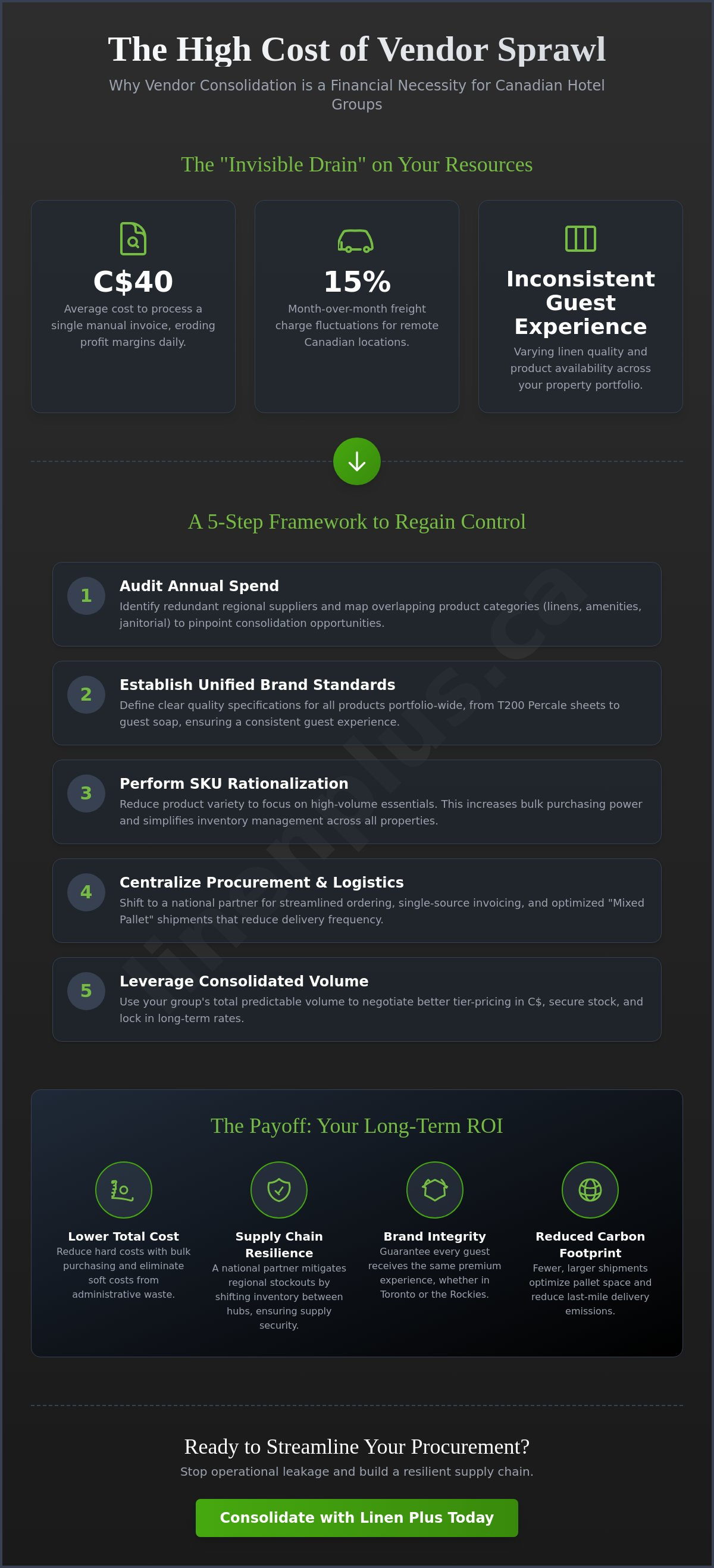
Executing the Consolidation: A 5-Step Framework for Hotel Groups
Implementing a vendor consolidation strategy for Canadian hotel groups requires a transition from fragmented local buying to a disciplined, centralized model. This process reduces operational friction and ensures every property, whether in Vancouver or Halifax, maintains identical quality standards. Follow this five-step framework to streamline your 2026 procurement cycle.
- Step 1: Audit and Categorize. Document every active vendor and the total annual spend per category. You'll likely find that 80% of your volume is concentrated in 20% of your suppliers.
- Step 2: Define Brand Standards. Select "Hero SKUs" for the entire group. This includes specific 650 GSM towels or standardized thread counts to ensure guest experience remains uniform across all locations.
- Step 3: Pilot Implementation. Roll out the consolidated model to a single region or specific property type first. Testing the workflow in a mid-scale cluster allows you to troubleshoot logistics before a national launch.
- Step 4: Centralize Ordering. Move procurement to a unified platform. This prevents "maverick spend," where property managers bypass approved vendors, which often accounts for 15% to 25% of budget leakage.
- Step 5: Review and Optimize. Use quarterly data to refine delivery frequencies. If a property in Alberta consistently pays high LTL (Less Than Truckload) fees, adjust bulk quantities to maximize shipping efficiency.
Overcoming Internal Resistance to Change
Property-level managers often fear losing autonomy. To gain buy-in, demonstrate how consolidation reduces receiving times by 40% per week. Show them the tangible quality of premium textiles like T200 Percale Bed Sheets. When staff see that higher-quality sheets and pillowcases lead to fewer guest complaints and easier laundry processing, adoption happens much faster.
Setting Key Performance Indicators (KPIs)
Success must be measured by hard data rather than anecdotal feedback. Track the reduction in total invoices processed per quarter; a 30% decrease is a standard benchmark for successful consolidation. Additionally, monitor the decrease in average shipping costs as a percentage of total spend. Targeting a shipping-to-spend ratio below 8% ensures your logistics are optimized for the Canadian market.
Streamline your facility operations today by partnering with a national supplier. Explore our hospitality procurement solutions.
The Long-Term ROI of a Unified Supply Chain Partner
A vendor consolidation strategy for Canadian hotel groups delivers measurable financial returns that extend far beyond simple invoice reduction. Operations managers often see a 15% to 22% decrease in administrative labor costs when switching from fragmented purchasing to a single-source model. This efficiency stems from streamlined procurement workflows and predictable, consolidated billing cycles that stabilize monthly cash flow. Instead of managing dozens of C$500 payments to niche suppliers, groups benefit from a single, transparent statement that simplifies reconciliation and audit processes.
Consolidating volume creates significant leverage during price negotiations. High-traffic areas like on-site spas require specialized medical supplies and disposables. By bundling these items with guest room essentials, hotel groups unlock tier-pricing typically reserved for much larger enterprises. Sustainability gains are equally impactful. Transitioning to a unified delivery schedule reduces the frequency of heavy vehicle arrivals at your loading docks. This directly lowers the group's carbon footprint and supports corporate ESG goals for 2026 by optimizing logistics and reducing packaging waste.
Consistency in guest experience is the foundation of brand equity. When every property in a Canadian group uses identical high-quality linens and amenities, guest satisfaction scores remain stable. This uniformity prevents the negative online ratings that often result from inconsistent product quality between different locations.
Future-Proofing for 2026 and Beyond
The Canadian regulatory environment is shifting quickly, particularly regarding single-use plastics and health safety standards. A consolidated partner acts as a strategic advisor, helping properties stay ahead of federal mandates. Whether it's sourcing compliant PPE or transitioning to eco-friendly guest room supplies, a primary vendor ensures your inventory remains current. This proactive approach prevents the risk of non-compliance fines or sudden stockouts caused by shifting regional requirements.
Why Linen Plus is the Strategic Choice for Canadian Groups
Linen Plus provides a national logistics network combined with deep expertise in the hospitality industry. We understand the specific demands of Canadian climates and regional supply chains. Our inventory spans from premium bed linens to essential janitorial products, offering a complete solution that ensures guest experience remains consistent across every province. We focus on durability and fiscal responsibility, helping your properties maintain high standards while protecting your operational margins.
Securing Your 2026 Operational Edge
Implementing a vendor consolidation strategy for Canadian hotel groups isn't just about reducing administrative tasks; it's a critical move for fiscal resilience. By 2026, the hospitality sector will demand leaner operations to offset rising labor costs. Transitioning to a single-source model reduces shipping overhead and eliminates the complexity of managing dozens of individual invoices. A unified supply chain ensures that every property in your portfolio maintains brand standards, from the thread count in guest rooms to the GSM of towels in the spa.
Linen Plus provides the infrastructure to support this transition. Our direct manufacturer partnerships allow us to secure consistent 2026 pricing for our partners. We manage a comprehensive inventory that spans premium linens, guest amenities, and essential janitorial supplies. Operating from our Alberta distribution hub, we offer reliable national coverage across all provinces. This centralized approach simplifies logistics and guarantees that your essential supplies arrive on schedule.
Streamline your hotel procurement with a Linen Plus hospitality account to optimize your supply chain today. We're ready to help your group achieve its 2026 efficiency goals.
Frequently Asked Questions
What are the risks of vendor consolidation for a hotel group?
The primary risks include supply chain vulnerability and reduced price competition. Relying on a single partner means a localized disruption, such as a 2023 transport strike in British Columbia, could freeze deliveries across all properties. To mitigate this, groups should maintain a secondary backup vendor for critical items like linens or sanitization chemicals to ensure 100% operational uptime.
How much can a hotel group save through vendor consolidation?
Hotel groups typically realize administrative and logistical savings of 10% to 15% within the first 12 months. Implementing a vendor consolidation strategy for Canadian hotel groups reduces the hidden costs of processing multiple invoices, which can cost up to C$25 per transaction in labor. Bulk shipping also lowers freight charges, which have increased by 7% annually in rural Canadian markets.
Is vendor consolidation suitable for boutique hotels or just large groups?
Consolidation is highly effective for boutique hotels because it provides the leverage needed to access wholesale pricing usually reserved for national chains. A 20 room property in Ontario can lower its operational overhead by bundling towels, guest amenities, and cleaning supplies into one delivery. This one-stop shop approach provides the service plus value that allows smaller operators to focus on guest experience.
How do I choose the right lead vendor for my hospitality supplies?
Select a lead vendor based on their Canadian logistics infrastructure and their ability to provide a complete solution across multiple categories. Prioritize partners with local warehouses in provinces like Alberta or Ontario to minimize lead times. A reliable partner should offer high GSM linens and eco-friendly bulk amenities while demonstrating a track record of 98% order fulfillment rates in the hospitality sector.
What is the difference between vendor consolidation and sole sourcing?
Vendor consolidation involves reducing the total number of suppliers to a manageable few; sole sourcing relies on exactly one provider for a specific category. A vendor consolidation strategy for Canadian hotel groups focuses on efficiency through strategic partnerships without creating a total dependency. This allows procurement managers to maintain high quality standards across diverse product lines like textiles and food service disposables.

Article by
Sohel Shahriar
Sohel Shahriar is the Chief Growth Officer (CGO) at Linen Plus Inc., Canada, bringing a strategic blend of growth marketing, brand leadership, and content expertise. Through his writing, he explores how quality linen, smart sourcing, and long‑term partnerships can create measurable impact for healthcare and hospitality organizations.


