


If your facility's linens lose their structural integrity after just 50 industrial wash cycles, you aren't paying for premium quality; you're paying for a marketing label. It's a common frustration for Canadian procurement managers who find that many bulk imports fail to meet the 3.2cm staple length required for true durability. You likely agree that guest satisfaction depends on the tactile quality of your sheets, yet high replacement costs from textile degradation can quickly erode your facility's ROI. Authentic Egyptian cotton isn't just a luxury choice; it's a strategic operational asset that ensures longevity through hundreds of commercial launderings.
This guide provides the technical clarity needed to distinguish genuine long-staple fibers from inferior blends that lead to pilling and premature thinning. We'll outline the specific authenticity markers and GSM requirements that define a high-performance textile investment. You'll discover how to optimize your linen inventory with a reliable supply chain that delivers a consistent "Plus" to your guest experience and your bottom line.
Key Takeaways
- Understand why the extra-long-staple fibers of Egyptian cotton provide the superior tensile strength necessary for high-frequency industrial laundering.
- Distinguish between single-ply and multi-ply yarns to avoid the "thread count myth" and ensure your facility invests in true commercial-grade quality.
- Optimize your textile budget by calculating the cost-per-use benefits of premium Giza fibers versus lower-tier standard percale sheets.
- Secure consistent supply and competitive bulk C$ pricing through direct manufacturer partnerships tailored for the Canadian hospitality and healthcare sectors.
Understanding Egyptian Cotton in a Commercial Context
This material represents a technical standard rather than a generic marketing term. The Nile River Valley's stable humidity and nutrient-rich soil produce Giza cotton, a variety optimized for high-performance commercial use. This unique environment allows the plant to produce fibres that are significantly longer and finer than standard varieties, providing the foundation for durable linen solutions that meet the rigorous demands of hospitality and healthcare sectors.
The Science of Long-Staple Fibres
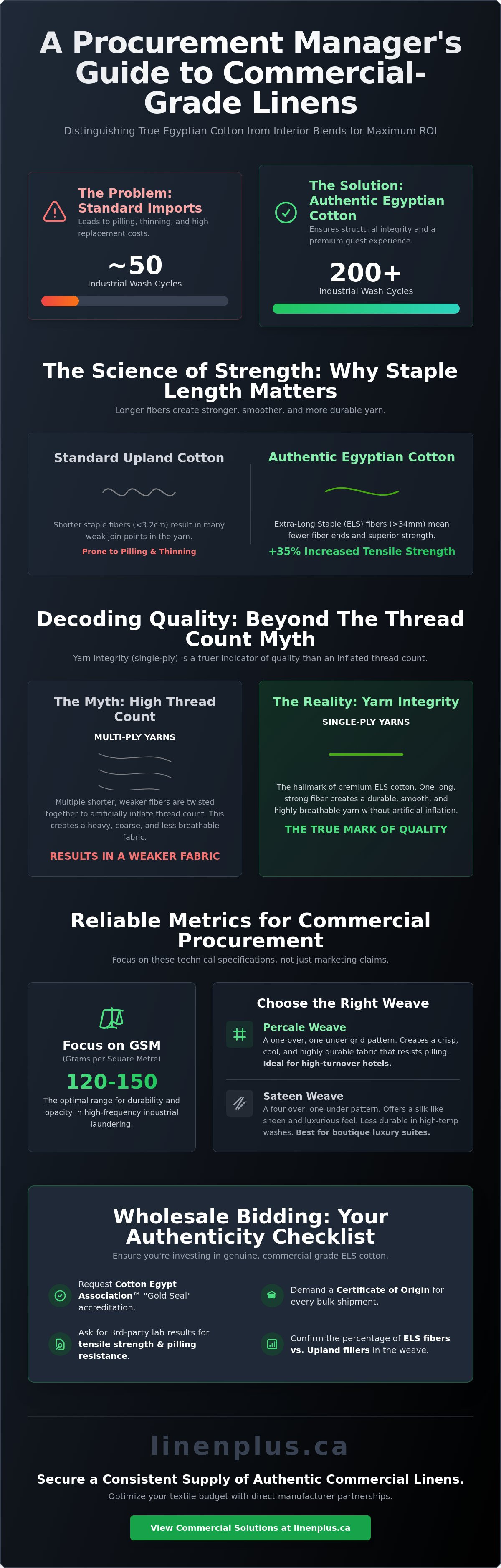
Commercial durability depends on staple length. Most global production consists of Upland cotton, which has shorter fibres. In contrast, the Gossypium barbadense species is known for extra-long-staple (ELS) fibres exceeding 34mm. Longer fibres mean fewer join points in the yarn. This architectural advantage results in a 35% increase in tensile strength compared to standard Upland cotton. For hospitality managers, this translates to linens that withstand 200 plus industrial wash cycles without losing structural integrity. Fewer exposed fibre ends also mean a drastic reduction in surface pilling, maintaining a smooth texture for guests over the product's entire lifecycle.
Authenticity vs. 'Egyptian-Grade' Marketing
Procurement officers often encounter "Egyptian-grade" or "Egyptian-feel" marketing. These terms usually hide blended fabrics containing as little as 10% authentic ELS fibres. To ensure you're investing in genuine Egyptian cotton sheets and pillowcases, verify the "Gold Seal" from the Cotton Egypt Association™. This organization uses DNA testing to confirm the origin of the cotton. It's a critical safeguard against the widespread fraud identified in a 2016 industry audit. For Canadian facilities, ensuring a transparent supply chain is essential for maintaining operational standards and long-term budget efficiency.
- Request the manufacturer's Cotton Egypt Association™ accreditation number.
- Confirm the percentage of ELS fibres versus Upland fillers in the weave.
- Ask for third-party lab results regarding tensile strength and pilling resistance.
- Verify that the supplier provides a certificate of origin for every bulk shipment.
The Technical Specifications of Premium Bedding
Thread count is frequently used as a marketing gimmick rather than a metric of quality. For commercial procurement, the focus shifts from the number of threads to the integrity of the yarn. A 300-thread count sheet made from 100% Egyptian cotton typically provides better breathability and tensile strength than a 1000-thread count generic cotton set. This is because high thread counts in retail products often rely on multi-ply yarns, where multiple thin, low-quality strands are twisted together to artificially inflate the count. This results in a heavy, coarse fabric that traps heat and pills after minimal use.
Need Reliable Wholesale Supplies for Your Facility?
Hotels, healthcare facilities, restaurants, and commercial operations across Canada trust Linen Plus for consistent bulk supply and commercial-grade quality.

Bulk Wholesale Pricing
Competitive pricing for large-volume procurement.

Reliable Nationwide Supply
Consistent inventory and fast shipping across Canada.

Hospitality & Healthcare Grade
Products designed for demanding commercial environments.
When evaluating sheets and pillowcases for technical spec comparisons, professionals prioritize GSM (grams per square metre). This measurement determines the actual density and weight of the fabric. For heavy-duty industrial laundering, a GSM between 120 and 150 ensures the fabric remains opaque and durable over hundreds of wash cycles. It's a more reliable indicator of longevity and fiscal responsibility than thread count alone.
Percale vs. Sateen: Choosing the Right Weave
Percale uses a one-over, one-under weave pattern. It's the standard for high-turnover hotels because it stays cool and resists pilling. The crisp feel is a direct result of this tight, flat weave. Sateen uses a four-over, one-under structure, creating a silk-like sheen and a heavier drape. While sateen offers a luxury experience for boutique suites, it's often less durable than percale in high-temperature industrial wash environments.
Wholesale Procurement: Single-Ply vs. Multi-Ply
Single-ply yarns are the hallmark of authentic premium Egyptian cotton. These yarns consist of long, strong fibers that don't require twisting with other strands. Multi-ply yarns use shorter, weaker fibers. This leads to a heavier, less breathable fabric that frays quickly. Choosing single-ply ensures your investment maintains its texture and professional appearance. Reviewing technical data sheets can help you select the most cost-effective bed linens for your facility's specific operational needs.
Maintenance and ROI: Maximizing Textile Lifespan
Procuring Egyptian cotton represents a shift from expense-based thinking to strategic asset management. While the initial capital expenditure for ELS (Extra-Long Staple) linens is higher than standard T-200 percale, the cost-per-use tells a different story. In high-turnover hospitality environments, a standard T-200 sheet typically shows signs of thinning or pilling after 125 industrial wash cycles. In contrast, the superior tensile strength of Egyptian cotton allows it to withstand 250 to 300 cycles before losing structural integrity. This 100% increase in lifespan effectively lowers the long-term procurement budget for Canadian facilities by reducing the frequency of replacement orders.
Industrial Laundering Protocols
Maintaining the "hand" of premium linens requires strict adherence to chemical and thermal limits. ELS fibers are sensitive to high-alkaline detergents. Keeping a pH level between 7 and 8.5 during the wash cycle prevents the premature breakdown of the cellulose structure. Wash temperatures should be capped at 60°C to ensure sanitization without inducing fiber stress or excessive shrinkage. Professional ironing isn't just for aesthetics; the heat and pressure from a flatwork ironer help compress the fibers and smooth the surface. This process increases the fabric's resistance to future staining and mechanical wear. For deeper insights into managing bulk supplies, see our Wholesale Linens Canada guide.
Storage and Inventory Rotation
Operational efficiency depends on the "Rule of Three." Every bed requires three sets of linens: one in use, one in the laundry, and one resting in the linen closet. This rotation isn't just about logistical availability. Cotton fibers are organic and need a 24-hour rest period between washing and use to recover their natural elasticity and moisture balance. Skipping this rest period leads to "fiber fatigue," where the threads become brittle and snap under tension. Proper rotation ensures your Egyptian cotton investment retains its premium feel for its entire projected lifespan.
Sourcing Authentic Egyptian Cotton Wholesale in Canada
Procuring authentic Egyptian cotton within the Canadian market requires a partner who manages the entire supply chain from manufacturer to facility floor. Linen Plus operates as a national B2B supplier, providing consistency for hospitality groups that manage multiple properties from Halifax to Victoria. By maintaining direct manufacturer partnerships, we verify the authenticity of every shipment, protecting your investment from the synthetic blends often mislabeled in the wholesale market. Our logistics network ensures that bulk orders arrive on a predictable schedule, which is vital for facilities maintaining a 95% occupancy rate. To complete a high-end guest experience, procurement managers often pair these sheets with our premium duvets and covers.
The One-Stop Shop Advantage
Managing multiple vendors is a significant administrative burden for operations managers. Consolidating your procurement of linens, medical supplies, and guest amenities into a single account reduces operational overhead by approximately 15% through streamlined invoicing and reduced shipping touchpoints. The 'Plus' factor means you get industry-specific expertise that understands the rigorous laundering requirements of Canadian healthcare and hospitality standards. We prioritize reliability and fast shipping so your staff isn't left waiting for essential inventory during peak seasons.
Custom Branding and Personalization
Luxury branding depends on details that guests can see and feel. Our custom embroidery services allow you to add logos to Egyptian cotton linens, reinforcing brand identity the moment a guest enters the suite. Personalized linens increase brand recall and signal a commitment to quality that generic products can't match. This level of customization transforms standard bedding into a signature element of your property's identity, helping to justify premium room rates and drive positive guest reviews.
Optimizing Your Textile Strategy for Long-Term Value
Selecting Egyptian cotton for your facility isn't just about guest comfort; it's a strategic decision to improve your bottom line through textile longevity and superior durability. By prioritizing technical specifications like high GSM and long-staple fibers, you ensure your linens withstand the rigorous laundering cycles typical in commercial environments. This approach maximizes your ROI by extending the replacement interval, a critical factor for managing operational budgets in Canada's competitive hospitality and healthcare sectors.
Since 2010, Linen Plus has functioned as a dependable B2B partner, providing direct manufacturer links that guarantee 100% authenticity for every shipment. We understand that timing is vital for your operations, which is why we offer nationwide distribution with 24-48 hour processing times. You don't have to sacrifice quality for speed when sourcing wholesale bedding. Our commitment to logistical excellence ensures your facility stays fully equipped with premium linens that reflect your high standards of care and service.
Browse our collection of authentic Egyptian cotton linens for your facility
We're ready to help you streamline your procurement process and upgrade your textile inventory today.
Frequently Asked Questions
Is Egyptian cotton really better than Pima or Supima cotton for hotels?
Egyptian cotton is the preferred choice for luxury hospitality because its extra-long staple (ELS) fibers frequently exceed 3.2 cm in length. While Pima and Supima offer high durability, Egyptian cotton's unique porous structure allows for superior absorbency and a smoother finish that guests associate with five-star service. For Canadian hotels, sourcing authentic Egyptian cotton ensures a higher tensile strength that withstands the mechanical stress of high-volume laundry systems more effectively than standard Pima blends.
What is the ideal thread count for Egyptian cotton sheets in a commercial setting?
The industry standard for high-end hospitality ranges between 300 and 400 thread count. While retail brands often market counts above 800, these are impractical for commercial use because the dense weave traps heat and increases industrial drying times by up to 15%. A 300TC Egyptian cotton sheet provides the optimal balance of breathability and structural integrity. It keeps guests cool while reducing energy costs during the drying process in your facility.
How can I tell if the wholesale sheets I'm buying are actually 100% Egyptian cotton?
Verify authenticity by looking for the Cotton Egypt Association (CEA) gold seal on wholesale packaging. This certification uses DNA mapping to ensure fibers were grown in Egypt rather than being a blend of inferior short-staple cottons. Procurement managers should request a Certificate of Origin from their supplier. This is vital because recent industry audits showed that nearly 80% of products labeled as Egyptian cotton in the global market were actually unauthorized blends.
Does Egyptian cotton require special detergents in industrial washing machines?
You don't need proprietary detergents, but you must use pH-neutral chemicals with a range between 7.0 and 8.0 to preserve fiber strength. Avoid heavy bleach or high-alkaline boosters that strip natural waxes from the cotton, as this leads to premature fraying. In Canadian facilities, using a soft water system with a hardness level below 5 grains per gallon prevents mineral buildup. This keeps the Egyptian cotton soft without requiring excessive fabric softeners that can coat and damage the fibers.
How many wash cycles can I expect from premium Egyptian cotton linens?
Premium Egyptian cotton linens typically last between 200 and 250 industrial wash cycles before they show signs of thinning or pilling. This longevity is approximately 30% higher than standard 100% cotton linens, which often fail after 150 cycles. By maintaining a strict par level of 3.0, you can distribute the mechanical wear across your inventory. This strategy often extends the service life of your linens to over 24 months in a standard hotel environment.

Article by
Sohel Shahriar
Sohel Shahriar is the Chief Growth Officer (CGO) at Linen Plus Inc., Canada, bringing a strategic blend of growth marketing, brand leadership, and content expertise. Through his writing, he explores how quality linen, smart sourcing, and long‑term partnerships can create measurable impact for healthcare and hospitality organizations.


