


Choosing the lowest bid on waste liners is often the most expensive procurement mistake a Canadian facility manager can make. You're likely aware that a single split seam in a high-traffic lobby or healthcare ward doesn't just create a mess; it pulls your custodial team away from scheduled tasks and adds unexpected labor expenses to your monthly budget. It's a frustrating cycle of overpaying for over-specced plastic or dealing with the fallout of under-specced failures that damage your operational efficiency.
This guide helps you eliminate bag failure and optimize your facility maintenance costs through technical precision. By mastering the specific engineering behind Heavy Duty Trash Bags, you'll ensure zero-leakage standards across your entire site without wasting capital on unnecessary thickness. We'll provide the clarity you need on Mil versus Micron measurements, resin types, and puncture resistance ratings. You'll gain a streamlined framework for bulk procurement that prioritizes fiscal responsibility and operational excellence within the Canadian commercial landscape, moving your department from reactive cleaning to proactive management.
Key Takeaways
- Distinguish between LLDPE and HDPE resins to match puncture resistance or load capacity with your facility's specific waste stream requirements.
- Reduce operational overhead by selecting Heavy Duty Trash Bags that prevent costly bag failures and the associated labor expenses of sanitation cleanup.
- Implement industry-specific selection criteria for hospitality and healthcare to manage everything from heavy organic wet waste to non-sharp clinical supplies.
- Utilize precise sizing formulas to calculate the ideal bag width and overhang, effectively eliminating the common issue of "bag drop" in commercial containers.
- Transition from standard retail ratings to technical mil and micron specifications to ensure long-term fiscal responsibility and procurement consistency across your Canadian operations.
Understanding Heavy Duty Trash Bags in a Commercial Context
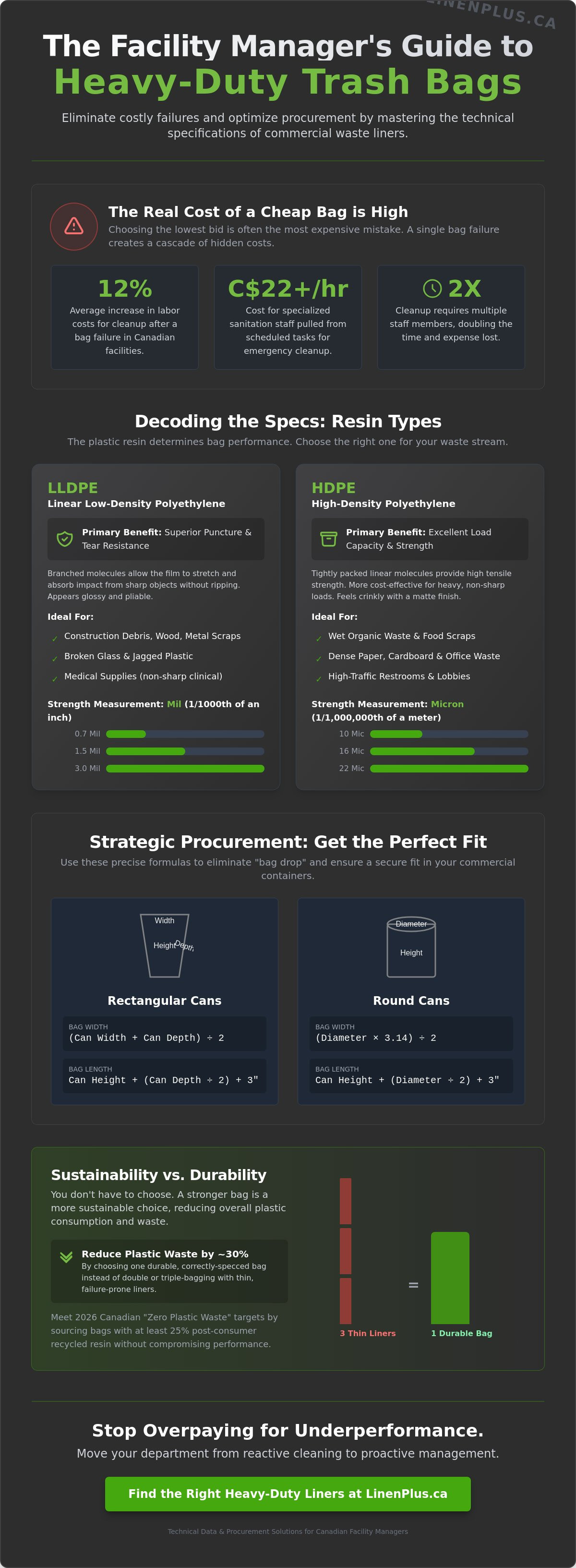
Commercial procurement requires more than a standard retail label. While a household bag might handle kitchen scraps, commercial Heavy Duty Trash Bags must withstand jagged glass, heavy liquids, and industrial debris. Sourcing these liners in bulk ensures operational readiness across large facilities. The history of trash bags shows a shift from simple storage to high-performance polymers like LLDPE (Linear Low-Density Polyethylene) designed for maximum stretch. In Canada, facility managers face a 12% average increase in labor costs, often exceeding C$22 per hour for specialized sanitation staff, when a bag fails. Cleanup requires multiple staff members and expensive sanitation equipment.
Performance is dictated by three primary metrics:
- Puncture Resistance: Measured in grams, this determines the force needed to pierce the plastic.
- Tear Strength: This ensures a small hole won't unzip the entire bag under pressure.
- Load Capacity: The maximum weight a liner can support without stretching to the point of failure.
By 2026, Canadian regulations under the Zero Plastic Waste initiative will mandate higher recycled content without compromising these technical specs for Heavy Duty Trash Bags. It's vital to choose liners that don't compromise integrity for compliance.
The Role of Waste Liners in Facility Hygiene
Proper liner selection is a cornerstone of infection control, particularly in medical facilities. A leak-proof seal prevents the spread of pathogens and keeps high-traffic areas sanitary. Integrating these liners with high-performance janitorial tools ensures a comprehensive approach to environmental services.
Sustainability vs. Durability in Heavy Duty Options
Choosing one durable bag over three thin liners reduces plastic waste by approximately 30%. Canadian facilities are shifting toward bags with 25% post-consumer recycled resin to meet 2026 environmental targets. This balance ensures the bag doesn't fail under pressure while meeting corporate ESG goals. Durable liners minimize the frequency of bag changes, directly lowering the overall cost per collection cycle.
Decoding Technical Specs: Resin Types, Mil, and Microns
Selecting the correct material for waste management requires an understanding of polymer chemistry. The performance of Heavy Duty Trash Bags depends on whether they are manufactured from Linear Low-Density Polyethylene (LLDPE) or High-Density Polyethylene (HDPE). These resins behave differently under stress. LLDPE molecules are branched, allowing the film to stretch and absorb the impact of sharp objects. In contrast, HDPE molecules are tightly packed and linear, providing high tensile strength that resists stretching but remains prone to "zippering" if punctured.
Need Reliable Wholesale Supplies for Your Facility?
Hotels, healthcare facilities, restaurants, and commercial operations across Canada trust Linen Plus for consistent bulk supply and commercial-grade quality.

Bulk Wholesale Pricing
Competitive pricing for large-volume procurement.

Reliable Nationwide Supply
Consistent inventory and fast shipping across Canada.

Hospitality & Healthcare Grade
Products designed for demanding commercial environments.
LLDPE vs. HDPE: Which Resin Fits Your Waste?
LLDPE is the standard for facilities handling construction debris, broken glass, or metal scraps. Its ability to elongate prevents sharp corners from piercing the film. You can identify LLDPE by its glossy appearance and soft, pliable texture. It is the primary choice for medical supplies disposal where puncture resistance is a safety requirement. HDPE is engineered for heavy, non-sharp loads like wet organic waste or dense paper stacks. It offers excellent load-bearing capacity at a lower cost per bag because the film can be thinner while maintaining strength. HDPE is easily recognized by its crinkly sound and matte, frosted finish. Procurement managers often utilize HDPE for high-traffic restrooms or food service areas where weight, not puncture risk, is the primary concern.
Calculating the Necessary Strength for Your Facility
Strength is measured using two distinct units: Mils for LLDPE and Microns for HDPE. A Mil is one-thousandth of an inch. For light office use, 0.5 to 0.7 Mil is sufficient. Industrial applications require 1.5 to 2.0 Mil. True contractor bags used on Canadian job sites typically start at 3.0 Mil and can reach 4.0 Mil for extreme demolition work. When evaluating HDPE, measurements are in Microns (one-millionth of a meter). A 10-micron bag is suitable for light waste, while a 22-micron bag handles heavy loads. Facility managers should reference industry performance standards to ensure products meet specific tear and dart impact requirements. Matching the gauge to the specific waste stream prevents overspending on over-engineered bags while avoiding the mess of a rupture. If your facility manages high-volume waste, you can find a complete solution for bulk procurement
Industry-Specific Selection: From Hospitality to Healthcare
Selecting the right waste containment solution depends entirely on the specific debris your facility generates. A bag designed for office paper will fail instantly under the weight of wet kitchen scraps or the sharp edges of discarded construction materials. Choosing high-performance Heavy Duty Trash Bags ensures operational safety and prevents the high costs associated with cleanup from avoidable ruptures. At Linen Plus, we provide a complete solution by matching bag specifications to the unique demands of Canadian commercial sectors.
- Industrial and Construction: These sites require bags with a thickness often exceeding 3.0 mil to handle jagged metal, wood scraps, and high-density masonry debris.
- Office and Retail: Procurement teams prioritize aesthetic clarity and scent control. Linear low-density bags provide the necessary stretch for overstuffed bins without compromising the professional appearance of the retail floor.
Hospitality and Food Service Optimization
Wet waste management is the primary challenge in hospitality environments. Kitchen staff deal with heavy organic matter and liquids that can seep through standard liners. We recommend liners with star-sealed bottoms. This design folds the plastic multiple times at the base; it eliminates seal gaps and allows the bag to conform to the bin shape for maximum weight distribution. This prevents leaks that lead to foul odors and pest issues in high-traffic dining areas so staff don't have to double-bag containers.
Healthcare Facility Waste Management
Clinical settings require strict adherence to safety protocols when handling non-sharp medical supplies. Waste streams must be clearly identified through colour-coding, typically using yellow or red liners for biohazardous materials. Bag strength must be sufficient to support heavy, saturated items like an incontinence underpad without tearing during transport. Using high-density Heavy Duty Trash Bags in these zones provides the puncture resistance needed to protect janitorial staff from exposure risks and ensures compliance with provincial health regulations.
Ensure your facility meets Canadian safety standards with the right waste solutions.
Shop professional medical waste supplies todayStrategic Procurement: Sizing and Bulk Ordering
Effective procurement starts with precise measurements to eliminate waste. To determine the correct size, calculate the bag width by dividing the container's circumference by two. For a standard 121-litre round bin with a 56 cm diameter, the circumference is approximately 176 cm, meaning you need a bag width of at least 88 cm. Always add 7.5 to 10 cm of length for the overhang. This extra length prevents the liner from slipping, a common issue known as "bag drop" that can increase janitorial cleaning time by 15% due to bin floor contamination.
Inventory management requires a balance between storage capacity and fiscal responsibility. Purchasing Heavy Duty Trash Bags in pallet quantities often yields savings of up to 22% compared to individual case orders. Before committing to a full-scale facility rollout, conduct a 48-hour trial in high-stress zones like loading docks or cafeterias. This testing phase ensures the resin quality handles your specific waste stream without punctures or seam failures.
Standardizing Your Receptacle Liners
Reducing SKU complexity is vital for operational excellence. By selecting three or four versatile bag sizes that fit multiple bin types, you simplify the ordering process and reduce warehouse errors. Training janitorial teams on proper installation is equally important. When staff don't maximize bag volume through correct fitment, the facility loses roughly 10% of usable space per liner, leading to premature replacement and increased material costs.
Bulk Purchasing with Linen Plus
Linen Plus provides a complete solution by leveraging direct manufacturer partnerships, ensuring consistent product specifications as we move toward 2026. Our infrastructure supports nationwide distribution, making it easier for multi-site operations to maintain quality standards across all Canadian provinces. This reliable supply chain allows facility managers to focus on operational goals rather than backorder logistics. Choosing a one-stop shop for Heavy Duty Trash Bags guarantees that your facility remains stocked with durable, cost-effective essentials that meet rigorous commercial standards.
Optimize Your Facility's Waste Management Strategy
Effective waste management in high-traffic commercial environments depends on more than just size. It requires a precise match between resin type and the specific waste profile of your facility. Whether you're managing sharp medical waste in a healthcare setting or heavy food scraps in a hospitality kitchen, selecting the right mil thickness ensures you avoid costly punctures and spills. Transitioning to a data-driven procurement model reduces overhead by eliminating the guesswork in your supply chain.
Linen Plus serves as your strategic partner by providing a complete solution for high-volume needs. We leverage direct manufacturer partnerships to secure wholesale pricing that keeps your operational costs predictable. Our inventory is specifically curated for the Canadian market, featuring a comprehensive range of Heavy Duty Trash Bags designed for durability and performance. With reliable nationwide shipping across Canada, your facility stays stocked and operational without logistical delays.
Shop Commercial Heavy Duty Trash Bags at Linen Plus
Maintaining a clean and efficient facility is easier when you have the right tools. We're here to help you streamline your procurement and focus on your core business goals.
Frequently Asked Questions
What is the difference between a contractor bag and a heavy duty trash bag?
Contractor bags are a specialized category of heavy duty trash bags engineered specifically for demolition and construction waste. While a standard heavy duty liner typically ranges from 0.9 to 1.5 Mils, a contractor bag starts at 2.0 Mils and can reach 4.0 Mils. These bags provide the extreme puncture resistance required for jagged materials like lumber, metal framing, and broken drywall.
How many Mils thick should a trash bag be for heavy construction debris?
You should use a thickness of at least 3.0 Mils for heavy construction debris like concrete chunks, brick, or heavy timber. For lighter renovation waste such as insulation or plastic sheeting, a 2.0 Mil bag is usually sufficient. Selecting the correct Mil rating prevents the need for double-bagging and reduces the risk of bag failure during transport to Canadian waste facilities.
Are high-density (HDPE) bags better than low-density (LLDPE) for kitchen waste?
LLDPE is the superior choice for kitchen waste because it offers significantly higher stretch and puncture resistance against sharp objects like bones or container edges. HDPE bags are thinner and tend to "zipper" or tear completely once they're punctured. Most facility managers prefer LLDPE heavy duty trash bags for commercial kitchens to ensure wet, heavy food scraps don't leak during disposal.
How do I calculate the correct trash bag size for a 55-gallon drum?
Calculate the bag width by taking the drum's circumference and dividing it by two. For a standard 55-gallon drum, this width is typically 38 inches. To find the length, add the drum's height to its diameter, then add 6 inches for the overhang. A bag sized 38 inches by 58 inches is the industry standard for these large containers to prevent the liner from slipping.
What does 'star seal' mean and why does it matter for heavy loads?
A star seal is a manufacturing design where the bottom of the bag is folded several times and sealed at a single point. This construction eliminates side seams, which are the most common failure points in traditional liners. It allows the bag to conform to the shape of the bin and distributes weight evenly, making it the most reliable seal for heavy, wet loads.

Article by
Sohel Shahriar
Sohel Shahriar is the Chief Growth Officer (CGO) at Linen Plus Inc., Canada, bringing a strategic blend of growth marketing, brand leadership, and content expertise. Through his writing, he explores how quality linen, smart sourcing, and long‑term partnerships can create measurable impact for healthcare and hospitality organizations.


