


Incontinence Underpads: Essential Protection for Long‑Term Care Facilities
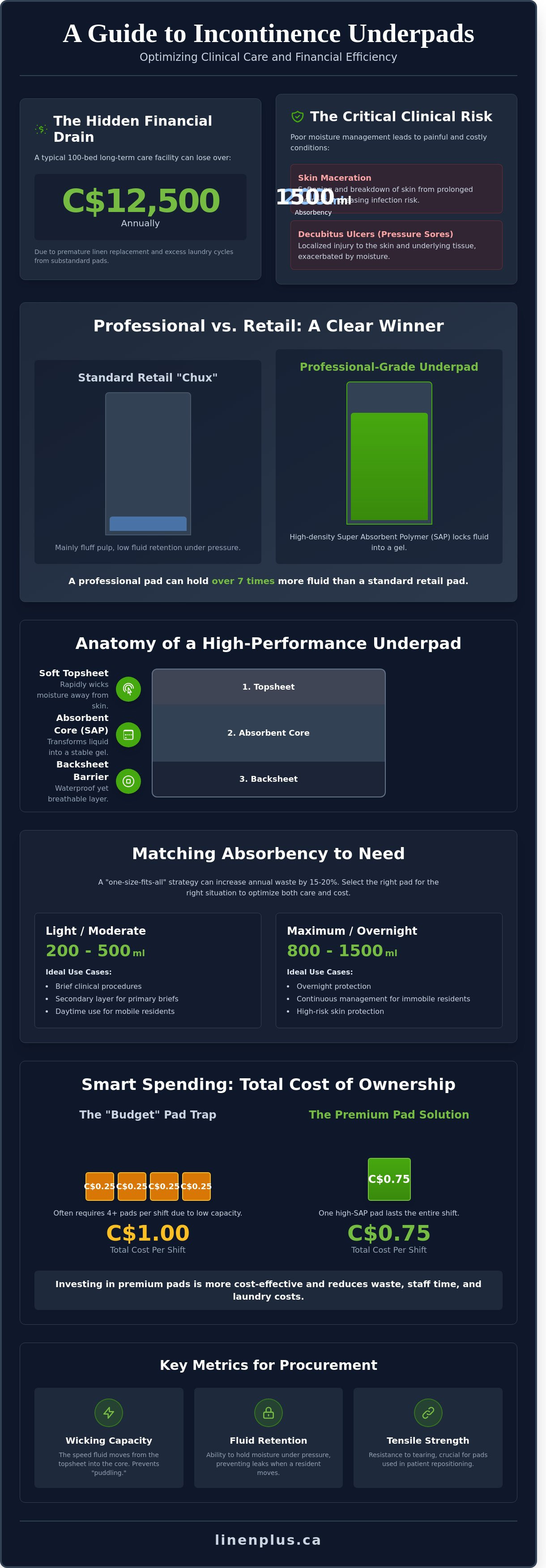
Incontinence Underpads are a critical first line of defense against moisture‑related costs, clinical risks, and staff inefficiencies in long‑term care settings. A typical 100‑bed Canadian facility can lose more than C$12,500 annually due to premature linen replacement and excess laundry cycles caused by moisture breakthrough. Balancing resident comfort with tight operational budgets is already challenging—substandard underpads only add to the problem by increasing skin breakdown risk and forcing nursing staff to perform multiple full bedding changes per shift.
Key Benefits of High‑Quality Incontinence Underpads
- Superior moisture containment to prevent leakage onto mattresses and linens
- Reduced laundry volume and linen replacement costs through higher absorbency cores
- Improved skin integrity by minimizing prolonged skin exposure to moisture
- Faster, less frequent bedding changes, saving nursing time per shift
- Enhanced resident comfort and dignity with softer, breathable top layers
- Lower total cost of ownership when compared to disposable or low‑GSM alternatives
Incontinence Underpads: How to Choose the Right Option
Incontinence Underpads require careful evaluation beyond price alone. This guide is designed to help procurement teams and clinical leaders assess absorbency levels, GSM ratings, backing materials, and construction quality to ensure the right balance between performance and cost efficiency. By selecting underpads engineered for professional use, facilities can protect resident skin health while reducing long‑term operational expenses.
What You’ll Learn in This Guide
- How higher GSM ratings improve absorbency and durability
- Which materials and backing types reduce moisture breakthrough
- How to calculate true cost-per-use, not just unit price
- Best practices for bulk procurement from reliable Canadian suppliers
- Strategies to maintain consistent inventory without overstocking
- Understand how clinical-grade Incontinence Underpads serve as essential moisture barriers to prevent skin maceration and the development of Decubitus ulcers.
- Master the technical selection process by matching specific absorbency levels to patient needs, ensuring optimal outcomes while reducing budgetary waste.
- Analyze the total cost of ownership between disposable and reusable options, comparing initial C$ price points against long-term cost-per-use efficiency.
- Improve facility operations by implementing "one pad" protocols and staff training techniques designed to prevent patient shearing and unnecessary product consumption.
- Discover the advantages of sourcing through a Canadian partner to secure consistent T200/T250 quality standards and streamlined bulk procurement logistics.
Understanding Incontinence Underpads: More Than Just Bed Protection
For Edmonton care home administrators, managing resident comfort starts with effective moisture management. An Incontinence pad, or underpad, serves as a multi-layered barrier engineered to lock away fluids and protect both the furniture surface and the user's skin. While many see them as simple bed covers, they're clinical tools designed to maintain a dry microclimate. In Alberta's long-term care sector, where 24 hour skin monitoring is standard, these pads are the first line of defense against skin breakdown.
The primary role of high-performance Incontinence Underpads is the prevention of Decubitus ulcers, or pressure sores, and skin maceration. Maceration happens when skin remains wet for too long, causing it to soften and break down. This increases infection risks and treatment costs. Professional-grade underpads are utilized across hospital beds, wheelchairs, and exam tables. They differ significantly from retail-level "chux" found in local pharmacies. While a standard retail pad might only contain fluff pulp, professional versions feature high Super Absorbent Polymer (SAP) density. This allows a single pad to absorb up to 1,500ml of fluid, compared to the 200ml capacity of lower-tier alternatives.
The Anatomy of a High-Performance Underpad
Modern underpads consist of three distinct layers. The topsheet uses non-woven fabrics that feel soft against the skin while facilitating rapid moisture wicking. Below this, the absorbent core determines the pad's efficiency. While fluff pulp provides basic absorption, SAP is the critical component that transforms liquid into a stable gel. Finally, the backsheet provides the waterproof barrier. Many Edmonton facilities now opt for breathable cloth-like backsheets over traditional polyethylene. These breathable barriers allow heat and vapor to escape, which is essential for residents at high risk for skin irritation.
Key Terminology for Procurement Officers
When reviewing bulk pricing or supply contracts, procurement officers should focus on three technical metrics:
- Wicking capacity: This measures the speed at which fluid moves from the topsheet into the core. Fast wicking is vital for preventing "puddling" against the resident's body.
- Fluid retention: This is the pad's ability to hold moisture when under pressure. A pad must keep fluid locked away even when a resident sits or lies directly on it.
- Tensile strength: This refers to the pad's resistance to tearing. High tensile strength is necessary for pads used during patient repositioning to ensure the material doesn't shred under the weight of an adult.
Choosing the right product isn't just about the lowest price per unit. Investing in pads with higher SAP density often reduces the total daily cost. Facilities in Western Canada typically find that using one premium pad at C$0.75 is more cost-effective than using four budget pads at C$0.25 each throughout a single shift.
Technical Selection Criteria: Matching Absorbency to Need
Procurement teams in Edmonton care homes often default to a single SKU to simplify inventory management. This "one size fits all" strategy is a mistake. It typically results in a 15% to 20% increase in annual waste. Using high-capacity Incontinence Underpads for a simple five minute procedural change drains the budget. Selecting an under-powered pad for overnight use leads to unnecessary linen changes and potential skin breakdown. Efficiency starts with matching the product to the specific clinical requirement.
Need Reliable Wholesale Supplies for Your Facility?
Hotels, healthcare facilities, restaurants, and commercial operations across Canada trust Linen Plus for consistent bulk supply and commercial-grade quality.

Bulk Wholesale Pricing
Competitive pricing for large-volume procurement.

Reliable Nationwide Supply
Consistent inventory and fast shipping across Canada.

Hospitality & Healthcare Grade
Products designed for demanding commercial environments.
- Light/Moderate (200ml to 500ml): Ideal for brief clinical procedures or as a secondary layer under a primary brief.
- Maximum/Overnight (800ml to 1500ml): These provide continuous moisture management for immobile residents.
- Size Variations: The standard 23"x36" pad fits most beds; however, bariatric care requires 30"x36" dimensions to prevent side-leakage.
Slip-resistant backings are a technical necessity for active residents. Pads that shift in a wheelchair or bed create friction. This friction often leads to stage 1 pressure sores. Choosing a pad with a high-grip poly-back ensures the product stays exactly where the caregiver placed it. When evaluating long-term budgets, A Cost Analysis of Reusable Versus Disposable Pads highlights how product performance dictates total operational spend.
Absorbency Levels and Clinical Scenarios
Clinical scenarios dictate the required fluid capacity. For residents on low-air-loss specialty mattresses, standard plastic-backed pads are inappropriate. They block the airflow intended to keep the skin cool. You must use air-permeable Incontinence Underpads in these cases. These specialized pads allow vapor to escape while locking in liquid; they maintain the therapeutic benefits of the mattress. For quick changes or seated residents, a lighter pad offers a cost-effective solution without sacrificing dignity.
Material Composition and Skin Integrity
Modern Canadian healthcare standards require all underpads to be 100% latex-free to prevent allergic reactions. Material structure also plays a role in patient comfort. Quilted surfaces are superior to non-quilted options because they prevent the absorbent polymer from clumping or pooling. This even distribution keeps the surface dry against the resident's skin. Advanced cores now include pH-neutralizing agents. These chemicals stabilize the skin's natural barrier, reducing the risk of ammonia-based dermatitis. Facility managers can source these specialized clinical supplies to improve resident outcomes while controlling costs.
Disposable vs. Reusable Underpads: A Total Cost Analysis
Edmonton facility managers often weigh immediate savings against long-term value. Choosing between disposable and reusable Incontinence Underpads impacts your budget, staffing efficiency, and environmental footprint. A total cost analysis reveals that the best choice depends on your facility's specific laundry capacity and infection control protocols.
The Case for Disposable Underpads
Disposable options offer immediate convenience and a lower upfront cost. These pads typically range from C$0.25 to C$0.55 per unit when purchased in bulk. They're essential for infection control in isolation wards because they eliminate the risk of cross-contamination during transport to laundry facilities. High-quality disposables often feature 5 to 10 grams of Super Absorbent Polymer (SAP), which locks moisture away more effectively than standard textiles. Staff save time by avoiding sorting and folding, though your facility will see a 15% to 20% increase in waste management costs due to the volume of material sent to the landfill.
The Case for Reusable (Launderable) Underpads
Reusable Incontinence Underpads are built for durability. A premium pad usually costs between C$12.00 and C$18.00 but is designed to withstand 200 to 250 industrial wash cycles. When you calculate the cost-per-use, reusables drop to approximately C$0.06 to C$0.09 per cycle. This represents a 70% saving compared to disposables over a 12-month period. Beyond the ledger, reusables provide a soft, textile-like feel that improves patient comfort and mimics traditional bedding. While they require water and energy, they drastically reduce the physical waste generated by your care home.
Managing these supplies requires a balanced approach. Following Facility Best Practices for Underpads helps Edmonton care homes determine the right mix for their specific resident needs. Consider these factors for your 12-month budget:
- Labor: Reusables require roughly 3 to 5 minutes of staff time per unit for laundering and distribution.
- Capital: Disposables require less initial investment, which helps facilities with tight monthly cash flows.
- Storage: Disposables take up 40% more warehouse space than a comparable supply of reusables.
- Performance: Use disposables for heavy overnight needs where high SAP concentrations prevent skin breakdown.
Linen Plus recommends a hybrid strategy. Use reusables for 85% of your daily needs to maximize fiscal responsibility, while keeping a stock of disposables for high-risk infection zones or emergency overflow. This ensures you maintain operational excellence without overextending your laundry department.
Facility Best Practices: Implementation and Usage
Correct positioning is vital for resident skin integrity. Align the pad so the absorbent core sits directly under the hips to prevent friction. This technique reduces shearing, which contributes to 25% of pressure injuries in Edmonton care facilities. Staff should always use the log-roll method to ensure Incontinence Underpads remain flat. Wrinkles in the fabric create localized pressure points that lead to rapid skin breakdown within hours.
Integration with briefs or liners creates a total system. Underpads serve as the final line of defense for bedding rather than the primary absorbent for mobile residents. Adopting a "one pad" protocol eliminates the wasteful habit of stacking multiple pads. Stacking traps excessive heat and moisture against the skin, which increases the risk of incontinence-associated dermatitis by 30% in high-humidity environments.
Optimizing Staff Efficiency
Standardizing inventory to three specific sizes reduces procurement errors by 18% and simplifies the training process for new hires. A "right-size" policy ensures staff don't use high-capacity 36" x 36" pads for chair protection where a smaller 17" x 24" pad suffices. When using Incontinence Underpads as repositioning aids, verify the tensile strength and weight capacity. Premium heavy-duty versions often support up to 400 lbs, allowing two caregivers to safely shift a resident without product failure or staff back strain.
Disposal and Laundry Protocols
Alberta health standards require strict adherence to biohazardous waste handling to prevent cross-contamination. For reusable options, laundry cycles must maintain a 71°C temperature for at least 25 minutes to achieve proper thermal disinfection. Facilities should monitor strike-through rates monthly. If more than 5% of pads show moisture on the underside during routine checks, it's time to retire the stock. This data-driven approach ensures you aren't paying for protection that's lost its efficacy through repeated laundering. Our complete solution approach helps you manage these variables with reliable bulk supply solutions that focus on long-term value and operational excellence.
Linen Plus: Your Canadian Partner for Bulk Underpad Supply
Canadian healthcare facilities rely on Linen Plus because we prioritize operational efficiency and product longevity. Our direct partnerships with manufacturers allow us to maintain strict T200 and T250 quality standards across our entire inventory. This ensures that every shipment of Incontinence Underpads meets the durability requirements of high-volume laundry cycles in Edmonton care homes. We don't just sell products. We provide a complete facility solution that integrates textiles with medical disposables to streamline your procurement process. This "Plus" advantage means your facility benefits from a single, reliable point of contact for diverse operational needs.
Quality control is a non-negotiable aspect of our business model. By working directly with factories, we eliminate the middleman and pass those savings directly to your facility's bottom line. Our textiles are tested for GSM consistency and fluid retention capacity, ensuring they perform under the rigorous demands of professional healthcare environments. We understand that a failure in product quality leads to increased labor costs and resident discomfort, so we only stock items that meet professional-grade benchmarks.
Wholesale Procurement Made Simple
Budgeting for long-term care requires precision and foresight. We offer tiered bulk pricing structures that help facilities reduce their per-unit costs by 12% to 18% compared to standard retail alternatives. Our dedicated account managers assist with recurring supply schedules so you never face a shortage during peak demand periods. You can Explore our full medical supply inventory to see how our "one-stop shop" model simplifies your accounts payable. This approach eliminates the need to manage five or six different vendors for your daily essentials, saving your administrative team hours of work every week.
Reliable Nationwide Logistics
Our Edmonton headquarters serves as a critical strategic hub for Western Canada. This location allows us to provide local care homes with 24-hour turnaround times on essential stock. We also maintain a robust shipping network that reaches Ontario, Quebec, and the Atlantic provinces with consistent reliability. During the supply chain disruptions experienced throughout 2022, we maintained a 96% fill rate on core items like Incontinence Underpads. We continue to invest in high inventory levels to protect our partners from global market shifts and unpredictable shipping delays. Our logistics team monitors every shipment to ensure your facility remains fully operational without interruption, regardless of your province.
Optimize Your Facility’s Supply Chain for Long-Term Efficiency
Selecting the right Incontinence Underpads isn't just about surface protection; it's about precise operational cost control. By matching technical specifications like GSM and absorbency to specific patient needs, facilities can reduce annual product waste by 15% or more. Whether your procurement strategy focuses on high-capacity disposables or reusable options designed to withstand 200 plus industrial wash cycles, the right choice safeguards both patient dignity and your facility's C$ budget.
Linen Plus has operated as a dependable B2B partner since 2010, providing the logistical support Canadian healthcare providers require. We offer direct-to-manufacturer pricing to keep your overhead low while our nationwide Canadian shipping ensures consistent delivery across all 10 provinces. You'll find that streamlining your bulk procurement with a single, reliable source simplifies your inventory management and improves care standards simultaneously.
Shop Bulk Incontinence Underpads at Linen Plus
Secure your inventory today to ensure your team always has the premium tools they need to succeed.
Frequently Asked Questions
What is the difference between an underpad and a bed pad?
An underpad and a bed pad refer to the same protective product, though healthcare professionals typically use the term underpad for clinical settings. These products protect linens from moisture damage. Incontinence underpads are available in disposable or reusable formats, with sizes like 23 by 36 inches being the standard for Edmonton long-term care facilities. Choosing the right size ensures 100% coverage of the target area.
How many underpads does a typical long-term care resident use per day?
A typical long-term care resident uses 3 to 4 underpads per day depending on their specific needs. This average ensures skin remains dry and prevents pressure sores. For a facility with 50 residents, this equates to roughly 150 to 200 pads daily. Planning your bulk orders based on these figures helps maintain a 100% fill rate for your supply room throughout the month.
Can incontinence underpads be used on specialty air mattresses?
You can use incontinence underpads on specialty air mattresses if you select breathable options. Non-breathable plastic backings block the airflow of Low Air Loss systems, which can lead to skin maceration. Choosing a pad with a cloth-like backsheet ensures the mattress's therapeutic benefits aren't compromised by 85% or more. This maintains the skin's microclimate and prevents heat buildup during long periods of rest.
Are all underpads safe for use during patient repositioning?
Not all underpads are safe for patient repositioning. Only specific heavy-duty pads with reinforced backsheets are rated for boosting or turning residents. Standard disposable pads often tear under the weight of a 150-pound adult, which creates a fall risk. Always verify the manufacturer's weight capacity and tensile strength before using a pad as a positioning aid to ensure 100% safety for staff and patients.
What absorbency level do I need for heavy overnight incontinence?
Heavy overnight incontinence requires a Maximum or Overnight absorbency level, typically capable of holding 1,500ml to 2,000ml of fluid. These pads use Super Absorbent Polymers to lock moisture away from the skin. High-capacity pads reduce the need for midnight linen changes by 60%, allowing both staff and residents to sleep more soundly. It's the most efficient way to manage heavy voiding without frequent bedding swaps.
How do I choose between disposable and reusable underpads for my clinic?
Clinics often choose disposable pads for high-turnover exam rooms to maximize infection control and minimize laundry costs. However, reusable pads are more cost-effective for long-term stays as they withstand 250 to 300 industrial wash cycles. If your clinic processes more than 20 patients daily, the convenience of disposables usually outweighs the C$0.50 per-wash cost of reusables. It's about balancing your daily patient volume with your facility's laundry capacity.
Do you offer wholesale discounts for bulk underpad orders in Canada?
We provide wholesale discounts on all bulk underpad orders across Canada. Our tiered pricing structure starts at 10 cases, offering significant savings for Edmonton care homes and medical centers. By ordering in pallet quantities, facilities can reduce their per-unit cost by up to 15% while ensuring they have a complete solution for their resident care needs. It's part of our commitment to being a dependable B2B partner.
What are the shipping times for medical supplies from Edmonton to Toronto?
Shipping medical supplies from our Edmonton warehouse to Toronto typically takes 3 to 5 business days. We process most orders within 24 hours to ensure your facility never runs out of essential stock. Our logistics network provides real-time tracking so you can manage your inventory with 100% accuracy from the moment the shipment leaves Alberta. This speed helps facilities maintain a steady supply chain without holding excess safety stock.

Article by
Sohel Shahriar
Sohel Shahriar is the Chief Growth Officer (CGO) at Linen Plus Inc., Canada, bringing a strategic blend of growth marketing, brand leadership, and content expertise. Through his writing, he explores how quality linen, smart sourcing, and long‑term partnerships can create measurable impact for healthcare and hospitality organizations.


