


What if a simple 0.5 adjustment to your PAR levels could reduce your annual textile replacement spend by 20%? In high-demand markets like Vancouver or Montreal, hospitality managers often face a choice between overstocking and risking a shortage during a 95% occupancy surge. Learning how to forecast linen needs for a hotel is a critical skill that prevents housekeeping bottlenecks and stops the cycle of premature wear caused by over-washing small batches. Efficiency in the laundry room starts with precision in the procurement office.
You understand that guest satisfaction depends on the availability of fresh, high-thread-count linens for every check-in. It's a challenge to balance those quality standards with the reality of laundry delays and rising operational costs. This guide provides a clear formula for PAR level calculation to help you optimize your budget. We'll show you how to reduce emergency shipping costs and align your inventory with seasonal occupancy forecasts to ensure your facility remains a reliable, top-tier destination.
Key Takeaways
- Establish a reliable inventory foundation by mastering PAR level calculations, ensuring your facility maintains the industry-standard 3 to 4 PAR to support seamless laundry cycles.
- Learn how to forecast linen needs for a hotel by integrating historical PMS occupancy data with real-time laundry turnaround times to prevent stockouts during seasonal peaks.
- Implement a rigorous quarterly physical inventory audit to identify actual stock on hand and eliminate the discrepancies that lead to emergency, high-cost purchasing.
- Transition from reactive buying to a proactive procurement strategy by standardizing linen types across your property to simplify management and improve long-term ROI.
- Optimize your operational budget by leveraging bulk procurement with a national Canadian supplier, ensuring consistent quality and reliable logistics for your hospitality textiles.
Understanding the PAR Level: The Foundation of Hotel Linen Forecasting
PAR levels are the cornerstone of any hospitality operation. A PAR, or Periodic Automatic Replacement, represents the minimum quantity of linen required to fully equip one guest room. To understand how to forecast linen needs for a hotel, you must first master this unit of measurement. Most Canadian hospitality managers aim for a 3 to 4 PAR standard. This buffer ensures that daily operations continue without interruption, regardless of occupancy spikes or laundry delays.
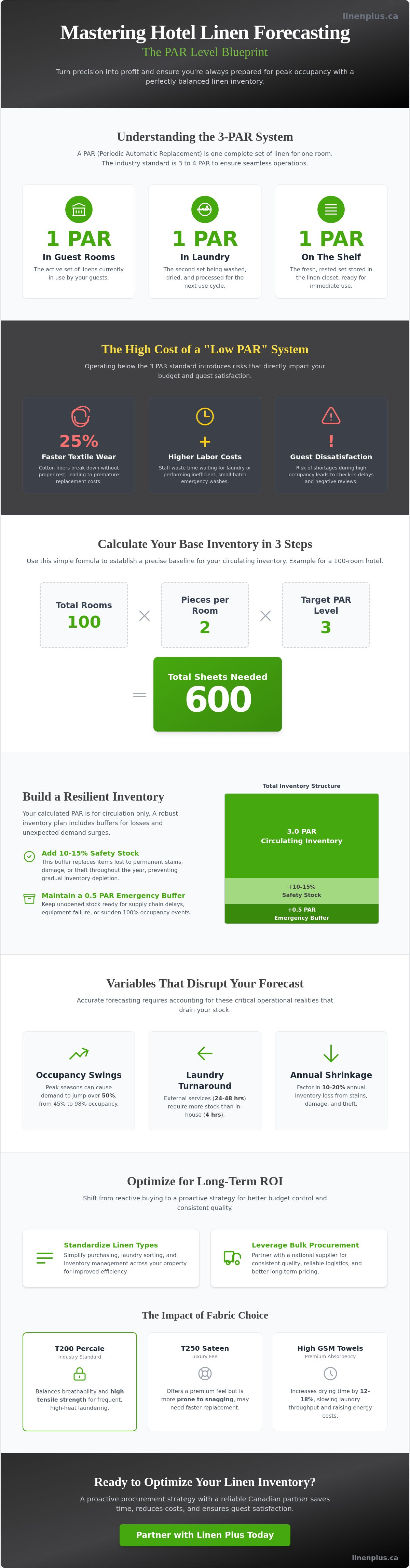
A standard 3-PAR system divides inventory into three distinct locations. One set is currently in the guest room. The second set is processed in the laundry facility. The third set remains in the linen closet, ready for immediate use. Operations that drop below this threshold often face "Low PAR" risks. This leads to higher labour costs because staff must wait for dryers to finish or perform emergency wash cycles. It also accelerates textile degradation. When cotton fibers don't have time to rest and re-hydrate between uses, they break down up to 25% faster than properly rotated stock. Applying basic inventory management principles helps avoid these hidden operational expenses and protects your bottom line.
Calculating Your Base Inventory Requirements
Establishing a baseline requires a simple but precise formula. Multiply your total room count by the number of pieces used per room, then multiply that total by your target PAR level. For a 100-room hotel using T200 Percale Bed Sheets, the calculation for flat sheets (assuming two per bed) looks like this:
- Total Rooms: 100
- Pieces per Room: 2
- Target PAR: 3
- Calculation: (100 x 2) x 3 = 600 sheets
It's vital to separate your circulating inventory from your new stock buffers. Circulating inventory includes everything currently in the wash-and-use cycle. New stock buffers, or safety stock, should account for an additional 10% to 15% of your total to replace items lost to permanent staining or physical wear. This ensures your facility remains a complete solution for guests without facing sudden shortages during peak Canadian travel seasons. Being prepared with a bulk reserve is the most cost-effective way to manage a high-traffic facility.
Key Variables That Disrupt Your Linen Forecast
Accurate procurement requires more than just looking at room counts. When you analyze how to forecast linen needs for a hotel, you must account for operational variables that drain stock. Occupancy rates in Canadian markets often swing from 45% in shoulder seasons to 98% during peak summer festivals or ski seasons. If your forecast doesn't account for these 50% jumps, you'll face immediate shortages. Laundry turnaround time (TAT) also dictates your PAR levels. External services typically require a 24 to 48-hour cycle, which demands a higher circulating inventory than in-house operations that can turn loads in 4 hours.
Need Reliable Wholesale Supplies for Your Facility?
Hotels, healthcare facilities, restaurants, and commercial operations across Canada trust Linen Plus for consistent bulk supply and commercial-grade quality.

Bulk Wholesale Pricing
Competitive pricing for large-volume procurement.

Reliable Nationwide Supply
Consistent inventory and fast shipping across Canada.

Hospitality & Healthcare Grade
Products designed for demanding commercial environments.
Shrinkage is a constant factor in the hospitality sector. Most Canadian properties experience a 10% to 20% annual loss from permanent stains, mechanical tearing in industrial extractors, or guest theft. If you don't build this attrition into your quarterly budget, your inventory will slowly deplete until it impacts guest satisfaction.
The Role of Thread Count and GSM in Longevity
T200 percale is the industry standard for high-turnover properties because it balances breathability with high tensile strength. It withstands frequent high-heat laundering better than finer weaves. In contrast, T-250 Sateen Bed Sheets offer a luxury feel but may require a more aggressive replacement cycle due to the weave's susceptibility to snagging. GSM (grams per square meter) also affects operational efficiency. Higher GSM towels feel premium but can increase drying times by 12% to 18%, which directly slows down laundry throughput and increases energy costs.
Accounting for Unexpected Spikes in Demand
Sudden group bookings or local emergency stays can push a hotel to 100% occupancy overnight. Relying on a standard 3-PAR system leaves no room for error if a delivery is delayed. A best practice for how to forecast linen needs for a hotel involves maintaining a 0.5 PAR "Emergency Buffer" in unopened boxes. This safety stock ensures your housekeeping team remains operational during equipment failures or supply chain hiccups. You can find durable bulk options through our hospitality supply solutions to help maintain these critical buffer levels.
A Step-by-Step Workflow for Forecasting and Procurement
Accurate procurement depends on a rigorous data collection process. To master how to forecast linen needs for a hotel, operations managers must bridge the gap between theoretical PAR levels and real-world inventory. This process ensures that your facility never faces a shortage during high-occupancy periods.
First, conduct a quarterly all-hands physical inventory audit. Count every piece of linen in circulation, in storage, and currently in the laundry cycle. Relying solely on digital records often leads to a 15% discrepancy in actual stock due to unreported losses, guest theft, or accidental disposal. This audit provides the "Current Inventory" figure required for your procurement formula.
Utilize historical occupancy data from your Property Management System (PMS) to project demand for the upcoming 90 days. If your hotel averages 85% occupancy during the Canadian summer peak, your inventory must reflect that volume plus a safety buffer. Understanding how to forecast linen needs for a hotel requires a precise calculation of your replacement cycle based on these occupancy shifts.
Determine your monthly burn rate by tracking items retired due to permanent staining, fraying, or holes. A standard 300-room hotel might see a 2% to 5% monthly loss across its commercial sheets and pillowcases. Finally, apply the forecasting formula to determine your exact needs:
- (Target PAR - Current Inventory) + Predicted Burn Rate = Order Quantity
Establishing a Monthly Audit Routine
Prevent quarterly surprises by tracking discards in the laundry room daily. Use a dedicated bin for damaged items and record these "discards" in a shared digital log. Provide housekeeping staff with standardized reporting sheets to flag shortages in specific floor closets immediately. This 30-day pulse check ensures your burn rate data remains accurate between major audits and prevents sudden, emergency ordering costs.
Lead Time Planning and Order Frequency
Shipping logistics across Canada require proactive scheduling. Orders traveling from central distribution hubs to remote resorts in British Columbia or the Maritimes can take 7 to 10 business days. Bulk ordering once per quarter often reduces shipping costs by 20% compared to monthly shipments. While smaller, frequent orders can assist with tight monthly cash flow management, they leave little room for error if supply chain delays occur.
Ready to stabilize your inventory? Explore our complete hospitality solutions for reliable bulk procurement.
Optimizing Your Linen Strategy for Long-Term ROI
Effective procurement means moving past reactive purchases made during peak occupancy. Proactive management involves analyzing historical turnover data to predict replacement cycles accurately. Understanding how to forecast linen needs for a hotel requires treating textiles as a guest satisfaction asset rather than a recurring expense. Standardizing linen across multiple floors or properties simplifies inventory counts and reduces the risk of mismatched sets. It's a strategy that allows for bulk purchasing advantages that lower the total cost per unit while ensuring brand consistency across the entire facility.
Selecting the Right Products for Your Tier
Hotels must align their textile choices with guest expectations to maximize ROI. For mid-scale properties, Premium Ring Spun Towels provide the necessary durability for industrial laundering while maintaining a soft hand-feel. Luxury tiers should focus on high-thread-count sheets to meet specific brand standards. Adopting a one-stop shop approach for hospitality supplies reduces administrative overhead by consolidating invoices and shipping logs. This efficiency is critical for operations managers overseeing tight C$ budget constraints in the Canadian market.
The Value of a Strategic Supply Partner
A reliable national distributor mitigates the risk of stockouts and inconsistent product quality. Partnering with a supplier ensures lead times remain predictable, even during seasonal spikes. For a deeper look at long-term planning, consult the Wholesale Linens Canada: The 2026 Commercial Procurement Guide. Integrating guest feedback into procurement decisions allows hotels to pivot toward materials that guests actually prefer. When a hotel masters how to forecast linen needs for a hotel, they transition from managing shortages to optimizing guest comfort and operational flow. This shift ensures every dollar spent on inventory contributes directly to higher guest review scores, providing a strategic plus to your property's bottom line.
Strengthen Your Hotel’s Operational Resilience
Effective inventory management prevents operational bottlenecks and protects your bottom line. By establishing a 3-PAR minimum and accounting for a standard 20% annual replacement rate due to inevitable wear and tear, you ensure your housekeeping team is never short on stock. Mastering how to forecast linen needs for a hotel involves more than just counting sheets; it's about anticipating seasonal occupancy peaks and managing lead times across the Canadian supply chain. Precise forecasting allows you to transition from reactive ordering to a proactive procurement strategy that maximizes guest comfort.
Linen Plus serves as your strategic partner with direct manufacturer relationships that provide competitive wholesale pricing on premium T200 and T250 linens. We maintain a comprehensive inventory ready for efficient nationwide distribution from our Canadian hubs. This infrastructure ensures your facility remains fully equipped regardless of sudden demand shifts or logistics challenges. Having a dependable supplier means you can focus on guest satisfaction while we handle the technical logistics of your bulk requirements. It's time to eliminate the guesswork from your supply room and build a more predictable, cost-effective operation.
Browse our full range of hospitality linens and guest room supplies to secure your facility's operational success. We're ready to help you streamline your procurement today.
Frequently Asked Questions
What is the ideal PAR level for a mid-range hotel?
A mid-range hotel typically requires a minimum 3.0 to 3.5 PAR level to maintain operational efficiency. This standard ensures one set is in the guest room, one set is in the laundry process, and one set is resting in the linen closet to preserve fiber integrity. In high-occupancy Canadian markets, maintaining a 3.5 PAR provides a critical safety buffer during peak seasonal demand or unexpected laundry delays.
How often should a hotel conduct a full linen inventory audit?
Hotels should conduct a full linen inventory audit four times per year, or once every quarter. Regular quarterly counts allow managers to identify inventory shrinkage early and adjust their procurement budgets before stock levels drop below the 2.5 PAR danger zone. These audits are essential to accurately determine how to forecast linen needs for a hotel and prevent emergency surcharges on last-minute bulk orders.
What is a typical annual 'burn rate' or loss percentage for hotel linens?
The typical annual burn rate for hotel linens ranges between 15% and 20% of total inventory. This loss includes permanent staining, mechanical damage during the wash cycle, and guest theft. In a 100-room facility, this means replacing approximately 60 to 80 sets of sheets annually just to maintain baseline PAR levels. Tracking these specific discard rates helps procurement managers stabilize their annual operating costs.
Does thread count affect how many sheets I need to keep in stock?
Higher thread count linens often require a higher PAR level because they have longer drying times and require more careful handling. While a 200-thread count sheet might cycle through a commercial laundry in a standard shift, a premium 300-thread count sateen sheet retains more moisture and needs additional rest time to prevent premature fiber breakdown. Choosing higher thread counts usually necessitates an extra 0.5 PAR to ensure stock is always available for housekeeping.
How do I calculate linen needs if my laundry service only picks up twice a week?
If your laundry service only collects twice per week, you must increase your inventory to a 4.0 or 5.0 PAR level to cover the longer turnaround time. Since clean linens won't return for three to four days, your on-site storage must hold enough stock to service 100% occupancy for the duration of the gap plus a 20% safety margin. This calculation prevents service interruptions when a Canadian holiday weekend extends the time between professional laundry pickups.

Article by
Sohel Shahriar
Sohel Shahriar is the Chief Growth Officer (CGO) at Linen Plus Inc., Canada, bringing a strategic blend of growth marketing, brand leadership, and content expertise. Through his writing, he explores how quality linen, smart sourcing, and long‑term partnerships can create measurable impact for healthcare and hospitality organizations.


