


What if the difference between a five-star review and a refund request isn't the room's view, but the 200-thread-count percale touching your guest's skin? You understand that in the hospitality sector, you aren't just selling a room; you're selling a restorative sleep experience. It's a reality that how hotel bed sheet quality affects guest satisfaction is often measured in the first thirty seconds a guest spends in bed. When linens feel thin or abrasive, it signals a lack of care that no amount of lobby decor can fix.
With cotton commodity prices reaching 84.43 cents per pound in May 2026, procurement managers face the difficult task of maintaining luxury standards while managing a 26.69 percent year-over-year cost increase. This guide provides a clear framework to help you choose between T200 percale and T250 sateen while meeting baseline requirements like the OEKO-TEX Standard 100. You'll discover how to balance tactile comfort with the commercial durability needed to survive 70 industrial wash cycles. We will also look at how shifting from high thread counts to better weave quality can lower your long-term replacement costs and improve your property's reputation as a provider of premium sleep.
Key Takeaways
- Understand how hotel bed sheet quality affects guest satisfaction by establishing a tactile first impression that reinforces your property's hygiene standards.
- Compare the structural benefits of T200 Percale versus T250 Sateen to find the optimal balance between crisp breathability and a smooth, luxury feel.
- Learn how to implement a systematic linen audit using high-intensity light inspections and the Hand-Feel Test to identify degradation before guests do.
- Optimize your operational ROI by sourcing textiles engineered to withstand the rigors of Canadian commercial laundry cycles without losing their premium texture.
- Discover how strategic manufacturer partnerships ensure consistent quality across bulk orders, preventing the hidden costs of premature replacement.
The Direct Link Between Textile Quality and Guest Satisfaction Scores
The tactile first impression of a guest room is often established before a traveler even unpacks. When a guest pulls back the duvet, the immediate texture of the sheets and pillowcases sets the tone for their entire stay. Understanding how hotel bed sheet quality affects guest satisfaction requires looking at the sensory feedback loop; high-quality textiles communicate luxury and attention to detail, while inferior products suggest cost-cutting. Hospitality-grade linens are specialized textiles designed to balance superior skin-feel with the structural integrity required to withstand repeated high-temperature industrial laundering and chemical processing.
Psychologically, the "crispness" of a sheet is synonymous with hygiene in a guest's mind. A crisp, firm fabric suggests the item is fresh and professionally processed. Conversely, limp or pilling linens often trigger concerns about cleanliness, even if the item is technically sterile. Beyond aesthetics, the physical properties of bedding materials and terms like breathability and moisture-wicking are critical for thermoregulation. If a guest overheats because of low-quality synthetic blends, their sleep quality suffers, which is the primary metric they use to evaluate their stay.
The Cost of Negative Reviews
In the digital age, a single mention of "scratchy" or "thin" sheets in an online review can significantly deter future bookings. Linens are frequently the most cited physical attribute in guest complaints because they are the only part of the room in constant contact with the guest for eight hours. While a dusty shelf might be overlooked, poor textile quality is impossible to ignore. For operations managers, investing in durable, high-GSM fabrics isn't just about comfort; it's a defensive strategy against the revenue loss associated with declining guest satisfaction scores.
Evaluating Textile Specifications: T200 Percale vs. T250 Sateen
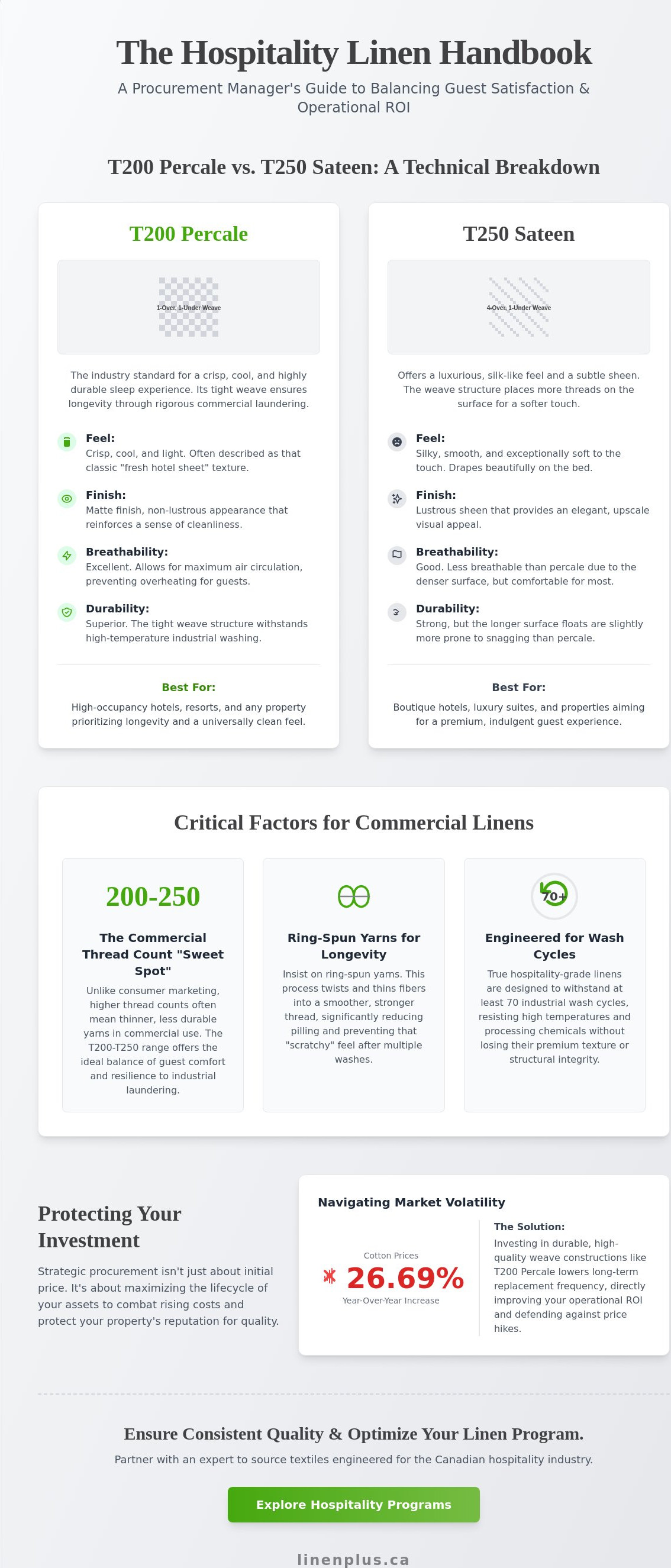
Selecting the right thread count is a strategic decision that impacts your bottom line. While consumer marketing often pushes for 800+ thread counts, the commercial reality in Canada is that T200 to T250 represents the ideal balance of luxury and laundry resilience. High thread counts often lead to thin fabrics that tear easily under industrial pressure. By sticking to this range, you ensure the fabric is thick enough to survive heavy use while remaining soft for the guest. It's a direct way to manage how hotel bed sheet quality affects guest satisfaction without overspending on delicate residential-grade products.
Need Reliable Wholesale Supplies for Your Facility?
Hotels, healthcare facilities, restaurants, and commercial operations across Canada trust Linen Plus for consistent bulk supply and commercial-grade quality.

Bulk Wholesale Pricing
Competitive pricing for large-volume procurement.

Reliable Nationwide Supply
Consistent inventory and fast shipping across Canada.

Hospitality & Healthcare Grade
Products designed for demanding commercial environments.
The choice between weave types depends on the specific atmosphere of your property. Percale uses a traditional one-over, one-under weave that provides a matte finish and exceptional breathability. It's the source of that classic "hotel crispness" that many guests associate with cleanliness. Sateen, conversely, uses a four-over, one-under structure. This creates a silk-like feel and a subtle luster, which is often preferred in boutique or upscale settings. Both must adhere to established textile safety and performance standards to ensure quality consistency across bulk orders.
To prevent pilling, look for ring-spun yarns. Unlike standard open-end yarns, ring-spun fibers are twisted and thinned to create a smoother, stronger thread. This technical detail is crucial for longevity; it prevents the "scratchy" texture that develops after multiple washes. If you're unsure which textile suits your facility's wash cycle, you can explore our hospitality programs for expert guidance.
Which Weave Fits Your Property Type?
For high-occupancy environments like mid-scale hotels or high-turnover rentals, Percale is usually the superior choice. Its tight weave offers maximum longevity and withstands the frequent, high-heat cycles typical of Canadian laundry facilities. If you are managing a luxury guest experience where aesthetic drape and a soft hand-feel are priorities, Sateen is the better investment. Selecting the right weave is a fundamental part of understanding how hotel bed sheet quality affects guest satisfaction at every price point. You can find both options in our collection of sheets and pillowcases, allowing you to tailor your procurement to your specific brand identity.
Step-by-Step: Conducting a Guest-Centric Linen Audit
A structured audit is the only way to catch textile degradation before a guest does. Start by holding a random sample of sheets against a high-intensity light source. This reveals thinning areas and micro-tears that aren't visible when the bed is made. These weak points are where the next structural failure will occur during a high-heat industrial wash cycle. Understanding how hotel bed sheet quality affects guest satisfaction requires moving beyond "does it look clean" to "is the fabric structurally sound."
Perform the "Hand-Feel Test" on linens that have surpassed 50 industrial washes. Compare these against a new control sheet from your current stock. If the used sheet feels abrasive or has developed a "fuzzy" texture, the fibers have broken down. This roughness is a primary driver of negative feedback regarding "scratchy" bedding. Additionally, measure the dimensions of your flat and fitted sheets. Significant shrinkage prevents a professional tight tuck, leading to a messy room appearance that guests equate with low service standards.
Whiteness levels are a non-negotiable hygiene indicator. Use a grayscale comparison card to check for the subtle graying or yellowing that occurs over time. Even if a sheet is technically sanitized, a dingy appearance suggests it's past its prime. If your current inventory fails these tests, it's time to refresh your hospitality linens to maintain your property's brand standards.
When to Retire Your Linens
Maintaining a 3-par or 4-par level rotation is essential to minimize daily wear. This system ensures one set is in the guest room, one is in the laundry, and at least one is resting in the linen closet. Resting fibers for 24 hours between washes allows them to recover, which extends their operational lifespan. When laundering can no longer restore the crisp white finish or when fabric thinning becomes visible under light, the item has reached the end of its life. For more insights on managing facility standards, view our hospitality industry overview.
Procuring for Longevity: Balancing Guest Luxury with Operational ROI
The financial success of a hospitality property depends on the longevity of its textile assets. In Canada, commercial laundry cycles are notoriously aggressive, utilizing high-temperature water and heavy chemical concentrations to meet health and safety standards. Retail-grade linens often disintegrate after fewer than 20 washes in these conditions. By sourcing textiles specifically engineered for industrial use, you ensure the fabric maintains its tensile strength and smooth finish. This technical durability is a primary factor in how hotel bed sheet quality affects guest satisfaction, as it prevents the premature thinning and pilling that guests interpret as poor maintenance.
While the initial purchase price of T200 Percale may be higher than lower-grade alternatives, the cost-per-use is significantly lower over the product's lifecycle. A high-quality commercial sheet can withstand 50 to 70 industrial wash cycles while maintaining its professional appearance. This reduces the frequency of replacement orders and minimizes the labor costs associated with inspecting and discarding worn stock. Establishing strong manufacturer partnerships allows you to secure consistent specifications across bulk orders, ensuring that a sheet purchased today matches the weight and texture of one purchased six months ago.
Our guide to Wholesale Linens Canada provides the infrastructure for national supply consistency, ensuring that whether you manage one property or fifty, the textile quality remains uniform across your entire portfolio. This level of consistency is vital for brand reputation; guests expect the same tactile experience every time they book with you.
The Linen Plus Solution
We provide direct manufacturer access for both T200 and T250 specifications, removing the uncertainty of middleman sourcing. Our national distribution network is designed for efficiency, allowing you to maintain optimal par levels without the need for excessive on-site storage. By utilizing our hospitality programs, you gain access to a complete solution that includes customization and branding options. Whether you need specific colorways or custom embroidery, these details elevate the guest experience while our durable textiles protect your operational ROI.
Optimizing Your Hospitality Textile Strategy
Mastering the technical details of procurement is the most direct way to ensure your facility delivers a premium sleep experience. By choosing the right weave for your property tier and implementing a rigorous audit cycle, you remove the guesswork from inventory management. It's clear that how hotel bed sheet quality affects guest satisfaction is a measurable metric that dictates your online reputation and long-term occupancy rates.
Linen Plus serves as your critical partner in this process. We provide specialized T200 Percale and T250 Sateen inventory that is already trusted by national Canadian hospitality chains. Our direct manufacturer pricing for bulk procurement allows you to secure commercial-grade durability without exceeding your operational budget. This ensures your facility remains stocked with linens that feel as good as they look, even after months of industrial processing.
Take the first step toward better guest reviews and lower replacement costs today. Shop Premium Wholesale Hotel Bed Sheets and experience the difference that professional-grade textiles make for your brand. We are ready to help you build a more resilient and comfortable guest experience.
Frequently Asked Questions
Does a higher thread count always mean better guest satisfaction?
No, a higher thread count doesn't guarantee better guest feedback. In commercial environments, excessively high thread counts often result in delicate fabrics that tear easily under industrial heat. True satisfaction comes from the fabric's breathability and "hand feel" after multiple washes. How hotel bed sheet quality affects guest satisfaction is more closely tied to the yarn type, such as ring-spun cotton, which stays smooth and resists pilling over time.
What is the difference between Percale and Sateen for hotel use?
Percale and Sateen differ primarily in their weave structure and resulting texture. Percale uses a one-over, one-under pattern, creating a matte finish that feels crisp and stays cool. This is ideal for high-occupancy hotels. Sateen uses a four-over, one-under pattern, which produces a silk-like sheen and a heavier drape. Boutique properties often choose Sateen to provide a more luxurious, residential feel for their guests during their stay.
How many washes should a high-quality hotel sheet last?
A high-quality commercial sheet should remain in guest-ready condition for 50 to 70 industrial wash cycles. Longevity depends heavily on maintaining a proper 3-par or 4-par rotation to allow fibers to rest between uses. If you notice thinning or micro-tears under high-intensity light before reaching this threshold, it often indicates the textile wasn't engineered for the specific chemical and heat stresses of Canadian commercial laundry systems.
How can I prevent my white sheets from looking gray or yellow over time?
Preventing discoloration requires a combination of strict laundry protocols and high-quality base textiles. You should always separate linens by color and use industrial detergents designed to neutralize the minerals found in local water supplies. Over-bleaching can actually damage fibers and cause yellowing over time. Consistent whiteness audits using a grayscale comparison card help you identify when a sheet has reached its operational end-of-life and needs replacement.
What is the best thread count for a 4-star hotel in Canada?
For a 4-star property in Canada, the T250 Sateen is currently the industry standard for balancing luxury with durability. This specification provides the smooth luster guests expect at a premium price point while surviving the rigors of frequent turnover. It aligns with the 2026 focus on the "sleep economy," where the tactile quality of the bedding is a central part of the hotel's overall value proposition and brand identity.

Article by
Sohel Shahriar
Sohel Shahriar is the Chief Growth Officer (CGO) at Linen Plus Inc., Canada, bringing a strategic blend of growth marketing, brand leadership, and content expertise. Through his writing, he explores how quality linen, smart sourcing, and long‑term partnerships can create measurable impact for healthcare and hospitality organizations.


