


Could a minor 3% discount on your supply order lead to a C$20,000 loss in surgical delays due to inconsistent indicator reliability? As the global sterilization pouches market reaches a projected $52.29 billion in 2026, procurement managers face increasing pressure to balance fiscal responsibility with strict clinical safety. You understand that settling for subpar bulk sterilization pouches for autoclaves isn't just a budget risk; it's a direct threat to patient outcomes and facility throughput.
We'll help you master the technical specifications and procurement strategies needed to secure high-quality, compliant pouches for your high-volume reprocessing needs. This guide provides the roadmap to navigate the December 20, 2026, deadline for FDA recognition of ISO 11607-1 and the introduction of ISO 11607-3 standards. You'll learn how to simplify inventory management, resolve the confusion between Class 1 and Class 4 indicators, and stabilize your cost-per-unit. We're covering everything from microbial barrier integrity to the latest ANSI/AAMI ST79 revisions to ensure your Canadian facility remains prepared and professional.
Key Takeaways
- Align your procurement with ISO 11140-1 and the upcoming 2026 ISO 11607-3 standards to ensure your facility meets the latest safety requirements for chemical indicators.
- Choose between self-sealing pouches for high-turnover environments and customizable tubing rolls for specialized, oversized surgical instruments to reduce material waste.
- Improve clinical workflow and instrument identification by utilizing high-clarity transparent films that allow for immediate verification after the autoclave cycle.
- Optimize your annual budget by evaluating the total cost of ownership for bulk sterilization pouches for autoclaves, comparing 200-count and 1000-count options to minimize unit prices.
- Implement proper loading techniques to ensure consistent steam penetration and drying, preventing the costly reprocessing cycles that often plague high-volume facilities.
Technical Standards for Autoclave Sterilization Pouches
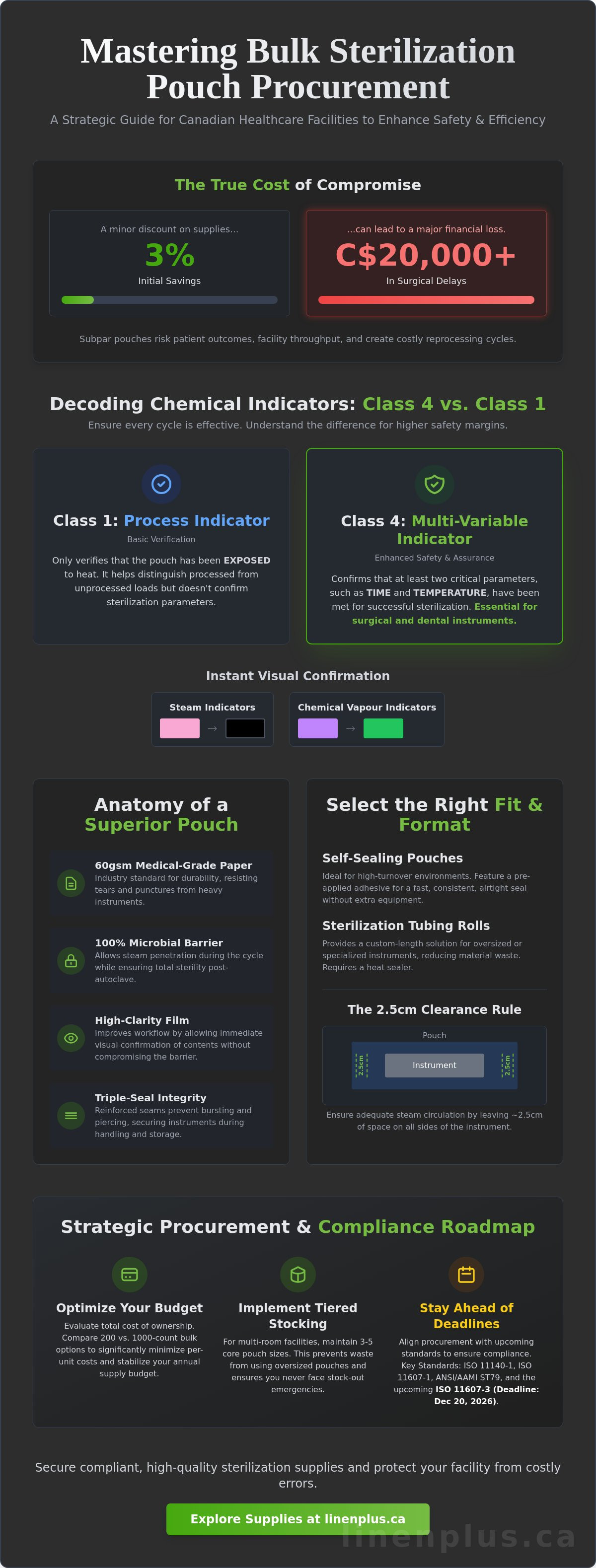
Medical-grade sterilization pouches act as the final line of defense for instrument integrity. Their primary role is to allow steam to penetrate the package during the cycle while maintaining a 100% microbial barrier post-autoclave. When sourcing bulk sterilization pouches for autoclaves, the paper weight is a primary indicator of quality. Industry-standard 60gsm medical paper provides the structural durability needed to resist tears and punctures from heavy surgical tools. This density ensures that once the cycle is complete, the contents remain sterile until the point of use.
Reliability in high-volume reprocessing depends on adherence to ISO 11140-1 standards for chemical indicators. These indicators are essential for validating that the package has been subjected to the correct sterilization principles. For procurement managers in Canada, ensuring your wholesale supplies meet these benchmarks is critical for audit compliance and patient safety. You'll find that choosing wholesale medical supplies that prioritize these technical specifications helps reduce reprocessing errors. Accuracy matters.
Class 1 process indicators only verify that the pouch has been exposed to heat, whereas Class 4 multi-variable indicators react only when specific temperature and time parameters have been met simultaneously.
Class 4 vs. Class 1 Indicators
Class 4 indicators provide a higher safety margin for surgical and dental instruments by monitoring at least two critical variables of the sterilization process. While Class 1 indicators distinguish processed from unprocessed loads, Class 4 indicators ensure the pouch interior reached the necessary conditions for microbial destruction. It's straightforward to interpret these changes. Steam indicators typically transition from pink to dark brown or black, while chemical vapour indicators shift from purple to green. These visual cues are vital for maintaining an error-free clinical workflow. Securing high-quality bulk sterilization pouches for autoclaves shouldn't be a guessing game for your facility.
Selecting the Right Size and Format for Bulk Orders
Selecting the correct dimensions for bulk sterilization pouches for autoclaves is a balance of clinical safety and operational efficiency. In high-turnover dental and medical environments, self-sealing pouches are the industry standard. They feature a pre-applied adhesive strip that ensures a consistent, airtight seal without the need for additional equipment. However, for specialized surgical instruments or oversized tools, sterilization tubing rolls provide a custom-length solution that reduces material waste. Efficiency drives profitability in these settings.
Need Reliable Wholesale Supplies for Your Facility?
Hotels, healthcare facilities, restaurants, and commercial operations across Canada trust Linen Plus for consistent bulk supply and commercial-grade quality.

Bulk Wholesale Pricing
Competitive pricing for large-volume procurement.

Reliable Nationwide Supply
Consistent inventory and fast shipping across Canada.

Hospitality & Healthcare Grade
Products designed for demanding commercial environments.
Standard bulk procurement involves a range of specific sizes to match your toolkit. 2.25"x4" pouches work perfectly for small burs or endodontic files. Conversely, 12"x15" options accommodate larger surgical kits or diagnostic trays. Selecting a pouch that provides roughly 2.5 cm of clearance on all sides of the instrument ensures adequate steam circulation. If the pouch is too tight, steam cannot reach all surfaces, which potentially compromises the cycle integrity. Accuracy is paramount for patient safety.
Self-Sealing vs. Heat-Sealed Options
Triple-seal integrity is a non-negotiable feature for self-adhesive pouches. These reinforced borders prevent heavy instruments from piercing the side seams during handling or storage. While self-sealing options offer speed, facilities processing unique instrument lengths often invest in heat-sealing equipment. This allows for the use of tubing rolls, which can be cut to the exact millimetre. It's a strategic choice: pay for the convenience of pre-made pouches or the versatility of a custom-seal system.
Inventory Planning for Multi-Room Facilities
Efficient inventory management prevents stock-out emergencies and optimizes storage. For multi-room facilities in Canada, we recommend a tiered stocking strategy. By maintaining a mix of three to five core sizes, you reduce the likelihood of using an oversized pouch for a small tool, which saves money over time. You can explore our full range of medical supplies to find the specific configurations that match your facility's daily procedure volume. Proper planning ensures your autoclave chambers are always loaded for maximum throughput.
Optimizing Infection Control with High-Volume Reprocessing
High-volume Canadian clinics must balance speed with strict safety protocols. Loading bulk sterilization pouches for autoclaves requires a specific "paper-to-plastic" orientation. This technique allows steam to move freely through the porous paper side while preventing moisture from becoming trapped against the film. High-clarity transparent film is a vital feature for rapid instrument identification. It reduces the time clinicians spend searching through trays, which directly improves procedural flow in busy surgical or dental environments. Efficiency is the backbone of a well-run facility.
Once the cycle is complete, maintaining the sterile barrier depends on controlled storage. According to AAMI ST79 guidelines, sterile storage areas should stay below 24°C (75°F) with a maximum 60% relative humidity. While many manufacturers certify pouch integrity for up to one year, implementing a First-In, First-Out (FIFO) system is the most reliable strategy. This ensures that older stock is used before newer bulk shipments, preventing the risk of using pouches with aged chemical indicators. Accuracy in inventory management prevents waste.
Organizational Tools for Bulk Supplies
Save valuable counter space by using wall-mounted dispensers for your various pouch sizes. This keeps the medical-grade paper clean and prevents accidental punctures before the pouch even enters the autoclave. Canadian facilities are also required to maintain strict record-keeping; every batch must be labeled with the sterilizer number, cycle date, and load number to ensure full traceability during audits. Organization is a prerequisite for compliance.
Avoiding Common Reprocessing Errors
Overfilling is a frequent mistake in high-pressure environments. If an instrument is too large, it exerts excessive pressure on the side seals during the vacuum phase, which can cause the pouch to burst. Another critical issue is the "wet pack." To prevent this, ensure pouches are completely dry before they are removed from the chamber. Wet paper acts as a wick for bacteria, which immediately compromises the sterile barrier. You can streamline your facility's safety protocols by sourcing professional dental and medical supplies designed for high-volume durability.
Maximizing Value in Bulk Sterilization Supply Procurement
Annual budget planning for Canadian medical and dental facilities requires more than just looking at the sticker price. Transitioning from 200-count boxes to 1000-count master cases for bulk sterilization pouches for autoclaves offers a significant reduction in price-per-unit. This volume-based strategy also lowers administrative overhead by reducing the frequency of purchase orders and receiving logs. It's a practical approach to fiscal responsibility. However, the lowest price isn't always the best value. You must evaluate the total cost of ownership by considering pouch reliability and failure rates. A single burst seal or faulty indicator forces a full reprocessing cycle. This wastes staff time, electricity, and water. High-quality pouches prevent these hidden costs. Learn how we support healthcare facilities nationwide with integrated supply solutions that prioritize both quality and cost-efficiency.
Sourcing from a national distributor with cross-industry expertise simplifies your logistics. Instead of managing dozens of niche vendors, a single partner can provide a complete solution for your facility. This "one-stop shop" model reduces shipping complexities and ensures that your bulk sterilization pouches for autoclaves arrive alongside your other critical consumables. For operations managers, this means more time spent on patient care and less time on inventory reconciliation. Accuracy in procurement is a competitive advantage.
The Linen Plus Advantage for Canadian Facilities
We're a dependable B2B partner focused on the practical needs of the healthcare and dental sectors. Our nationwide distribution network provides the supply chain stability you need to avoid backorders on essential items. We understand Canadian-specific logistics and the high-stakes nature of your industry. You won't find unnecessary fluff here; just professional service and durable products. We help you maintain operational excellence through every cycle. Secure your bulk sterilization pouches today and partner with a supplier that values your facility's success.
Securing Your Facility’s 2026 Sterilization Strategy
Transitioning into 2026 requires a procurement strategy that prioritizes technical precision over simple unit costs. You've seen how ISO 11140-1 compliant indicators and durable 60gsm medical grade paper form the foundation of a reliable microbial barrier. By aligning your inventory with these standards, you eliminate the risks associated with inconsistent sterilization cycles and safeguard your facility’s clinical reputation. Accuracy in the reprocessing room translates directly to success in the operatory.
Effective management of bulk sterilization pouches for autoclaves isn't just about storage; it's about maintaining a seamless supply chain. Our nationwide Canadian distribution ensures your facility remains stocked with the precise sizes needed for every procedure. This organized approach reduces waste and stabilizes your annual budget. You're now equipped to make data-driven decisions that enhance both patient safety and operational efficiency. Let's ensure your facility stays prepared for the high-volume demands of modern healthcare.
Shop High-Quality Bulk Sterilization Pouches
Frequently Asked Questions
What is the shelf life of instruments stored in sterilization pouches?
Instruments stored in properly sealed pouches remain sterile indefinitely unless an event, such as a tear or moisture exposure, compromises the package. While many manufacturers certify pouch integrity for 365 days, Canadian healthcare standards emphasize event-related sterility. This means you must inspect each pouch for damage before use. If your facility maintains a 60% relative humidity and temperatures below 24°C, a 12-month rotation remains a safe and practical clinical benchmark.
Can I use steam sterilization pouches in a dry heat sterilizer?
You cannot use standard steam sterilization pouches in a dry heat sterilizer because the plastic film will melt or ignite. These pouches are specifically engineered for the moisture and temperature profiles of an autoclave. Dry heat sterilization often reaches temperatures exceeding 160°C, which far surpasses the thermal tolerance of the polypropylene film used in bulk sterilization pouches for autoclaves. Always verify that your packaging material matches your specific sterilization method to avoid equipment damage.
What is the difference between Class 1 and Class 4 sterilization indicators?
Class 1 indicators are basic process identifiers that only confirm a package was exposed to heat. Class 4 indicators are multivariable, meaning they only change color when both specific temperature and time parameters are met simultaneously. For high-volume Canadian clinics, Class 4 indicators provide a significantly higher safety margin. They ensure the internal conditions were sufficient for microbial destruction rather than just verifying that the outside of the pouch got hot during the cycle.
Why do my sterilization pouches sometimes turn brown or char?
Charring or browning usually indicates that the pouch paper was exposed to excessive temperatures or placed too close to the autoclave's heating element. This often happens if the chamber is overloaded or if the drying cycle is set too high. Ensure you leave at least 2.5 cm of space between the pouches and the chamber walls. Additionally, residual chemical detergents on instruments can react with the medical-grade paper, causing localized discoloration during the high-pressure cycle.
Are sterilization pouches recyclable or biodegradable?
Most bulk sterilization pouches for autoclaves are not recyclable or biodegradable because they consist of bonded medical-grade paper and polypropylene film. Once used in a clinical setting, these materials are often classified as biohazardous waste, which requires specific disposal protocols according to provincial regulations. While the industry is exploring sustainable materials, current 60gsm pouches prioritize the 100% microbial barrier required for patient safety over environmental breakdown. Proper disposal is a regulatory requirement for all Canadian facilities.

Article by
Sohel Shahriar
Sohel Shahriar is the Chief Growth Officer (CGO) at Linen Plus Inc., Canada, bringing a strategic blend of growth marketing, brand leadership, and content expertise. Through his writing, he explores how quality linen, smart sourcing, and long‑term partnerships can create measurable impact for healthcare and hospitality organizations.


