


A 2023 industry audit revealed that nearly 40% of healthcare facilities experience procurement delays due to a lack of clarity in Personal Protection Equipement technical specifications. You likely agree that keeping your staff safe while managing a tight budget is a constant balancing act, especially when faced with supply chain instability. It's frustrating to manage the delicate balance between practitioner comfort and the rigorous fluid resistance required for Level 2 Isolation Gowns without overspending your budget. You need a reliable partner who understands that quality consistency is non-negotiable in a clinical setting.
We promise to help you master the technical specifications and clinical applications necessary to optimize your facility's protection and procurement strategy. This guide will examine material durability, explain Health Canada compliance requirements, and provide a clear path to cost-effective bulk purchasing that keeps your team safe and your operations running smoothly.
Key Takeaways
- Understand the ANSI/AAMI PB70 liquid barrier standards to ensure your facility protection aligns with mandatory Impact Penetration and Hydrostatic Pressure requirements.
- Compare the technical advantages of SMS, Polypropylene, and Poly-coated materials to select the most cost-effective and durable barrier for clinical use.
- Master the strategic deployment of Level 2 Isolation Gowns for high-turnover procedures like dental prophylaxis, suturing, and blood draws.
- Learn how bulk procurement strategies can optimize your facility’s budget in C$ while preventing stockouts and PPE fatigue in the Canadian market.
- Streamline your medical textile supply chain by identifying the key factors that contribute to long-term procurement efficiency and reliable inventory management.
Understanding AAMI Level 2 Protection Standards
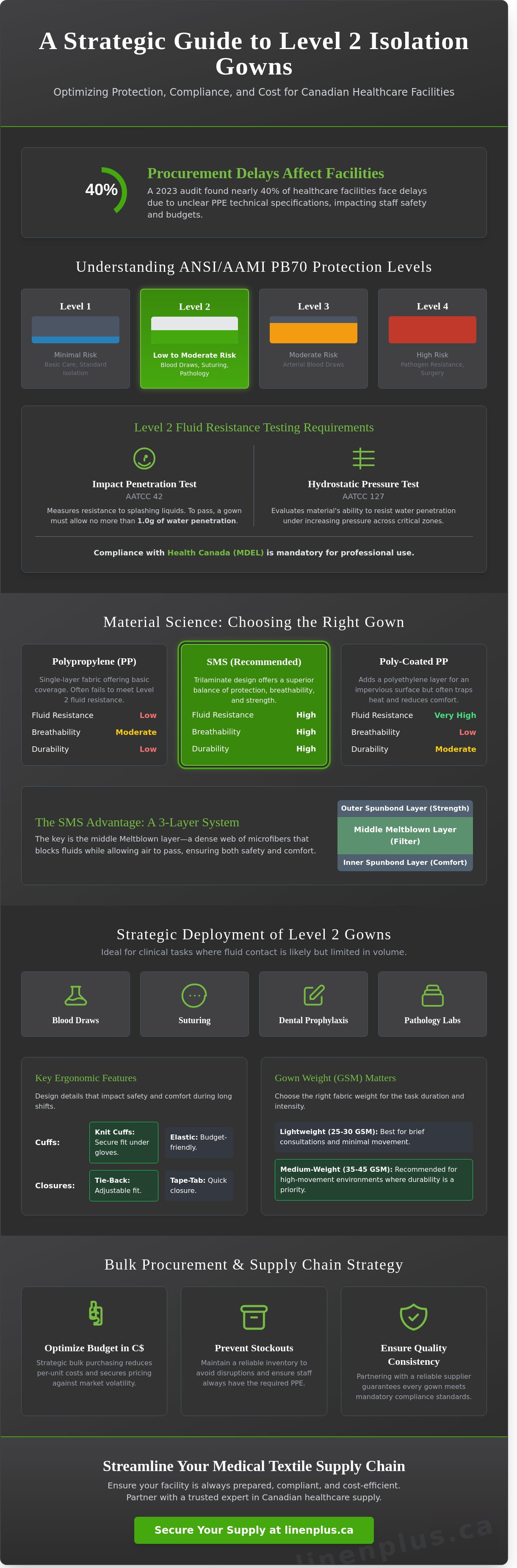
The ANSI/AAMI PB70 standard serves as the definitive benchmark for liquid barrier performance in medical textiles. It classifies Medical Gowns into four distinct levels based on their ability to resist fluid penetration. For Canadian healthcare facilities, Level 2 Isolation Gowns provide critical protection in low to moderate risk scenarios. This classification covers common clinical tasks like blood draws, suturing, or working in pathology labs where splashes are a consistent possibility.
Level 1 gowns are designed for minimal risk, such as basic care or standard isolation. In contrast, Level 2 gowns must withstand both liquid spray and a degree of pressurized fluid. Level 3 gowns offer higher resistance for moderate risk situations like arterial blood draws. Choosing the correct level ensures that staff aren't under-protected while avoiding the unnecessary costs of over-specifying for routine tasks.
The Science of Fluid Resistance
Testing requirements for Level 2 protection involve two primary metrics. The Impact Penetration test (AATCC 42) measures how well a fabric resists water droplets hitting the surface at a specific velocity, which simulates splashes. The Hydrostatic Pressure test (AATCC 127) evaluates the material's ability to resist water penetration under increasing force. For a gown to meet Level 2 standards, it must pass both tests across all critical zones, including the front panel and sleeves.
Regulatory Compliance in Canadian Healthcare
Procurement teams must ensure that medical supplies meet Health Canada Medical Device Establishment License (MDEL) requirements to guarantee safety and efficacy. Compliance isn't optional; it's a legal necessity for professional facilities. Specifically, an AAMI Level 2 gown must allow no more than 1.0g of water penetration during impact testing. These standards ensure that staff remain protected during routine procedures where fluid exposure is a constant variable in the workplace.
Material Science: Comparing SMS, Polypropylene, and Poly-Coated Gowns
Selecting the right material for Level 2 Isolation Gowns determines both staff safety and long-term cost efficiency. Most Canadian healthcare facilities choose between Spunbond Polypropylene (PP), Poly-coated PP, and SMS. Standard PP is a single-layer fabric that offers basic coverage but often lacks the liquid barrier needed for Level 2 requirements. Poly-coated gowns add a polyethylene layer to create an impervious surface. While these are excellent for fluid resistance, they often trap heat, which impacts comfort during 12-hour clinical shifts.
Need Reliable Wholesale Supplies for Your Facility?
Hotels, healthcare facilities, restaurants, and commercial operations across Canada trust Linen Plus for consistent bulk supply and commercial-grade quality.

Bulk Wholesale Pricing
Competitive pricing for large-volume procurement.

Reliable Nationwide Supply
Consistent inventory and fast shipping across Canada.

Hospitality & Healthcare Grade
Products designed for demanding commercial environments.
SMS (Spunbond-Meltblown-Spunbond) utilizes a trilaminate design to offer a superior balance. The outer layers provide tensile strength; the middle meltblown layer acts as the primary filter. This construction aligns with FDA guidance on medical gown standards regarding barrier performance and fluid resistance. Material weight is also a factor, usually measured in grams per square meter (GSM). Lightweight gowns (25-30 GSM) work well for brief consultations, but medium-weight versions (35-45 GSM) are better for high-movement environments where durability is a priority.
SMS Construction vs. Single-Layer Poly
The meltblown layer in SMS is the critical differentiator for safety. It's a dense web of microfibers that block fluid droplets while allowing air molecules to pass through. This breathability helps prevent heat exhaustion in busy wards. Single-layer poly gowns don't have this internal filtration and often fail under mechanical stress. Multi-ply SMS gowns remain durable when staff are lifting or moving patients, reducing the frequency of gown changes caused by accidental rips.
Ergonomic Features and Closure Styles
Cuff design directly affects glove integrity. Knit cuffs provide a soft, secure fit that stays in place under medical gloves. Elastic wrists are a more budget-friendly alternative, though they can sometimes pinch the skin during extended wear. For donning speed, over-the-head styles are becoming the standard in fast-paced Canadian environments. Tie-back and tape-tab closures allow for a more adjustable fit around the neck and waist. Securing a complete solution for medical apparel ensures your facility stays compliant with safety protocols while managing bulk procurement costs effectively.
Strategic Deployment: When to Choose Level 2 for Your Facility
Level 2 Isolation Gowns serve as the workhorse barrier for clinical tasks where fluid contact is likely but limited in volume. Canadian healthcare facilities typically deploy these for suturing, arterial blood draws, and specimen handling in diagnostic labs. In dental settings, Level 2 protection is standard for prophylaxis and basic restorative procedures. To ensure full protection, staff should always pair these gowns with disposable nitrile gloves to prevent cross-contamination and maintain a sterile environment.
Outpatient vs. Acute Care Applications
Outpatient surgery centres rely on Level 2 gowns for their cost-effectiveness and reliable barrier performance. They're ideal for minor procedures where fluid exposure doesn't exceed the AAMI Level 2 spray impact and hydrostatic pressure thresholds. Acute care environments like orthopedic surgery require an escalation to Level 3 or 4. A study on isolation gown materials highlights that while Level 2 SMS or Polypropylene fabrics offer excellent breathability, they can't withstand the heavy fluid volumes or mechanical pressure common in joint replacements. For diagnostic labs, these gowns provide the necessary protection against accidental splashes during specimen processing.
Staff Safety and Comfort Trade-offs
PPE compliance often drops when staff experience heat stress during long shifts. Level 2 gowns provide a lighter, more breathable alternative to higher-level barriers, which is critical for maintaining focus during detailed tasks. Facility managers should use a selection framework based on two factors: procedure duration and anticipated fluid volume. If a procedure lasts over 60 minutes but involves minimal fluid, a breathable Level 2 gown maintains comfort without compromising safety. For high-fluid tasks, the risk of strike-through makes the transition to Level 3 mandatory. Choosing a complete solution from a reliable vendor ensures your team stays protected and comfortable throughout their shift.
Stock your Canadian facility with our complete range of medical supplies.
Bulk Procurement and Supply Chain Reliability
Purchasing Level 2 Isolation Gowns in high volumes provides a predictable cost structure for facilities managing high patient turnover. Bulk procurement reduces the unit price by as much as 15% compared to ad-hoc ordering; it also mitigates the risk of stockouts during seasonal demand spikes. Effective inventory management prevents "PPE fatigue," where staff morale drops due to inconsistent gear quality or supply gaps. Integrating these gowns into a comprehensive facility plan that includes incontinence underpads ensures all essential textiles arrive on a synchronized schedule. This holistic approach simplifies accounting and logistics for procurement managers.
Logistics and Distribution for Canadian Facilities
Reliable lead times depend on nationwide distribution networks. Canadian facilities face unique geographical challenges. A partner with multiple regional hubs ensures delivery within 3 to 5 business days across the provinces. Direct manufacturer partnerships provide a buffer against market volatility. These relationships stabilize pricing and guarantee a steady flow of Level 2 Isolation Gowns even when global supply chains tighten. Choosing a domestic wholesale partner means you avoid the complexities of cross-border customs delays and fluctuating exchange rates.
Quality Assurance and Lot Consistency
Maintaining AAMI compliance requires rigorous verification of manufacturer test data. Buyers should demand lot-specific certificates of conformance to ensure every shipment meets fluid resistance standards. Utilizing a one-stop shop for diverse needs, from bed linens to clinical PPE, creates a unified quality standard across the facility. This consolidation reduces the administrative burden of vetting multiple vendors. It also ensures that the GSM and durability of all textiles remain consistent, protecting both the patient and the facility's bottom line.
Optimize Your Facility’s Safety and Procurement Strategy
Selecting the right protective equipment requires a precise balance of technical compliance and fiscal responsibility. Adhering to ANSI/AAMI PB70 standards ensures your Level 2 Isolation Gowns provide the necessary fluid resistance for low-to-moderate risk scenarios. By prioritizing advanced SMS or poly-coated materials over basic polypropylene, you're investing in durable protection that maintains staff comfort during extended shifts. It's about more than just a single purchase; it's about building a resilient inventory that protects both your frontline workers and your bottom line.
Linen Plus acts as a dedicated B2B partner, offering a complete solution for healthcare and hospitality providers across all 10 provinces. Our direct manufacturer partnerships ensure you receive consistent wholesale value without middleman markups. With nationwide distribution and localized expertise, we guarantee reliable lead times to keep your facility fully stocked. We're here to simplify your supply chain so you can focus on operational excellence and patient care. You can trust our team to deliver the quality your industry demands every day.
Browse our full range of AAMI-compliant Level 2 Isolation Gowns and experience the reliability of a partner committed to your success.
Frequently Asked Questions
What is the main difference between AAMI Level 1 and Level 2 isolation gowns?
The primary difference is that Level 2 gowns provide a higher liquid barrier, requiring both impact penetration and hydrostatic pressure testing. Level 1 gowns only undergo impact penetration testing. According to AAMI PB70 standards, Level 2 isolation gowns must resist water penetration at 20cm of hydrostatic pressure. This extra testing ensures better protection during low-risk procedures where fluid contact is expected.
Are Level 2 isolation gowns typically reusable or disposable?
Level 2 isolation gowns are available in both disposable and reusable versions depending on your facility's operational needs. Disposable gowns are common for high-turnover environments, while reusable gowns are engineered to withstand 50 to 100 laundry cycles. Choosing reusable options can reduce long-term waste and provide a predictable supply chain for Canadian healthcare providers looking for a cost-effective, bulk solution.
Can Level 2 isolation gowns be used for chemotherapy administration?
Level 2 gowns aren't recommended for chemotherapy administration because they lack the specific chemical resistance required for hazardous drugs. Chemotherapy handling requires gowns that meet ASTM F739 standards for permeation resistance. For these specialized tasks, facilities typically require Level 3 or Level 4 gowns that have been tested against at least 7 chemotherapy drugs for a minimum duration of 30 minutes.
How do I verify if a gown is truly AAMI Level 2 compliant?
You can verify compliance by reviewing the manufacturer's technical data sheets and third-party lab results for AATCC 42 and AATCC 127 tests. Reliable suppliers provide a Certificate of Conformance to prove the gown meets AAMI PB70 standards. In Canada, ensure the gown is listed under a valid Medical Device Establishment License (MDEL) as required by Health Canada's Class I medical device regulations.
What does SMS material mean in the context of isolation gowns?
SMS stands for Spunbond-Meltblown-Spunbond, which is a triple-layer non-woven fabric designed for durability and filtration. The middle meltblown layer provides a barrier against bacteria and fluids, while the outer spunbond layers add strength. Many Level 2 isolation gowns use SMS material with a weight between 35 and 45 GSM to ensure the gown remains lightweight, breathable, and protective for staff during long shifts.

Article by
Sohel Shahriar
Sohel Shahriar is the Chief Growth Officer (CGO) at Linen Plus Inc., Canada, bringing a strategic blend of growth marketing, brand leadership, and content expertise. Through his writing, he explores how quality linen, smart sourcing, and long‑term partnerships can create measurable impact for healthcare and hospitality organizations.


