


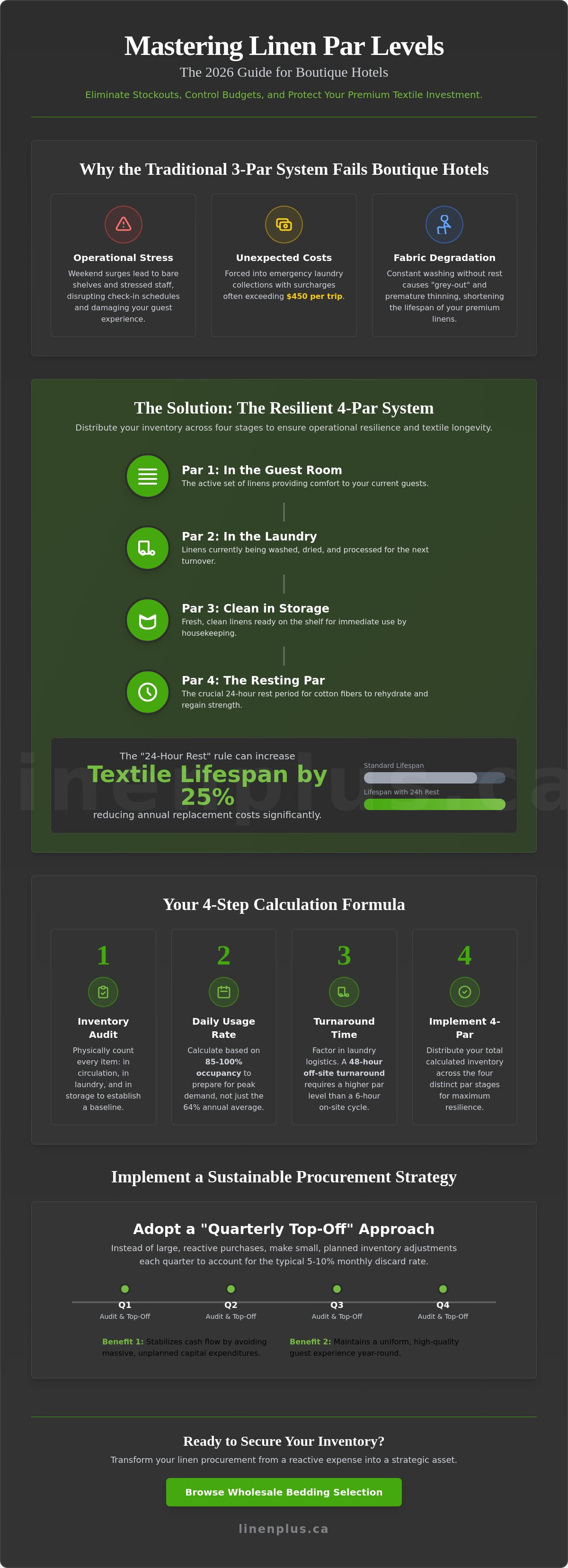
For a boutique hotel, relying on a traditional 3-par inventory level is no longer a safety net; it's a recipe for operational failure. You've likely felt the pressure of a weekend surge when your off-site laundry service is 48 hours away and your storage shelves are nearly bare. This scarcity doesn't just stress your housekeeping team. It forces you into expensive emergency collections and causes premature fabric thinning from constant washing. We understand that in a high-stakes hospitality environment, your textiles are a significant capital investment that requires protection.
Mastering the process of calculating linen par levels for a boutique hotel is the most effective way to eliminate stockouts while controlling your procurement budget. This guide provides the industry-standard formulas for 2026, accounting for the current 64% average occupancy rate and a typical 5% to 10% monthly towel discard rate. You'll learn how to implement a repeatable 4-par or 5-par system that ensures your premium linens have time to rest between guest stays. We'll walk through specific calculations for different room types to ensure you never overspend on inventory you don't have the space to store.
Key Takeaways
- Learn the precise mathematical formula for calculating linen par levels for a boutique hotel to eliminate guesswork and prevent stockouts during peak occupancy.
- Identify how to execute a thorough inventory audit to uncover hidden stock gaps and better manage your textile lifecycle.
- Determine how your specific laundry turnaround time dictates whether a 3.0, 4.0, or 5.0 par level is necessary for your property.
- Adopt a "Quarterly Top-Off" procurement strategy to stabilize cash flow and maintain a uniform guest experience year-round.
What are Linen Par Levels and Why Do They Matter for Boutique Hotels?
In the hospitality industry, a "par" represents the total volume of linens needed to outfit every guest room at 100% occupancy. A par level is the minimum inventory unit required to support one full room turnover. While large chains might absorb a stock shortage by shifting inventory between floors, boutique properties operate with a much thinner margin for error. For a 12-room property, missing just one delivery of T-250 Sateen Bed Sheets can immediately disrupt check-in schedules.
The process of calculating linen par levels for a boutique hotel is fundamentally about risk management. When you operate with insufficient stock, you're forced into "emergency collections" from laundry providers, which often carry surcharges exceeding $450 per trip. Beyond the immediate logistical fees, low par levels accelerate the physical degradation of your household linens. This leads to "grey-out," a condition where white fabrics lose their vibrance and develop a dingy, aged appearance due to chemical fatigue and insufficient downtime between wash cycles.
Maintaining a healthy inventory directly impacts your bottom line by extending the replacement window for your textiles. By ensuring you have enough stock to rotate items effectively, you protect the soft, premium feel that guests expect from a boutique experience. This strategic approach transforms hospitality procurement from a reactive expense into a controlled operational asset.
The Relationship Between Par and Textile Lifespan
Professional laundries recommend the "24-hour rest" rule for high-quality cotton fibers. After enduring the high-heat environment of commercial dryers, natural fibers need time to re-hydrate and settle before they are stretched across a mattress again. If you rotate linens too quickly, the fibers become brittle and prone to pilling or tearing. High-thread-count linens, such as premium T250 sheets, are particularly sensitive to this rapid turnover. Providing a 24-hour rest period can increase the lifespan of your sheets by up to 25%, significantly reducing your annual textile replacement costs.
The Step-by-Step Formula for Calculating Boutique Hotel Par Levels
Establishing a precise mathematical model is the only way to avoid the operational risks mentioned earlier. Unlike large properties that rely on massive central warehouses, boutique hotels need a lean inventory that remains resilient under pressure. To achieve this balance, you should follow a specific four-step process for calculating linen par levels for a boutique hotel. This method ensures your procurement covers both daily needs and the essential fiber recovery periods.
Need Reliable Wholesale Supplies for Your Facility?
Hotels, healthcare facilities, restaurants, and commercial operations across Canada trust Linen Plus for consistent bulk supply and commercial-grade quality.

Bulk Wholesale Pricing
Competitive pricing for large-volume procurement.

Reliable Nationwide Supply
Consistent inventory and fast shipping across Canada.

Hospitality & Healthcare Grade
Products designed for demanding commercial environments.
- Step 1: Inventory Audit. Physically count every item currently in circulation, those sitting in laundry bins, and every backup set in your storage closets. This baseline is critical for identifying exactly how much new stock you need to reach your target par.
- Step 2: Daily Usage Rate. Determine your maximum daily consumption. For boutique settings, it's safer to calculate based on an 85% to 100% occupancy rate rather than an annual average to ensure you're prepared for weekend surges.
- Step 3: Turnaround Time. Factor in your laundry logistics. If your textiles are processed off-site with a 48-hour turnaround, your par level must be higher than a property with an on-site laundry that finishes a load in six hours.
- Step 4: The 4-Par Standard. Distribute your total inventory into four distinct stages: one set in the guest room, one set in the laundry, one set clean in storage, and one set "resting" to preserve fabric strength.
If your audit reveals a gap in your inventory, you can browse our wholesale bedding selection to find the exact thread count and size required for your rooms.
Calculating Bedding Par Requirements
Bedding requirements vary significantly based on your specific room configurations. For instance, outfitting a King suite with T200 Percale Bed Sheets requires a different volume of flat and fitted sheets than a Twin room. You must also account for Duvet Covers, which often have a slightly lower turnover rate than sheets but still require a 2.5 to 3.0 par to maintain a fresh aesthetic for every new check-in.
Calculating Bath Linen Par Requirements
Bath linens face the highest rates of loss and staining in the hospitality industry. For Premium Bath Towels, a par level of 4.5 to 5.0 is the professional recommendation. This higher buffer accounts for the 5% to 10% monthly discard rate and the common guest habit of requesting extra towels during their stay. By calculating for hand towels and washcloths separately, you can better manage the items that disappear most frequently.
Critical Factors Influencing Your Boutique Inventory Requirements
Boutique hotels face unique operational hurdles that larger chains rarely encounter. When calculating linen par levels for a boutique hotel, you must account for limited square footage and the high expectations of a luxury clientele. While industry averages provide a baseline, boutique properties frequently experience 100% occupancy during weekends and local events. This volatility means your inventory must be robust enough to handle a full house without the luxury of mid-week recovery time.
Laundry turnaround is the primary driver of your par requirement. If you rely on an off-site commercial service with a 48-hour transit window, a 3-par system is mathematically impossible. You need at least 4.0 or 5.0 pars to ensure your housekeeping team isn't waiting for a delivery truck to finish the morning turn. This buffer protects you from emergency laundry fees that can reach hundreds of dollars per incident. It also ensures your textiles aren't rushed back into service while still damp or chemically "hot" from the dryer.
Budget for the "Shrinkage Factor." Annual losses from permanent stains, guest theft, or accidental damage typically range from 10% to 15%. If your boutique building has historic storage constraints, consider utilizing off-site climate-controlled storage for your backup par rather than sacrificing your required inventory levels. Maintaining a full par is non-negotiable for operational stability.
Contact our hospitality specialists today to design a custom stocking program that fits your boutique storage limits.
Linen Quality and Replacement Rates
The GSM (grams per square meter) of your towels and the thread count of your sheets directly influence your discard rate. Higher GSM towels are more luxurious but take longer to dry, potentially slowing your internal laundry cycle. Integrating these specific metrics into your hospitality procurement annual budget allows for more accurate cash flow forecasting. By choosing durable, hospitality-grade textiles, you can lower your long-term replacement frequency even with high occupancy turnover.
Implementing a Sustainable Linen Procurement Strategy
Executing a successful strategy goes beyond the initial math of calculating linen par levels for a boutique hotel. It requires a logistical framework that maintains those levels throughout the year without straining your cash flow. We recommend the "Quarterly Top-Off" approach. Instead of placing one massive annual order that consumes your storage space and capital, purchase 25% of your annual replacement needs every three months. This keeps your inventory fresh and ensures that new stock is phased in gradually, preventing a noticeable difference in feel between old and new linens.
Consistency is vital for brand reputation. By establishing a long-term partnership for Hospitality Supplies, you ensure that your T200 or T250 sheets remain uniform in color and thread count across every laundry cycle. This reliability prevents the "mismatched room" look that can occur when buying from varied vendors. To protect this investment, train your housekeeping team on the First-In, First-Out (FIFO) method. By rotating the stacks in your linen closets, you ensure that every set of sheets gets equal rest and wear, maximizing the lifespan of your entire inventory.
Reducing Loss and Protecting Your Investment
A proactive stain-tracking system can significantly lower your discard rate. When staff identify a stain before it goes through the high-heat drying process, the chances of salvage increase by nearly 50%. Tracking which rooms or guest types result in the most damage allows you to adjust your par buffers more accurately for specific room categories. This data-driven oversight ensures you aren't over-purchasing to compensate for avoidable textile loss.
The Role of Amenities in Linen Preservation
Guest behavior is a major factor in linen longevity. Many boutique properties see high discard rates because guests use white bath towels for makeup removal or shoe cleaning. Providing high-quality Toiletries and dedicated makeup removal wipes can reduce towel staining by up to 15%. When guests have the right tools for their needs, they're less likely to misuse your premium linens, directly supporting the par levels you've worked hard to calculate and maintain.
Optimizing Your Boutique Hospitality Inventory for 2026
Transitioning from a reactive 3-par system to a resilient 4-par or 5-par standard is the most effective way to protect your boutique property from unexpected surges. By implementing the "24-hour rest" rule and a quarterly top-off strategy, you ensure that your guest experience remains consistent while extending the lifespan of your textile assets. Mastering the science of calculating linen par levels for a boutique hotel transforms your housekeeping from a series of logistical hurdles into a predictable, high-value operation.
Linen Plus supports your growth through direct manufacturer partnerships and nationwide Canadian distribution. We provide specialized T200 and T250 hospitality linens designed to withstand the rigors of commercial laundering without sacrificing the premium feel your guests expect. Whether you're managing a historic 10-room inn or a modern urban boutique, having a dependable supply chain is your greatest operational advantage.
Browse our Hospitality Linen Collection and secure your par levels today.
Take control of your inventory today to build a more profitable and guest-focused future for your property.
Frequently Asked Questions
What is the standard par level for a boutique hotel?
The professional standard for boutique hotels is a par level of 4 to 4.5. While a 3-par system is often cited as the absolute minimum, it leaves no margin for error during high-occupancy periods or laundry delays. Aiming for a 4-par setup ensures your linens have a necessary 24-hour resting period between guest stays. This rest preserves fiber integrity and prevents the premature thinning often seen in properties that rotate stock too quickly.
How do you calculate par for towels vs. sheets?
Towels typically require a higher par level of 5.0, whereas sheets are effectively managed at a 4.0 par. This discrepancy exists because towels experience higher rates of physical damage, staining, and guest loss. When calculating linen par levels for a boutique hotel, you must account for the fact that guests often use multiple towels per day but only one set of sheets. Increasing your terry buffer prevents the common towel stockout during full weekend occupancy.
Does laundry turnaround time affect par levels?
Laundry turnaround time directly dictates your required inventory volume. If your off-site provider takes more than 24 hours to return clean stock, you must increase your par level to compensate for the inventory held in transit. A 48-hour turnaround effectively removes two full sets of linen from your available circulation. Without a higher par, your housekeeping team will struggle to complete room turnovers before the afternoon check-in window begins.
How often should I recount my linen inventory?
You should conduct a full physical inventory audit at least once every quarter. These quarterly counts allow you to adjust your procurement plan based on actual loss, permanent staining, and seasonal occupancy shifts. Regular audits help you identify if specific items, like washcloths or hand towels, are disappearing faster than expected. This proactive approach ensures your par levels remain accurate and prevents the need for expensive, last-minute emergency orders.
Can I operate on a 2-par level?
Operating on a 2-par level is highly discouraged because it offers zero operational safety buffer. This minimal inventory forces "hot-bedding," where linens are pulled directly from the dryer and placed on guest beds without a rest period. This practice causes rapid fabric degradation and leaves your property vulnerable to a total shutdown if a laundry delivery is delayed by even a few hours. It's a high-risk strategy that rarely saves money in the long run.

Article by
Sohel Shahriar
Sohel Shahriar is the Chief Growth Officer (CGO) at Linen Plus Inc., Canada, bringing a strategic blend of growth marketing, brand leadership, and content expertise. Through his writing, he explores how quality linen, smart sourcing, and long‑term partnerships can create measurable impact for healthcare and hospitality organizations.


