


What Is a Commercial Laundry Service Cost Analysis?
A Commercial Laundry Service Cost Analysis is a structured evaluation of the true cost of laundering linens and textiles by measuring total cost of ownership across labor, utilities, chemicals, equipment, linen replacement, and service contracts. It goes beyond cost‑per‑pound pricing to identify hidden expenses, compare on‑premise laundry versus outsourced services, and optimize long‑term operational and procurement decisions.
A Commercial Laundry Service Cost Analysis measures the full cost of laundering operations—including labor, utilities, chemicals, and linen lifespan—to reduce hidden expenses and guide strategic decisions between in‑house and outsourced laundry services.
Key Takeaways
- Execute a professional commercial laundry service cost analysis using the Total Cost of Ownership (TCO) framework to transition from viewing laundry as a utility to managing it as a high-value asset.
- Identify the hidden drivers behind the "Cost per Pound" metric, specifically focusing on how labor volatility and operational inefficiencies impact your bottom line.
- Evaluate the strategic trade-offs between On-Premise Laundry (OPL) and outsourced services by uncovering common hidden contract surcharges that inflate long-term expenditures.
- Determine the "sweet spot" between textile durability and thread count to minimize the replacement variable and maximize your return on investment.
- Leverage strategic manufacturer partnerships to streamline procurement and secure a more resilient, cost-effective supply chain for your Canadian healthcare or hospitality facility.
The Financial Architecture of Commercial Laundry Operations
Commercial laundry isn't just a recurring bill; it's a complex ecosystem of capital and operational variables. Most facility managers view laundry as a utility, similar to electricity or water. This perspective is outdated. In the current economic climate, a professional commercial laundry service cost analysis must adopt a Total Cost of Ownership (TCO) model. This shift moves the focus from a simple line item to comprehensive asset management. When you treat your textiles as assets, you protect the initial investment and optimize the lifecycle of every sheet and towel in your facility.
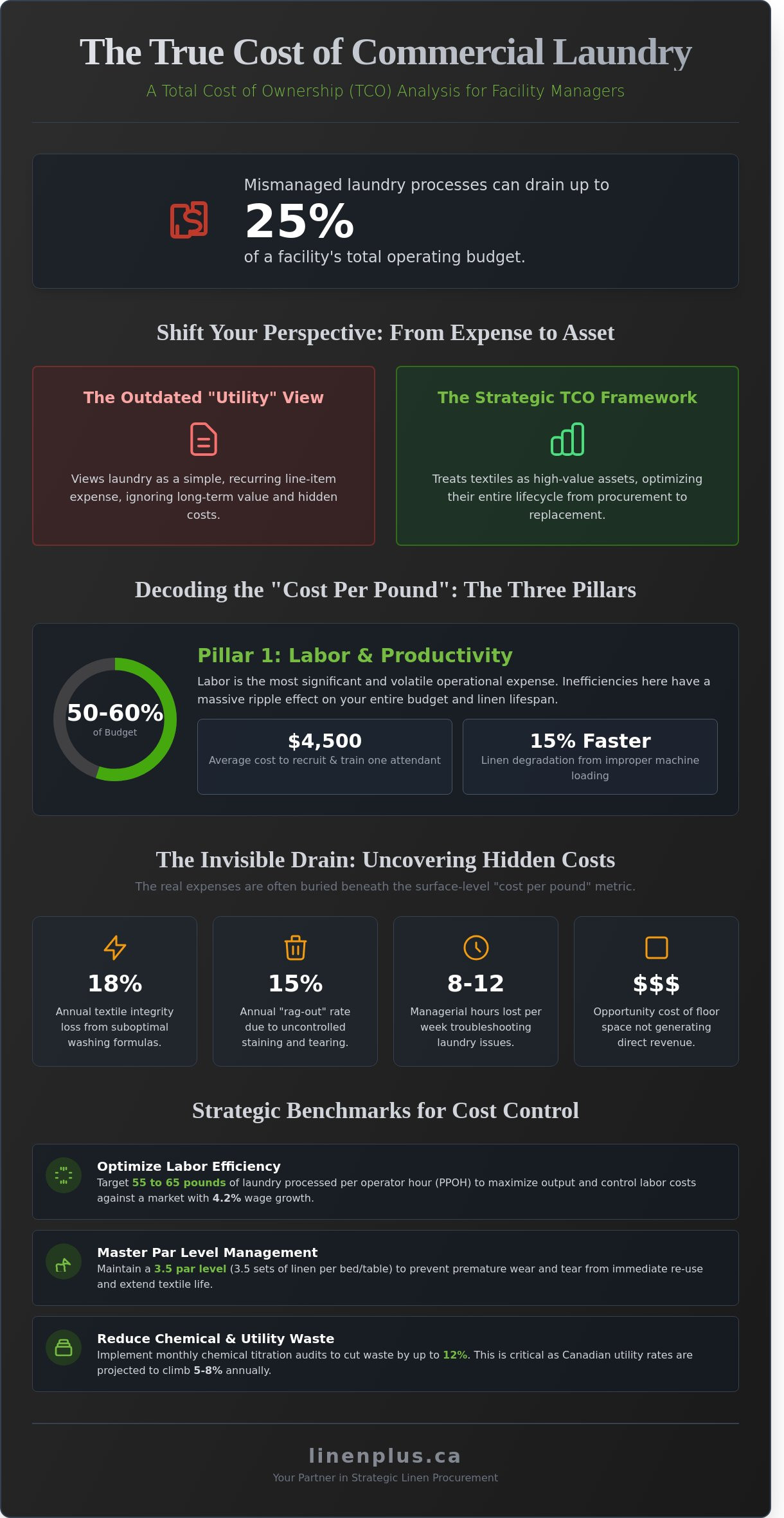
Understanding the architecture of these costs requires a clear distinction between Capital Expenditures (CAPEX) and Operating Expenses (OPEX). CAPEX involves the heavy-duty machinery and initial textile par levels. OPEX covers the daily grind: labor, which typically accounts for 45% of total costs, utilities, and chemical supplies. Many operators fall into the trap of using a "cost per pound" metric. This figure is often deceptive because it ignores the 18% average annual loss in textile integrity caused by suboptimal laundry processes. A low price per pound means very little if your inventory replacement cycle doubles in frequency.
The Invisible Drain: Identifying Hidden Costs
Hidden costs are the silent killers of a balanced budget. Administrative overhead is a primary offender; managers in mid-sized facilities often spend 8 to 12 hours weekly troubleshooting laundry staff schedules or vendor discrepancies. There's also the opportunity cost of floor space. In metropolitan hubs like Toronto or Vancouver, every square foot dedicated to a folding station is square footage that isn't generating guest revenue. Additionally, the "rag-out" rate, the percentage of linens retired due to staining or tearing, can reach 15% annually without strict quality controls.
Setting Your Benchmarks for 2026
As we look toward 2026, Canadian utility rates are projected to climb by 5% to 8% annually. This makes energy efficiency the most critical lever for cost control. Labor markets remain historically tight, with wage growth in the service sector hitting 4.2% in the last fiscal quarter. To combat these rising pressures, smart procurement is essential. Utilizing high-quality hospitality linens helps stabilize budgets by providing a higher "wash-life" threshold. Durable, professional-grade textiles reduce the frequency of replacement orders, providing a predictable cost structure in a volatile market.
- Labor Efficiency: Aim for a benchmark of 55 to 65 pounds of laundry processed per operator hour.
- Chemical Titration: Monthly audits can reduce chemical waste by up to 12% through precise dosing.
- Par Level Management: Maintaining a 3.5 par level prevents premature wear and tear from immediate re-use.
Deciphering the Cost per Pound: The Three Pillars of Laundry Expense
Cost per pound is the industry standard for measuring operational efficiency in any laundry facility. It provides a clear snapshot of fiscal health by dividing total monthly expenses by the weight of processed linen. A thorough commercial laundry service cost analysis hinges on this number to identify exactly where capital is leaking. Understanding these pillars is vital for any specialist looking to optimize their facility's bottom line.
Labor and Productivity Metrics
Labor typically accounts for 50% to 60% of your total operating budget. It's the most volatile variable, especially with the labor shortages seen across Canada in 2024 and 2025. PPOH is the total weight of clean, dry laundry divided by the total hours worked. Facilities aiming for excellence target a PPOH between 50 and 70 for small-scale operations, while industrial plants often exceed 100. Poorly trained staff often overstuff machines, a mistake that can shorten the lifespan of a 200-pound washer by 3.5 years and degrade linen fibers 15% faster than normal wear. High turnover adds hidden costs, as the average hospitality facility spends $4,500 to recruit and train a single laundry attendant.
Utility Consumption in a Canadian Context
Energy and water represent the second pillar, often fluctuating based on regional carbon taxes and local utility rates. Standard commercial washers use between 1.5 and 3 gallons of water per pound of laundry. Investing in certified equipment can save a significant amount of money on annual overhead by reducing both water and heating requirements.
Drying is the most expensive part of the cycle. When using high-GSM bath towels, the dense loops retain more moisture. This requires longer dry times and higher heat, which can increase energy bills by 12% compared to standard hospitality linens. Modern facilities utilize ozone laundering to reduce hot water needs by 80% and heat reclamation systems to capture energy from dryer exhaust, effectively lowering the cost per pound. You can explore our hospitality solutions to find linens designed for both comfort and drying efficiency.
Need Reliable Wholesale Supplies for Your Facility?
Hotels, healthcare facilities, restaurants, and commercial operations across Canada trust Linen Plus for consistent bulk supply and commercial-grade quality.

Bulk Wholesale Pricing
Competitive pricing for large-volume procurement.

Reliable Nationwide Supply
Consistent inventory and fast shipping across Canada.

Hospitality & Healthcare Grade
Products designed for demanding commercial environments.
Chemistry and Professional Grade Solutions
Chemistry is the final pillar. It usually stays under 10% of the budget but dictates the quality and longevity of the finished product. Professional-grade detergents are formulated to work at lower temperatures, preserving fabric integrity. Maintaining a pH level between 5.5 and 6.5 during the final rinse prevents skin irritation and ensures your sheets maintain their crisp, white appearance for over 200 industrial wash cycles. Using the wrong softener can reduce towel absorbency by 25%, leading to guest dissatisfaction and premature linen replacement.
- Labor: Focus on PPOH to drive staff efficiency.
- Utilities: Implement ozone and ENERGY STAR equipment to cut water costs.
- Chemistry: Use professional-grade titration to extend linen life.
Strategic Comparison: On-Premise Laundry (OPL) vs. Outsourced Services
Facility managers face a persistent dilemma: do you prioritize absolute control or operational convenience? For a 150-bed hospital or a 200-room boutique hotel, this decision dictates the entire commercial laundry service cost analysis. Outsourcing offers a hands-off approach, but it introduces the "industrial wash" factor. Large-scale commercial plants often utilize aggressive chemical formulations and high-alkali detergents to ensure sanitization at massive volumes. This harsh environment can degrade textile fibers 25% faster than the controlled cycles of an in-house setup, forcing more frequent replacement cycles.
Financial viability for OPL typically hits a threshold at 500 pounds of laundry per day. Below this volume, the labor costs and utility overhead of a private laundry room often outweigh the benefits. However, when quality and consistency are non-negotiable, OPL serves as a complete solution for maintaining brand standards. It's a strategic move for those who view linens as a long-term asset rather than a disposable expense.
The Case for On-Premise Laundry (OPL)
Managing laundry in-house grants total authority over chemical ratios and precise wash temperatures. This level of precision is vital for maintaining the tactile quality and brightness of sheets and pillowcases during 95% occupancy peaks. Facilities running OPL often operate efficiently with a 3-par linen inventory. In contrast, outsourced models usually require a 5-par minimum to buffer against delivery delays or shorted shipments. This 40% reduction in required stock significantly lowers initial capital expenditure and storage requirements. Control is a premium that pays for itself through extended linen longevity and immediate turnaround.
Evaluating Commercial Laundry Contracts
Contracts are rarely as simple as a flat price-per-pound quote. Savvy operators use data from the TRSA to determine true costs of hospital laundering, uncovering expenses that standard invoices often obscure. A thorough commercial laundry service cost analysis must look past the base rate to identify "leakage" points. A 2025 industry survey indicated that hidden surcharges, such as environmental fees, fuel adjustments, and minimum weight penalties, can inflate a base contract by 12% to 18%. To maintain fiscal responsibility, managers should implement a monthly audit process.
- Automatic Replacement Fees: Fixed monthly charges for linen replacement, regardless of actual loss or damage.
- Minimum Weight Requirements: Billing for a baseline poundage even during low-occupancy periods.
- Energy Surcharges: Variable fees tied to utility fluctuations that shift the provider's risk onto your budget.
- Vague "By the Piece" Billing: Complexity that makes it difficult to track exactly what was processed and when.
Linen Plus acts as a one-stop shop for facilities looking to optimize either model. Whether you need high-durability textiles that withstand industrial processing or professional-grade chemicals for your OPL, we provide the dependable support system required for operational excellence.
The Replacement Variable: How Textile Quality Impacts Long-Term ROI
Procurement managers often fall into the trap of looking at the price tag on a shipping manifest rather than the reality of the laundry cycle. A budget sheet priced at $6.00 might seem like a win for the quarterly budget, but if it fails after 30 industrial washes, it's a financial liability. High-quality linens are built to survive the aggressive mechanical action and chemical exposure inherent in professional processing. When conducting a commercial laundry service cost analysis, the most critical metric isn't the acquisition price; it's the cost per use.
Thread count is a common distraction for buyers. While a 400-thread count sateen sheet feels luxurious, it often lacks the structural integrity required for 2026 industrial standards. T200 Percale remains the industry benchmark because its tight, plain weave offers the perfect balance of breathability and tensile strength. These linens typically endure 150 to 200 wash cycles before showing signs of structural failure. In contrast, lower-tier retail alternatives often "rag out" after just 45 cycles, tripling your replacement frequency.
- Tensile Strength: The force required to tear the fabric, which dictates how well it handles high-speed extractors.
- Shrinkage Rates: Commercial-grade textiles are pre-shrunk to stay within a 2-3% margin, preventing fitment issues.
- GSM (Grams per Square Meter): A measurement of fabric density that directly correlates to absorbency and drying time.
Durability and the "Rag-Out" Factor
The lifespan of your inventory depends on construction details like reinforced hems and high-density stitching. Premium duvet covers that feature heavy-duty closures and double-stitched edges prevent the premature fraying that forces items into the rag pile. Pilling and thinning aren't just aesthetic issues; they represent a loss of fabric mass that compromises heat retention and comfort. A 10% increase in textile lifespan can reduce annual procurement costs by up to 25%.
Textile Selection for Healthcare Facilities
Operational excellence in healthcare requires textiles that can withstand the rigors of infection control. Reusable medical supplies and barriers must maintain their integrity through high-heat cycles exceeding 71 degrees Celsius (160 degrees Fahrenheit). You're balancing patient skin integrity with the need for industrial-grade durability. Investing in VAT-dyed linens ensures that colors don't fade under harsh bleaching protocols, keeping your facility looking professional for longer periods. This durability is a cornerstone of any accurate commercial laundry service cost analysis, as it minimizes the churn of your inventory.
Stop overpaying for frequent replacements and start investing in linens built for the long haul. View our high-durability commercial linen collections here.
Optimizing Your Procurement Strategy with Linen Plus
Operational excellence requires more than just tracking expenses; it demands a procurement partner that understands the nuances of a commercial laundry service cost analysis. Linen Plus eliminates the middleman by leveraging direct manufacturer partnerships. This strategy typically reduces the acquisition cost of textiles by 15% to 20% compared to traditional retail sourcing. By securing bulk pricing on high-turnover items like sheets and pillowcases, facilities lower their total cost of ownership through superior durability. We focus heavily on the "Cost per Use" metric, ensuring every towel and sheet survives the rigors of industrial processing without premature thinning.
The Linen Plus Advantage
Our nationwide Canadian distribution network ensures that lead times stay under 72 hours for 95% of orders. This speed allows managers to maintain leaner inventory levels without risking stockouts or emergency surcharges. We provide technical guidance on specifications such as GSM and thread count to ensure your textiles survive 150 or more industrial wash cycles. As a complete solution, we offer everything from medical supplies to guest amenities. This "One-Stop Shop" model consolidates your vendor list and simplifies accounts payable, adding a "Plus" to your operational efficiency.
Next Steps for Facility Managers
Transitioning to a more efficient model starts with hard data. Most facilities find that a rigorous 30 day audit reveals hidden losses in their current process, often stemming from poor textile longevity. To begin your optimization, consider these immediate actions:
- Conduct a 30-day laundry cost audit: Track every load, chemical ounce, and labor hour to establish a baseline for your 2026 budget.
- Evaluate par levels and rag-out rates: If your rag-out rate exceeds 3% per month, your textile quality is likely insufficient for your machinery.
- Request a textile durability assessment: Contact a Linen Plus specialist to review your current inventory and identify high-GSM alternatives that reduce long-term spend.
By shifting from reactive purchasing to a strategic partnership, you can achieve a 22% reduction in annual textile replacement costs. Linen Plus remains committed to providing the fiscal responsibility and product longevity required for modern healthcare and hospitality facilities. It's time to move beyond simple vendor transactions and embrace a supply chain built for the high-stakes demands of your industry.
Mastering Your Facility's Fiscal Resilience
Navigating the complexities of a commercial laundry service cost analysis requires a shift from short-term savings to long-term asset management. Industry data from 2025 indicates that facilities prioritizing high-performance textiles like T200 and T250 linens reduce their annual replacement costs by 18% because these fabrics are engineered to withstand over 200 industrial wash cycles. Whether you're managing an on-premise laundry or outsourcing to a provider, the total cost of ownership hinges on procurement efficiency and textile durability. Canadian facilities face unique logistical pressures, making nationwide distribution and direct manufacturer pricing essential for maintaining a healthy bottom line.
Linen Plus serves as your strategic partner, eliminating middleman markups through direct manufacturer partnerships and ensuring your inventory remains stocked via our robust Canadian distribution network. By selecting linens specifically designed for the rigors of 2026 industrial standards, you're not just buying sheets; you're securing your facility's operational future. Optimize your facility’s textile lifespan with Linen Plus bulk solutions. Your path to a more profitable and predictable laundry operation starts with the right materials.
On‑Premise Laundry (OPL) vs Outsourced Laundry Services
On‑Premise Laundry (OPL) and outsourced commercial laundry services differ primarily in cost structure, control, and long‑term financial risk. OPL offers operational control and predictable per‑pound costs but requires high capital investment, labor management, and ongoing maintenance. Outsourcing reduces upfront costs and staffing complexity but introduces variable pricing, contract surcharges, and long‑term dependency on third‑party service levels.
Best choice depends on volume, labor stability, utility rates, and linen replacement velocity—not headline cost‑per‑pound pricing.
Quick Comparison
On‑Premise Laundry (OPL)
- High capital investment (equipment, infrastructure)
- Full control over quality and turnaround time
- Higher labor exposure and compliance responsibility
- Lower marginal cost at high volume
- Predictable long‑term cost when optimized
Outsourced Laundry
- Low upfront investment
- Reduced staffing and regulatory burden
- Variable pricing with contract escalators
- Less control over linen handling and lifespan
- Higher long‑term cost at scale if unmanaged
Frequently Asked Questions
What is the average commercial laundry cost per pound in Canada?
In 2026, the average commercial laundry cost per pound in Canada ranges from $1.50 to $2.85 CAD. Prices fluctuate based on provincial labor laws and local utility rates, with urban centers like Toronto and Vancouver often seeing a 15% premium. High-volume contracts for healthcare or hospitality typically secure rates at the lower end of this spectrum, while smaller facilities pay more for specialized handling and frequent pickups.
Is in-house laundry cheaper than outsourcing for small hotels?
Small hotels with fewer than 50 rooms typically find that outsourcing is 20% more cost-effective than managing an in-house operation. When you factor in the $50,000 initial investment for industrial washers and the ongoing 12% rise in labor costs, the math shifts toward external partners. Outsourcing allows these businesses to convert fixed overhead into a predictable variable expense, freeing up space for revenue-generating amenities.
How often should commercial linens be replaced in a high-volume facility?
High-volume facilities should replace bed linens every 100 to 150 industrial wash cycles to maintain professional standards. Towels require more frequent replacement, usually after 50 to 75 cycles, as their fibers degrade faster under high heat. Implementing a strict rotation system ensures you don't face a massive replacement bill all at once. Most managers budget for a 25% inventory refresh every quarter to keep quality consistent.
What are the hidden costs of commercial laundry services?
Hidden costs often include fuel surcharges ranging from 3% to 7% and annual linen loss rates that can reach 15% of total inventory. A thorough commercial laundry service cost analysis reveals that environmental compliance fees and weekend delivery premiums also inflate the final invoice. Tracking these specific line items monthly prevents budget creep and ensures your provider remains accountable for every piece of fabric processed.
How does thread count affect laundry costs?
Higher thread count linens, such as T300 or T400 sheets, increase laundry costs because they require 25% more drying time and specialized pressing. While these premium fabrics offer a better guest experience, their dense weave traps moisture more effectively than T180 blends. This results in higher energy consumption and slower throughput in the finishing department. You'll need to balance the luxury appeal against these increased operational expenses.
What is a "par level" and how does it impact laundry efficiency?
A par level refers to the minimum amount of inventory required to support daily operations, with a 3-par system being the industry baseline. This includes one set in the room, one in the laundry, and one in storage. Maintaining a 4-par level in 2026 provides a 25% safety margin against supply chain delays and reduces emergency rush charges. Proper par levels prevent staff from over-washing small loads, which optimizes machine efficiency.
Can high-quality detergents actually save money in the long run?
High-quality, pH-balanced detergents save money by extending the lifespan of your linens by up to 20% compared to generic bulk chemicals. Professional grade formulas effectively remove stains at lower temperatures, which reduces energy bills by approximately 15% per load. Investing in superior chemistry prevents premature fiber breakdown and keeps your whites looking bright for more cycles. It's a strategic move that protects your largest textile investments.
How do I calculate the ROI of upgrading to energy-efficient laundry equipment?
Calculate the ROI by dividing the total equipment cost by the annual savings in water, electricity, and labor. Most facilities see a full return on investment within 24 to 36 months. Modern high-efficiency extractors reduce water usage by 30% and cut drying times by 10 minutes per load. These measurable gains directly impact your bottom line while improving your facility's environmental footprint and reducing long-term maintenance needs.

Article by
Sohel Shahriar
Sohel Shahriar is the Chief Growth Officer (CGO) at Linen Plus Inc., Canada, bringing a strategic blend of growth marketing, brand leadership, and content expertise. Through his writing, he explores how quality linen, smart sourcing, and long‑term partnerships can create measurable impact for healthcare and hospitality organizations.


