


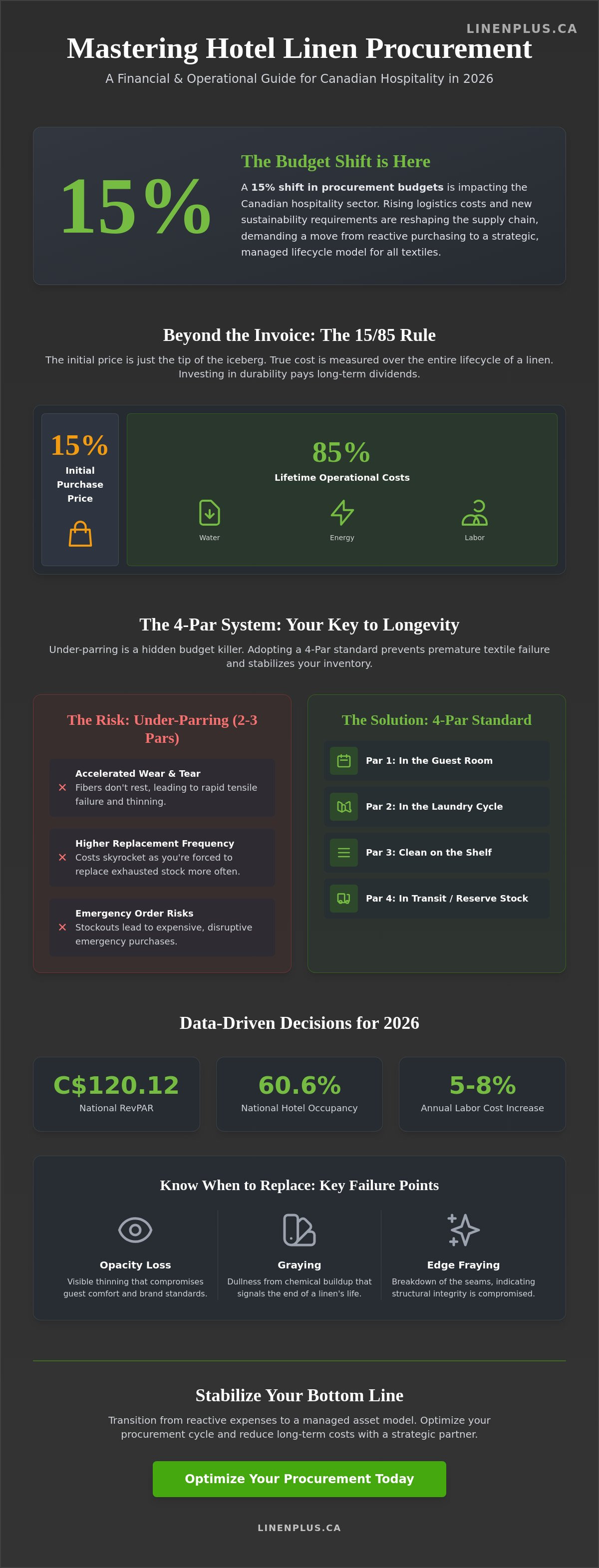
A 15% shift in procurement budgets is hitting the Canadian hospitality sector this year as rising logistics and sustainability requirements reshape the supply chain. If your facility hasn't adjusted its forecasting for these 2026 pressures, you're likely facing the friction of unpredictable discard rates and budget overruns. Effective hotel linen replacement cost planning for procurement managers isn't just about reacting to depleted stock; it's about moving toward a managed lifecycle asset model that stabilizes your bottom line.
We understand that balancing the demands of housekeeping with the reality of rising utility costs and a C$120.12 national RevPAR is a constant challenge. This guide provides the financial and operational frameworks you need to forecast replacement costs accurately and optimize your procurement cycles. You'll learn how to implement a standardized 4-par inventory system and navigate upcoming regulatory changes, including the July 2026 CUSMA review and June's OEKO-TEX updates. We'll break down how to lower your total cost of ownership through data-driven textile selection and regional logistics strategies designed for the Canadian market.
Key Takeaways
- Shift from price-per-unit to a Total Cost of Ownership (TCO) model that accounts for Canadian laundry utility rates and textile longevity.
- Adopt a strict 4-par inventory standard to reduce the mechanical stress on fibers and extend the usable life of your bed sheets and towels.
- Streamline your hotel linen replacement cost planning for procurement managers by establishing a 12-month calendar that anticipates seasonal occupancy surges.
- Reduce operational overhead by transitioning to a direct-to-manufacturer supply chain, utilizing pallet-level logistics to minimize national shipping expenses.
The Economics of Hotel Linen Lifecycles in 2026
For most Canadian facilities, the initial price of a bed sheet or bath towel represents only a fraction of its financial footprint. Total Cost of Ownership (TCO) in the hospitality sector measures the cumulative expense of a textile from acquisition through its final wash cycle. Shifting from reactive purchasing to a strategic lifecycle model is the foundation of effective hotel linen replacement cost planning for procurement managers. While the history of household linens focuses on domestic comfort, modern commercial textiles are engineered as high-utilization assets that must survive hundreds of industrial laundry cycles.
Reactive procurement often leads to the "durability gap." This occurs when facilities purchase retail-grade or low-tensile products that cannot withstand the high-heat chemical processes required by Canadian health standards. These products fail prematurely, forcing emergency orders that carry higher freight costs and disrupt housekeeping workflows. Strategic management treats every bed sheet as an investment in operational stability rather than a disposable expense.
The 15/85 Rule: Beyond the Invoice Price
The 15/85 rule states that the invoice price typically accounts for only 15% of a linen's lifetime cost. The remaining 85% is tied to operational overhead, including water, energy, and labor. Investing in high-tensile strength fabrics pays dividends by extending replacement cycles. When a product lasts 20% longer, the acquisition cost is amortized over more guest stays, significantly lowering your cost-per-use. Focusing on durability ensures your budget isn't consumed by constant replenishment of inferior stock.
Impact of 2026 Utility and Labor Trends on Procurement
Current economic shifts make textile selection a critical lever for cost containment. Energy-efficient textiles, such as faster-drying cotton-polyester blends, directly lower utility bills by reducing dryer run times. Procurement managers must factor in a 5-8% annual increase in laundering labor costs as Canadian facilities face tightening workforce markets and wage adjustments. Choosing commercial-grade bath towels that retain their softness without excessive chemical softeners helps mitigate these rising operational expenses.
Establishing Data-Driven Replacement Triggers and Par Levels
With Canadian hotel occupancy reaching 60.6% as of March 2026, the physical demand on your textile inventory is constant. Maintaining a high Revenue Per Available Room (RevPAR) of C$120.12 requires a guest experience that isn't compromised by thinning sheets or graying towels. Precision in hotel linen replacement cost planning for procurement managers starts with moving beyond the traditional 3-par system to a more resilient 4-par standard. This system ensures you have one set in the guest room, one in the laundry, one clean on the shelf, and one in transit or reserve storage to buffer against supply chain lead times.
Under-parring is a hidden budget killer. When a facility operates on a 2-par or 3-par cycle, linens are pulled from the dryer and placed immediately back into service. This prevents the cotton fibers from "resting" and rehydrating, which leads to accelerated tensile failure and premature thinning. By analyzing the Total Cost of Ownership (TCO), it becomes clear that the cost of increasing your inventory par level is significantly lower than the cost of replacing exhausted textiles twice as often.
Need Reliable Wholesale Supplies for Your Facility?
Hotels, healthcare facilities, restaurants, and commercial operations across Canada trust Linen Plus for consistent bulk supply and commercial-grade quality.

Bulk Wholesale Pricing
Competitive pricing for large-volume procurement.

Reliable Nationwide Supply
Consistent inventory and fast shipping across Canada.

Hospitality & Healthcare Grade
Products designed for demanding commercial environments.
Identifying replacement triggers is essential for maintaining brand standards. Procurement managers should monitor for three specific failure points: opacity loss (thinning), graying from chemical buildup, and edge fraying. If your current stock shows these signs, it's time for sheets and pillowcases replenishment to avoid negative guest reviews.
The Par Level Formula for Cost Containment
To calculate your facility's specific needs, follow this data-driven framework:
- Daily Unit Requirement: Multiply your total room count by the number of linen units used per bed.
- Occupancy Adjustment: Multiply the daily requirement by your average occupancy rate (e.g., 0.606 for the current national average).
- Par Factor: Multiply that result by 4 to establish your total required inventory.
Maintaining this 4-par level extends the lifespan of each individual item by reducing the frequency of aggressive industrial laundering. It's a proactive strategy that stabilizes your annual spend.
Discard Rate Analysis: Forecasting the Unknown
Predictable budgeting requires tracking monthly loss and damage. We categorize these into "soft discards" and "hard discards." Soft discards include linens with small permanent stains that can be repurposed by housekeeping for cleaning tasks. Hard discards are textiles with structural tears or heavy graying that must be removed from the facility entirely. Tracking these rates allows you to create a "top-up" budget that prevents emergency bulk purchases. For a more streamlined approach to inventory management, consider integrated procurement programs that align with your facility's specific discard cycles.
Creating a 12-Month Procurement and Budgeting Calendar
Successful hotel linen replacement cost planning for procurement managers relies on a calendar that mirrors the hospitality industry's seasonal peaks. Instead of reactive ordering, a 12-month roadmap allows you to leverage volume pricing and avoid the "out of stock" crises that often occur during high-occupancy months. Aligning your purchasing with the fiscal year ensures that inventory remains stable even as guest demand fluctuates.
- Q1: The Baseline Audit. Use the post-holiday lull to conduct a comprehensive physical count across all par locations. This data identifies the "discard gap" and sets the baseline for your annual budget adjustment.
- Q2: Summer Peak Preparation. Place bulk orders 90 to 120 days in advance of the July tourism surge. With 5,356 new hotel rooms entering the Canadian market in 2026, competition for high-quality bed sheets will increase.
- Q3: Performance Review. Assess the durability of your current inventory after the heavy summer wash cycles. If your bath towels are showing premature fraying, Q3 is the time to re-evaluate your Canadian hospitality supply chain partners.
- Q4: Holiday Top-Ups. Finalize small-batch orders to ensure par levels remain stable through December. This prevents the need for emergency, high-freight shipping during the winter holiday rush.
Seasonal Demand and Lead-Time Planning
Canadian geography presents unique logistical hurdles. Procurement timelines must account for potential winter shipping delays and regional freight bottlenecks. If you're sourcing for facilities in remote or northern regions, adding a 14-day buffer to standard lead times is a practical necessity. For more detailed insights on navigating national logistics and regional distribution, consult our Wholesale Linens Canada Guide.
Quarterly Inventory Audits: Keeping the Budget on Track
Efficient audits don't require shutting down operations. Focus on "spot counts" in clean-linen closets and the laundry room to verify your par levels. This audit data is your strongest tool when justifying mid-year budget pivots to senior management. If discards are higher than forecasted, present the raw numbers to secure additional funding before stock hits critical lows. Don't wait for a shortage to act; review our hospitality procurement programs to align your 12-month budget with current market data.
Optimizing the Canadian Supply Chain for Cost Containment
Execution is the final pillar of hotel linen replacement cost planning for procurement managers. Even the most precise 12-month budget can be derailed by inefficient sourcing or high freight surcharges. Shifting from retail-style purchasing to a direct-to-manufacturer model eliminates the markups associated with middlemen. This transition doesn't just lower your unit price; it provides a direct line to the technical specifications required for industrial durability.
Loss prevention is another critical factor in cost containment. Linen theft and accidental loss during third-party laundering can account for a significant portion of your annual discard rate. Implementing custom branding or property-specific embroidery serves as a powerful deterrent. It ensures your assets are easily identifiable in a commercial laundry environment and discourages guest "souveniring," which protects your inventory par levels over the long term.
Direct Sourcing and Volume Discounts
Buying at scale allows procurement managers to reach the "price-floor" for high-utilization items like T200 percale or T250 sateen sheets. When you source directly, you secure consistent dye lots and thread count specifications across every shipment. This consistency is vital for large-scale facilities where mismatched whites or varying fabric textures can diminish the guest experience. By committing to volume-based procurement, you stabilize your acquisition costs and reduce the administrative burden of managing multiple small-batch invoices.
Logistics Efficiency: The Hidden Procurement Saver
Freight costs often represent a hidden drain on Canadian hospitality budgets. Centralized national distribution is the most effective way to mitigate this expense. By utilizing pallet-level shipping from regional hubs, facilities can significantly reduce the cost-per-unit of transport. This logistical strategy also minimizes "stock-out" risks, ensuring that a room-refresh project involving new duvet covers or top-of-bed accents isn't delayed by cross-border shipping bottlenecks.
Standardizing your procurement through a national provider allows for predictable lead times across all Canadian provinces. This reliability is the foundation of a managed lifecycle asset model, allowing you to maintain a lean but effective inventory. Ready to transform your facility's financial performance? Optimize your facility’s procurement with Linen Plus Hospitality Solutions and secure your 2026 budget goals.
Securing Your Facility’s Operational Stability for 2026
Mastering hotel linen replacement cost planning for procurement managers requires a shift in perspective. By moving from reactive purchasing to a 4-par lifecycle model, you protect your inventory from premature failure and stabilize your annual budget. Implementing a 12-month calendar ensures your facility remains prepared for seasonal occupancy surges while navigating the unique logistical hurdles of the Canadian market. Every decision, from textile selection to vendor consolidation, should prioritize reducing the total cost of ownership through durability and efficiency.
Linen Plus supports your facility with a direct-to-manufacturer pricing model. We maintain a specialized inventory of T200 and T250 hospitality textiles to meet rigorous commercial standards. Our national Canadian distribution network ensures reduced lead times. This helps you maintain consistent quality across every guest room. It's time to transform your linen management into a predictable, cost-effective operation. Don't wait for a stock shortage to act. Explore Wholesale Hospitality Procurement Solutions at Linen Plus and start optimizing your facility's bottom line today. You have the tools and the data to lead your department toward long-term financial success.
Frequently Asked Questions
How often should a hotel replace its bed linens on average?
Commercial bed linens typically require replacement every 12 to 18 months, or after approximately 150 to 200 industrial wash cycles. This timeline varies based on your inventory par levels and the tensile strength of the fabric. Facilities that maintain a strict rotation schedule often see longer lifespans, while those with lower stock counts experience accelerated fiber exhaustion and more frequent discard rates.
What is the most cost-effective thread count for commercial hotel sheets?
The T180 to T250 thread count range is the industry standard for balancing durability with guest comfort. While higher thread counts may seem more luxurious, they often use thinner yarns that fail quickly under the mechanical stress of industrial laundering. Choosing a T200 percale or T250 sateen blend provides the structural integrity needed to survive high-heat drying while maintaining a professional finish for guests.
How do par levels directly affect my annual replacement budget?
Higher par levels, such as a 4-par system, reduce the wash frequency for each individual item, which directly extends the product's usable life. When you operate with insufficient stock, linens are laundered and returned to service without a rest period. This leads to "hot-bedding," where fibers break down faster and force you to increase your "top-up" budget to cover premature failures.
What are the main causes of premature linen wear in commercial laundries?
Mechanical stress from over-drying and the use of aggressive chemical bleaches are the primary causes of premature thinning and tearing. Industrial dryers running at excessive temperatures can make cotton fibers brittle, leading to opacity loss. Additionally, failing to allow linens to rehydrate between cycles prevents the yarns from regaining their natural elasticity, making them more susceptible to structural failure during the next wash.
How can I calculate the cost-per-wash for my facility’s towels and sheets?
Divide the initial acquisition cost of the item by its expected number of wash cycles, then add your internal or contracted laundry price per pound. This calculation is a fundamental component of hotel linen replacement cost planning for procurement managers. By tracking this metric, you can identify if a lower-priced textile is actually costing you more over its lifecycle due to a shorter replacement window.

Article by
Sohel Shahriar
Sohel Shahriar is the Chief Growth Officer (CGO) at Linen Plus Inc., Canada, bringing a strategic blend of growth marketing, brand leadership, and content expertise. Through his writing, he explores how quality linen, smart sourcing, and long‑term partnerships can create measurable impact for healthcare and hospitality organizations.


